
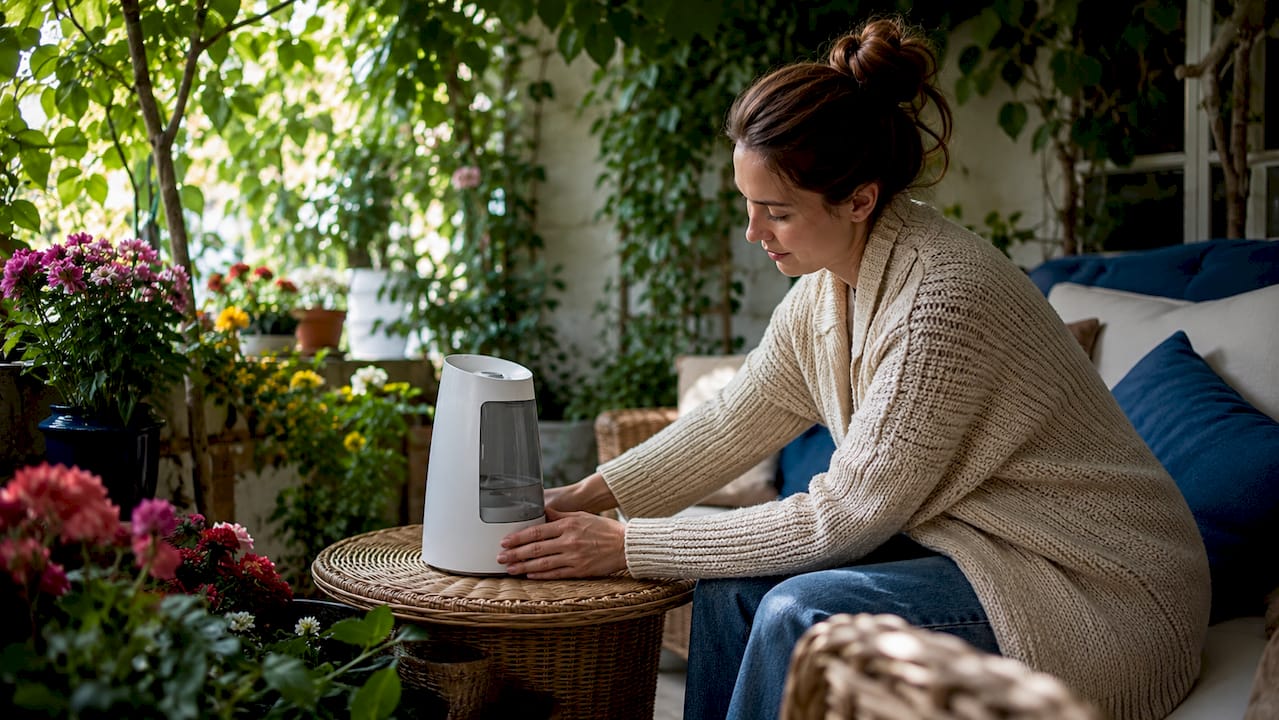
A cool-mist humidifier, positioned correctly and cleaned regularly, is the single most effective tool for maintaining safe, comfortable air in your baby’s nursery. To set up a humidifier in a baby’s room correctly, you need to choose the right type, place it at least 3 feet from the crib on a raised surface, and keep nursery humidity between 40% and 60%. Get any one of those three things wrong and you risk mould, bacterial contamination, or worse. This guide covers every step, from choosing the best humidifier for a baby to the cleaning routine that keeps it safe.
How to set up a humidifier in a baby’s room
The first decision is the most important one. The American Academy of Pediatrics mandates cool-mist humidifiers only for infants. Warm mist models and vaporisers heat water to produce steam, which creates a genuine scalding risk if your baby or a sibling gets close. That risk alone rules them out entirely.
Cool-mist humidifiers come in two main types: ultrasonic and evaporative. Ultrasonic models use high-frequency vibrations to produce a fine mist and tend to run quietly, which suits sleeping babies well. Evaporative models push air through a wet wick filter, which naturally limits over-humidification. Both are safe choices when used correctly.
Beyond type, three features matter most for nursery use:
- Wide-neck water tanks: Narrow-neck tanks are nearly impossible to clean thoroughly. Mould and bacteria thrive in hard-to-reach corners. Choose a model where your hand or a cleaning brush fits easily inside.
- Automatic shut-off: A humidifier with auto shut-off turns itself off when the water runs out. This prevents the motor from burning and removes one more overnight worry.
- Output capacity matched to room size: A unit designed for a 50 square metre living area will over-humidify a 12 square metre nursery within hours. Match the output rating to your actual room size.
Pro Tip: Before buying, check whether replacement filters are available in Australia. Some imported models use proprietary filters that are difficult or expensive to source locally.
Where should you place a humidifier in the nursery?
Placement determines whether your humidifier helps or harms. The recommended distance is 3–6 feet from your baby’s sleep area. Closer than that and the concentrated mist can dampen bedding and create conditions for mould growth on fabric.
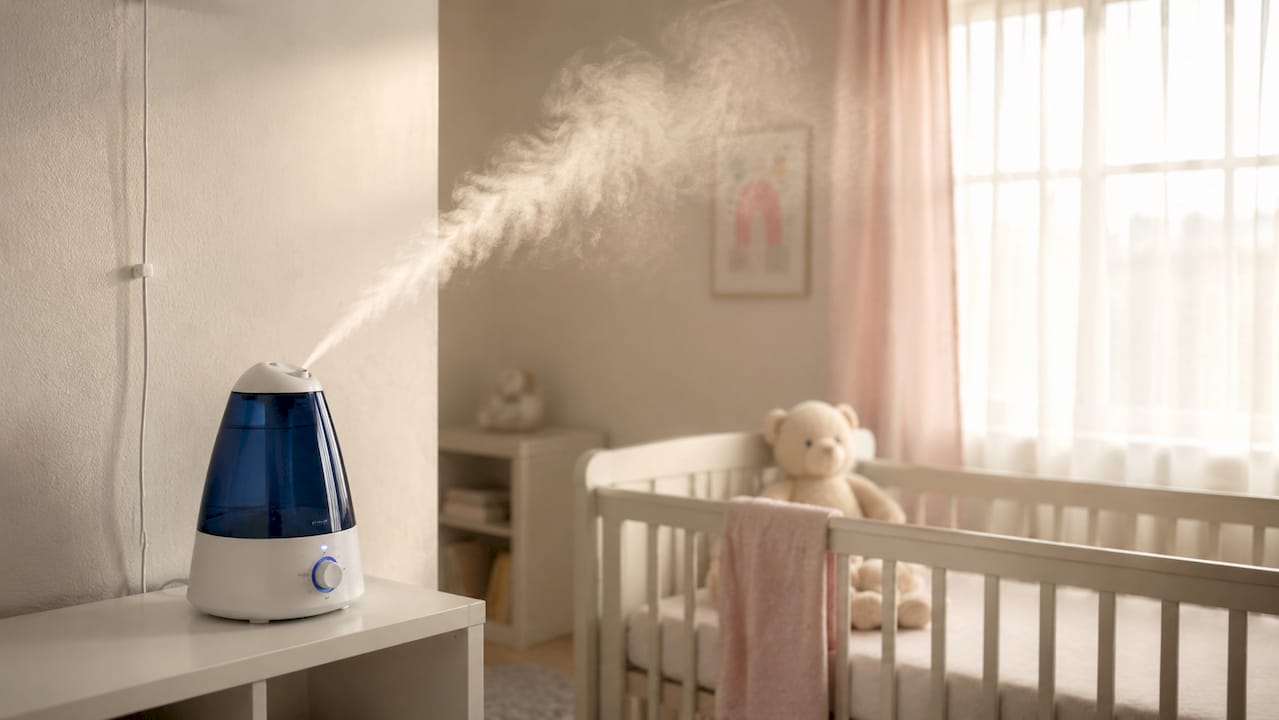
The surface matters just as much as the distance. Elevate the humidifier on a waterproof surface such as a dresser top, a nightstand, or a low bookshelf with a waterproof tray underneath. Never place it directly on carpet. Carpet absorbs moisture from the base of the unit and creates a damp patch that breeds mould underneath, often without you noticing for weeks.
Here are the three most practical placement options for a standard nursery:
- Dresser top with a silicone tray: The most popular choice. The height keeps the mist dispersing into the room rather than pooling at floor level, and the tray catches any drips.
- Corner nightstand: Works well in smaller nurseries. Position the unit in a corner so the mist disperses diagonally across the room, away from the crib.
- Low anchored bookshelf: A good option if your dresser is too close to the crib. Anchor the shelf to the wall for stability and place a waterproof liner on the shelf surface.
Once positioned, point the mist nozzle toward the open centre of the nursery. Directing mist at the crib, walls, or curtains causes localised dampness and mould on fabrics and surfaces. The goal is even moisture distribution across the whole room.
| Placement Option | Pros | Cons |
|---|---|---|
| Dresser top with tray | Height aids dispersion, easy to access | Needs waterproof tray, check stability |
| Corner nightstand | Space-efficient, good angle | May be too close in small rooms |
| Low bookshelf | Flexible positioning | Requires wall anchoring for safety |
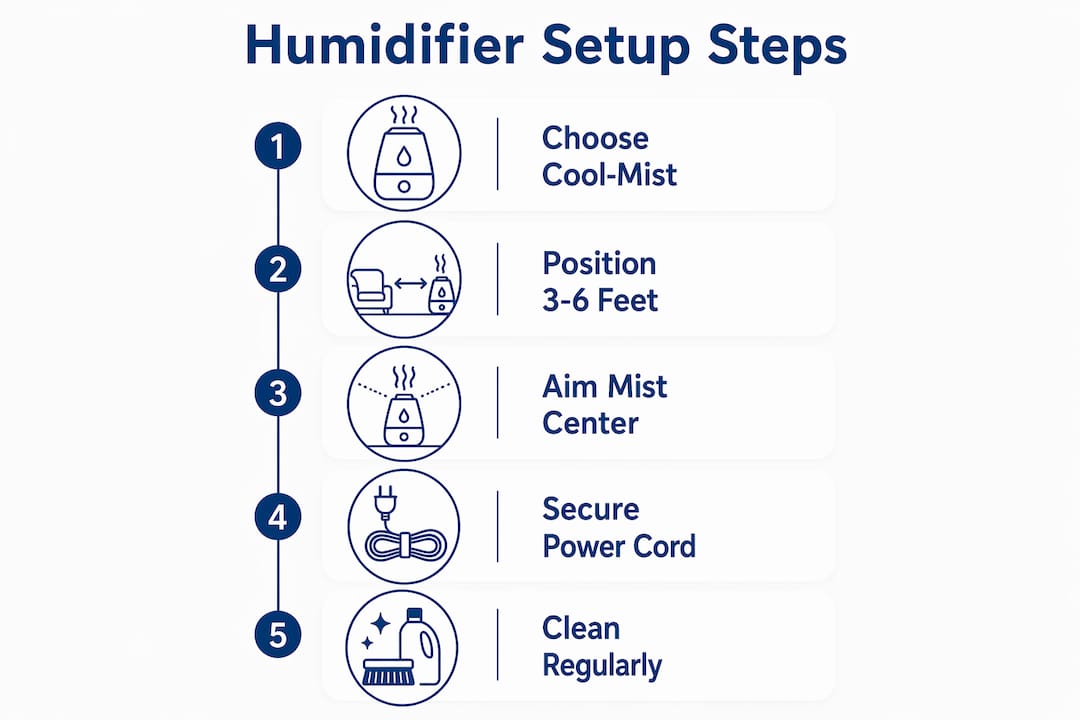
Power cord management is non-negotiable. Cords must be secured and kept at least 3 feet from your baby’s reach. Route cords along the wall and use cable clips or cord covers to keep them flat and out of reach. A dangling cord is a strangulation hazard.
Pro Tip: Use a furniture anchor strap to secure the humidifier to the wall or dresser back if you have a curious toddler who shares the room or visits regularly.
What humidity level is safe for a baby’s room?
The target range for nursery humidity is 40%–60% relative humidity. Within that range, mucus membranes stay moist, skin irritation reduces, and breathing is easier for infants whose airways are still developing. Below 40%, the air becomes dry enough to cause cracked skin and nasal congestion. Above 60%, you create conditions that support mould growth and dust mite populations.
A built-in humidity display on your humidifier is a starting point, but not sufficient on its own. Use an independent digital hygrometer to get an accurate reading from the centre of the room. Built-in sensors sit next to the water source and often read lower than the actual room humidity.
Follow these operating guidelines for safe overnight use:
- Start on the lowest setting and check the hygrometer reading after 1–2 hours.
- Turn the humidifier off or reduce the setting if humidity climbs above 60%.
- Check bedding and walls for condensation each morning. Damp surfaces mean the output is too high.
- Use distilled water in ultrasonic models. Tap water in ultrasonic humidifiers aerosolises mineral particles, known as white dust, which settle on surfaces and degrade air quality.
- Never run the humidifier continuously without monitoring. Adjust based on the season, as Australian summers can already push indoor humidity above 60% in coastal areas.
A digital hygrometer costs between $15 and $40 at most Australian hardware stores. That small investment removes all guesswork from humidity management.
How often should you clean a baby’s humidifier?
Cleaning frequency is where most parents fall short. The correct schedule is every 1–2 days. That sounds frequent, but standing water in a warm nursery becomes a bacterial breeding ground within 24 hours. Mould spores released into the air from a contaminated tank are a direct respiratory risk for infants.
Follow this cleaning routine:
- Empty the tank completely before each refill. Never top up water sitting in the tank from the previous session.
- Rinse the tank with clean water and shake to dislodge any residue.
- Sanitise with 3% hydrogen peroxide. Pour a small amount into the tank, swirl to coat all surfaces, and let it sit for 30 minutes before rinsing thoroughly.
- Dry all components completely before reassembling. Moisture left in the base or tank promotes mould growth even between uses.
- Replace filters on schedule. If your model uses a wick filter, follow the manufacturer’s replacement interval. A clogged filter reduces output and harbours bacteria.
For practical guidance on maintaining consistent humidity with specific models, the Levoit humidifier maintenance tips on the Pureair-au blog cover cleaning routines in detail.
Pro Tip: Keep a second water tank if your model supports it. While one tank is drying after cleaning, the second is ready to go. This removes the temptation to skip a cleaning cycle.
Common mistakes when setting up a nursery humidifier
Even parents who research thoroughly make the same setup errors. Recognising them early saves you from discovering mould behind the dresser or a baby with worsening congestion.
The most common mistakes are:
- Placing the unit on carpet or the floor. Moisture pools underneath, and the mist disperses poorly at floor level. Always elevate.
- Pointing the nozzle at the crib. Directing mist away from the crib and walls prevents dampness on bedding and fabric. Wet bedding is a suffocation risk for infants.
- Using tap water in an ultrasonic humidifier. The resulting white dust coats surfaces and introduces mineral particulates into the air your baby breathes.
- Skipping humidity monitoring. Running the humidifier without a hygrometer is guesswork. You will not notice when humidity creeps above 60% until you see condensation or smell mould.
- Ignoring the cleaning schedule. A humidifier that has not been cleaned in a week is actively making the air worse, not better.
“Humidifiers aid comfort but are not a treatment for respiratory illnesses. Proper usage and monitoring prevent unintended moisture problems.” — babyallergyprevention.com.sg
If you notice white dust on surfaces, switch to distilled water immediately. If you see condensation on windows or walls, reduce the output setting and check your hygrometer. If there is a musty smell, disassemble the unit completely and sanitise every component before using it again. For homes prone to excess moisture, pairing your humidifier with an air purifier for mould prevention adds a useful layer of protection.
Key takeaways
Safe, effective nursery humidification requires a cool-mist unit, correct placement at 3–6 feet from the crib on a raised waterproof surface, and humidity maintained at 40%–60% with daily cleaning.
| Point | Details |
|---|---|
| Choose cool-mist only | Warm mist and vaporiser models pose scalding risks and are not safe for infant rooms. |
| Placement distance matters | Keep the unit 3–6 feet from the crib on an elevated, waterproof surface, never on carpet. |
| Monitor humidity daily | Use an independent hygrometer and turn off the unit if readings exceed 60%. |
| Clean every 1–2 days | Sanitise with 3% hydrogen peroxide and dry all parts completely before reassembling. |
| Use distilled water | Tap water in ultrasonic models produces white dust that degrades nursery air quality. |
What i have learned from setting up nursery humidifiers
Parents often ask me whether a humidifier is worth the effort. My honest answer is yes, but only if you treat it like a piece of medical equipment rather than a set-and-forget appliance.
The mistake I see most often is buying a well-reviewed model and then neglecting the cleaning schedule within two weeks. Life with a newborn is exhausting, and a daily tank rinse feels like one more task. But a contaminated humidifier is genuinely worse than no humidifier at all. The cleaning routine is not optional.
I also think the industry undersells the importance of the hygrometer. Most parents focus entirely on the humidifier itself and never buy a separate monitor. That is backwards. The hygrometer is what tells you whether the device is doing its job or creating a new problem. Spend $20 on a digital hygrometer before you spend $150 on a humidifier.
One more thing worth saying: if you are in coastal Australia during summer, check your baseline indoor humidity before you buy anything. In Sydney or Brisbane, indoor humidity can sit at 65%–70% without any humidifier running at all. Adding one in those conditions pushes you straight into mould territory. A dehumidifier may actually serve you better for part of the year. The goal is always the 40%–60% range, regardless of which direction you need to move to get there.
— Lucas
Find the right humidifier for your nursery at Pureair-au
Setting up the right humidifier for your baby’s room starts with choosing a unit that is genuinely suited to Australian conditions. Pureair-au stocks a curated range of cool-mist humidifiers, including the Blueair InvisibleMist H35i and the Blueair 2-in-1 Purify + Humidify DH3i, both designed for easy maintenance and safe home use. Every product in the Pureair-au range is AHAM verified for performance and reliability.
Browse the full nursery humidifier range at Pureair-au to find a model matched to your room size, budget, and maintenance preferences. The Pureair-au team can also help you identify whether a combined air purifier and humidifier unit suits your nursery better than a standalone model.
FAQ
What type of humidifier is safest for a baby?
Cool-mist humidifiers, either ultrasonic or evaporative, are the only safe choice for infant rooms. Warm mist models and vaporisers pose scalding risks and are not recommended for use around babies.
How far should a humidifier be from a baby’s crib?
Place the humidifier 3–6 feet from the crib on a raised, waterproof surface. Closer placement concentrates mist on bedding, which creates dampness and mould risk.
What humidity level is right for a baby’s room?
The target range is 40%–60% relative humidity. Use an independent digital hygrometer to monitor levels and turn the unit off if readings exceed 60%.
How often should you clean a baby’s humidifier?
Clean and dry the water tank every 1–2 days using 3% hydrogen peroxide. Standing water left overnight becomes a breeding ground for bacteria and mould within 24 hours.
Can you use tap water in a baby’s humidifier?
Tap water in ultrasonic humidifiers produces white mineral dust that reduces air quality. Use distilled water or choose an evaporative model with a wick filter to avoid this problem.