
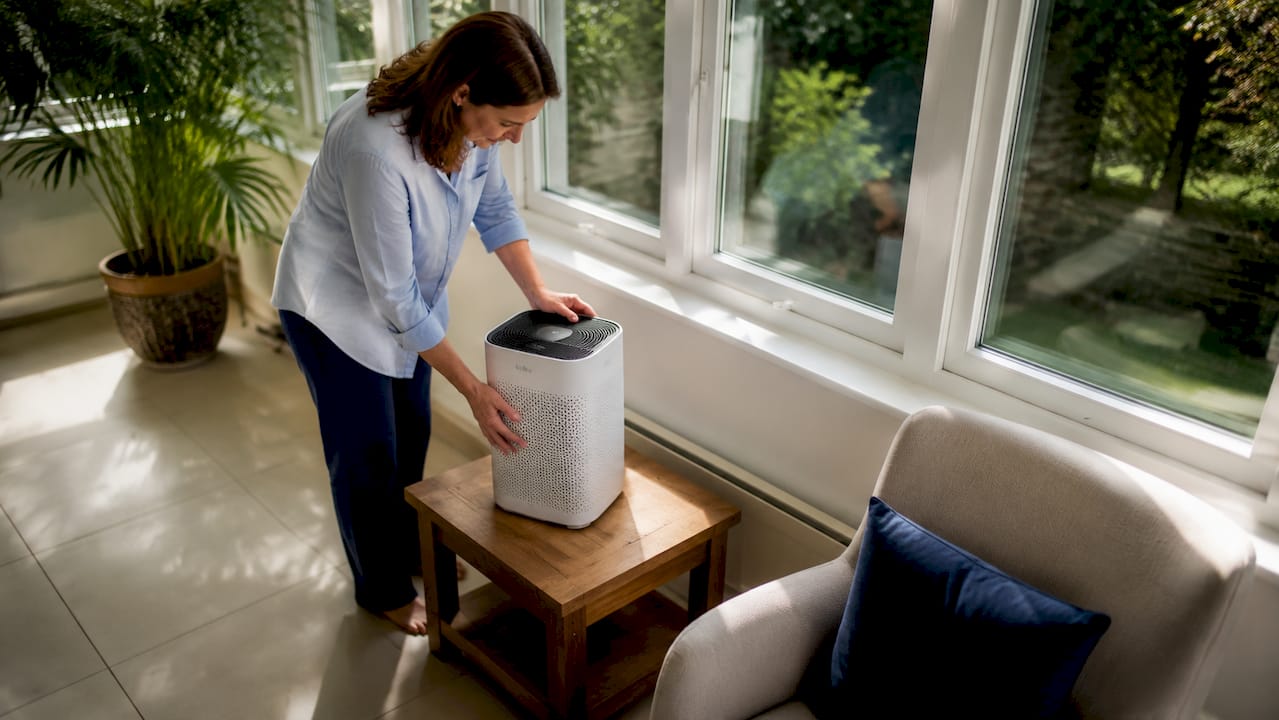
Effective air purifier setup is defined by three decisions: choosing the right unit size, placing it near your breathing zone, and keeping airflow unobstructed. When you set up an air purifier in your living room correctly, you can dramatically reduce dust, pollen, pet dander, and bushfire smoke particles that accumulate in the space where your family spends the most time. The industry standard metric for sizing is Clean Air Delivery Rate (CADR), which measures how quickly a unit cleans a given volume of air. Get these fundamentals right from the start, and your purifier will work as intended every single day.
How to set up an air purifier in your living room: size first
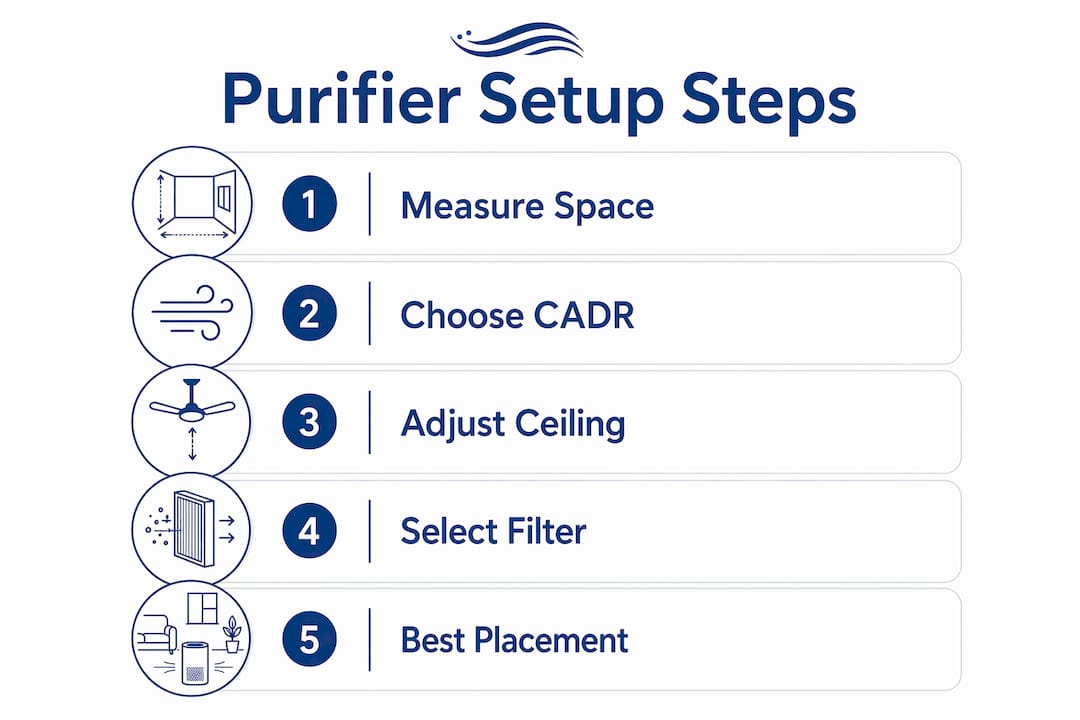
Choosing the right size is the single most important step before you install an air purifier anywhere. An undersized unit running flat out will never keep pace with a large living room, no matter how well you position it.
Match CADR to your room’s square footage
CADR should be at least two-thirds of your living room’s square footage. A 30-square-metre room needs a CADR of at least 20. That ratio keeps air changes per hour (ACH) at a level that actually clears pollutants rather than just recirculating them.
For allergy sufferers, the target ACH rises to 4–6 per hour. That means a purifier rated for your room size at general use may still fall short if someone in the household has asthma or hay fever. When you choose an air purifier for a family home with allergy concerns, size up by one tier.
Adjust for ceiling height
Standard CADR ratings assume an 8-foot (2.4-metre) ceiling. For every 2 feet above that, add 25% more CADR capacity to maintain the same cleaning performance. A living room with 3-metre ceilings holds significantly more air volume than the square footage alone suggests.
Pro Tip: Measure your ceiling height before buying. A unit that looks right on paper for a 25-square-metre room may be underpowered if your ceilings are 3 metres or higher.
Filter type matters as much as CADR
A true HEPA filter captures 99.97% of airborne particles at 0.3 microns. That is the standard you need. Avoid units labelled “HEPA-style” or “HEPA-like” as these lack certified filtration performance. For living rooms where cooking smells, pet odours, or VOCs from furniture are a concern, activated carbon filters complement HEPA by targeting gases and chemical pollutants that HEPA alone cannot remove.
Purifier sizing reference table
| Room Size (sq metres) | Minimum CADR | Recommended ACH | Notes |
|---|---|---|---|
| Up to 20 sq m | 14 | 2–3 | Suitable for small living areas |
| 20–30 sq m | 20 | 3–4 | Standard living room size |
| 30–45 sq m | 30 | 4–5 | Upgrade CADR for allergy relief |
| 45+ sq m or open plan | 40+ | 4–6 | Consider multiple units |
Where should you place an air purifier in your living room?
Placement determines whether your purifier cleans the air you actually breathe or the air behind the couch. The industry term for this is “breathing zone targeting,” and it is the most overlooked factor in air purifier placement tips.
Position it near your main seating area
Place your unit 3–10 feet from your main seating area, with the output vent facing towards you. This creates a directional flow of clean air directly into the zone where you and your family spend the most time. A unit sitting in the corner of the room, pointed at a wall, is cleaning air that nobody is breathing.
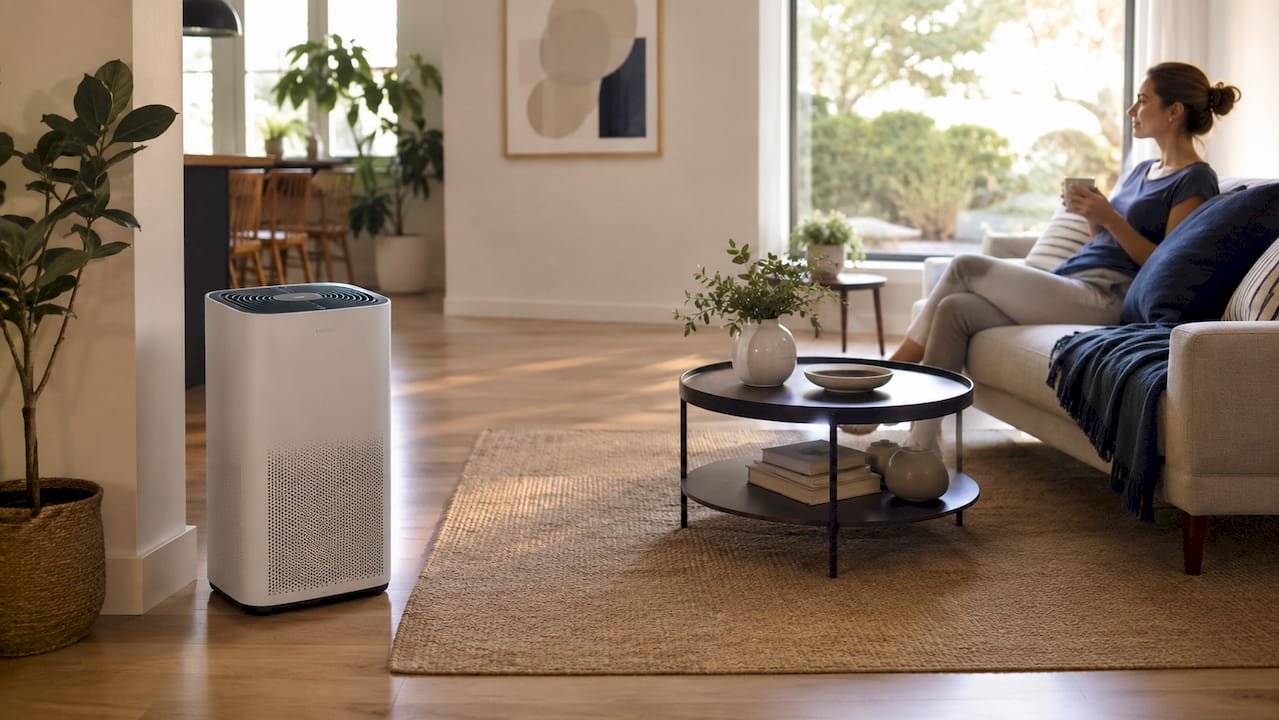
The output direction is as important as the distance. Most living room purifiers, including models like the Blueair Blue Max 3250i and Levoit Core 300S, have a top-facing or front-facing output. Orient the unit so that clean air flows towards your sofa or main chairs.
Give the unit room to breathe
Maintain at least 12 inches of clearance around all intake vents. Blocking the intake with furniture or walls reduces cleaning effectiveness by up to 50%. That is not a minor performance dip. It means your purifier is working at half capacity while you assume it is running normally.
Keep the unit away from HVAC return vents as well. Return vents pull air back into your ducted system, and placing a purifier nearby creates competing airflow that disrupts the unit’s ability to draw in and filter room air consistently.
Handling open-plan living spaces
Open-plan living rooms present a real challenge. A single unit may not effectively handle the volume of an open-floor plan because the space behaves like an “infinite volume” from the purifier’s perspective. The practical solution is either a high-CADR unit positioned near your primary seating, or two smaller units placed at opposite ends of the space.
- Place one unit near the sofa or main seating cluster
- Position a second unit near the kitchen or dining area if the spaces connect
- Avoid placing either unit in a corner or against a wall
- Point output vents towards occupied zones, not towards open space
Pro Tip: In open-plan homes, think of each functional zone (lounge, dining, kitchen) as a separate room for purifier placement purposes. One unit per zone is more effective than one large unit in the middle.
How do you install and maintain a living room air purifier?
Getting the unit running correctly from day one saves you from months of suboptimal performance. Here is a practical checklist for installation and ongoing maintenance.
Step-by-step installation
- Measure your room before unboxing. Confirm the unit’s CADR matches your room size and ceiling height.
- Choose your spot using the 3–10 foot rule from your main seating area. Mark the position before placing the unit.
- Check clearance on all sides. Confirm at least 30 centimetres of free space around intake vents.
- Plug into a standard power point away from water sources. Avoid using extension leads if possible, as these can reduce power consistency.
- Set the fan speed to high for the first hour to establish a clean air baseline, then reduce to medium or auto mode.
- Register the unit with the manufacturer if applicable, to track filter replacement reminders.
Fan speed and noise balance
Running the purifier on high speed when the room is unoccupied maximises ACH. When you are in the room, drop to medium or low to reduce noise without sacrificing meaningful air quality. Most modern units, including those from Blueair and Philips, have an auto mode that adjusts fan speed based on real-time air quality sensors. Use it.
Filter maintenance schedule
- Check the pre-filter monthly. Rinse or vacuum it if the manufacturer permits.
- Replace the HEPA filter every 6–12 months depending on usage and air quality in your area. During bushfire season in Australia, replace filters more frequently.
- Replace activated carbon filters every 3–6 months. Carbon saturates faster than HEPA and loses effectiveness quietly, with no visible sign of wear.
- Wipe down the exterior monthly with a dry cloth to prevent dust buildup on intake grilles.
For a detailed walkthrough of a specific model, the Levoit Core 300S setup guide on the Pureair-au blog covers practical installation steps that apply broadly to most living room units.
What mistakes should you avoid when positioning an air purifier?
Most purifiers underperform not because of a product flaw, but because of avoidable placement errors. These are the most common ones.
- Placing the unit in a corner or behind furniture. Obstructions reduce cleaning rate by 30%–50%, making a quality purifier perform like a budget model.
- Ignoring ceiling height when sizing. Room volume, not just square footage, determines the CADR you actually need. A room with high ceilings holds far more air than its floor area suggests.
- Pointing intake away from pollutant sources. If you have pets, position the intake facing the pet’s bed or resting area to capture dander before it spreads through the room.
- Choosing a unit that is too noisy and then turning it off. A purifier that stays off because it is too loud provides zero benefit. Check the decibel rating at medium speed before buying, not just at low speed.
- Relying on one unit in a large or open-plan space. A single small space air purifier cannot clean an open-plan living and dining area. Either size up significantly or add a second unit.
Key takeaways
Correct placement near your breathing zone, matched to the right CADR for your room volume, is what separates an effective air purifier setup from one that runs all day and changes nothing.
| Point | Details |
|---|---|
| CADR sizing rule | Choose a unit with CADR equal to at least two-thirds of your room’s square footage. |
| Breathing zone placement | Position the purifier 3–10 feet from your main seating, with output facing towards you. |
| Clearance requirement | Maintain at least 30 centimetres around all intake vents to prevent up to 50% airflow loss. |
| Ceiling height adjustment | Add 25% more CADR for every 2 feet of ceiling height above the standard 8-foot baseline. |
| Filter maintenance | Replace HEPA filters every 6–12 months and carbon filters every 3–6 months for consistent performance. |
What i have learned from getting this wrong first
I spent the first few months with my own living room purifier wondering why the air still felt stale. The unit was running constantly on auto mode, sitting in the corner behind an armchair, about two metres from the nearest power point. It looked tidy. It was nearly useless.
Moving it to a spot beside the sofa, with the output facing the main seating area and nothing blocking the intake, made a noticeable difference within a day. The air quality reading on the unit’s sensor dropped by a third. That single change cost nothing.
What I see most often when people ask about their setups is the same mistake: they treat the purifier like a piece of furniture to be hidden rather than a functional appliance that needs clear airflow. The best air purifier for a living room is not necessarily the most expensive one. It is the one positioned correctly for the space.
I also think people underestimate how much Australian conditions change the maintenance equation. During bushfire season, a filter that would normally last 12 months can saturate in 6 weeks. If you live in a high-pollen area or near a busy road, check your pre-filter monthly rather than quarterly. The unit will tell you nothing is wrong until performance drops noticeably. Do not wait for that.
If you are in an open-plan home and frustrated that your purifier seems to make no difference, the answer is almost always a second unit rather than a bigger one. Two well-placed units outperform one oversized unit every time.
— Lucas
Find the right purifier for your living room at Pureair-au
Getting the setup right starts with having the right unit. Pureair-au stocks a curated range of HEPA-certified air purifiers, humidifiers, and replacement filters suited to Australian living rooms, from compact units for smaller spaces to high-CADR models built for open-plan homes.
Browse the full air purifier catalogue to filter by room size, CADR rating, and features like activated carbon filtration or smart auto mode. If you want a combined solution, the Blueair 2-in-1 Purify + Humidify DH3i handles both air quality and humidity in a single unit, which suits Australian homes where dry air and airborne particles often arrive together. All products on Pureair-au are AHAM verified, so the CADR ratings you see are the ones you get.
FAQ
What is the best position for an air purifier in a living room?
Place the unit 3–10 feet from your main seating area with the output vent facing towards you. Keep at least 30 centimetres of clearance around all intake vents and avoid corners or spots behind furniture.
How do i know if my air purifier is the right size for my living room?
Check the CADR rating. It should equal at least two-thirds of your room’s square footage. If your ceilings are above 2.4 metres, increase the required CADR by 25% for every additional 60 centimetres of height.
How often should i replace the filter in my living room air purifier?
Replace HEPA filters every 6–12 months under normal conditions. During Australian bushfire season or in high-pollen areas, check filters monthly and replace sooner if airflow drops or the unit’s indicator light activates.
Can one air purifier cover an open-plan living and dining area?
A single unit is rarely sufficient for a large open-plan space. Position one unit near your primary seating zone to create a clean air pocket, and add a second unit near the dining or kitchen area for broader coverage.
Does it matter whether i use true HEPA or hepa-style filters?
True HEPA filters are certified to capture 99.97% of particles at 0.3 microns. HEPA-style or HEPA-like filters carry no such certification and perform inconsistently. Always check for the true HEPA label when buying a replacement filter or a new unit.