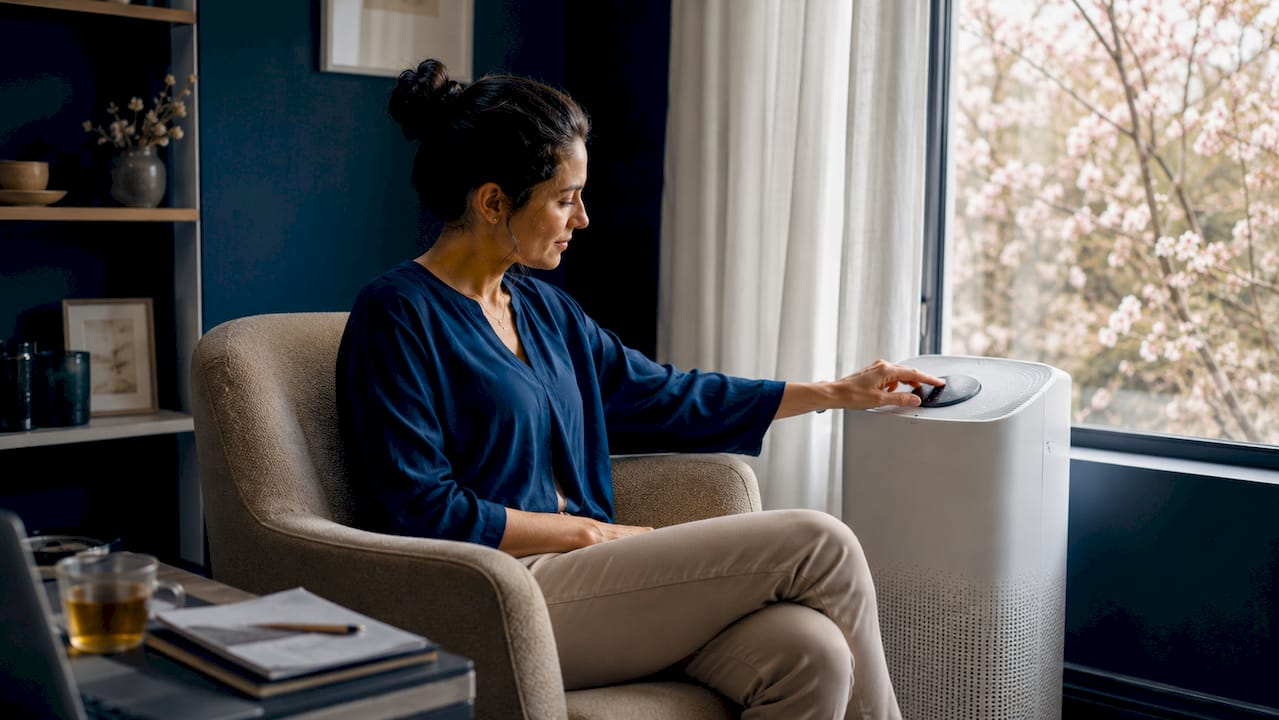
Air purifiers equipped with True HEPA filters reduce indoor pollen concentrations by 55–80%, making them one of the most effective tools for managing hay fever symptoms at home. The reason why air purifiers help hay fever comes down to a single mechanism: they pull airborne allergens through a dense fibre mat and trap them before you breathe them in. Clinical evidence confirms that continuous use, particularly overnight in bedrooms, can improve allergy symptoms by up to 60%. This guide explains the technology, the evidence, and the practical steps you need to get real relief.
Why air purifiers help hay fever: the HEPA filter explained
True HEPA filtration is the standard that separates effective air purifiers from decorative ones. A True HEPA filter captures at least 99.97% of airborne particles at 0.3 microns in diameter. That size matters because 0.3 microns is the hardest particle size to trap. Filters that handle 0.3 microns handle everything larger with even greater efficiency.
Pollen grains typically measure between 5 and 100 microns. That makes them far larger than the 0.3-micron benchmark, which means a True HEPA filter captures pollen with near-total efficiency. Grass pollen, one of the most common hay fever triggers in Australia, sits at the larger end of that range and is caught on first pass through the filter.
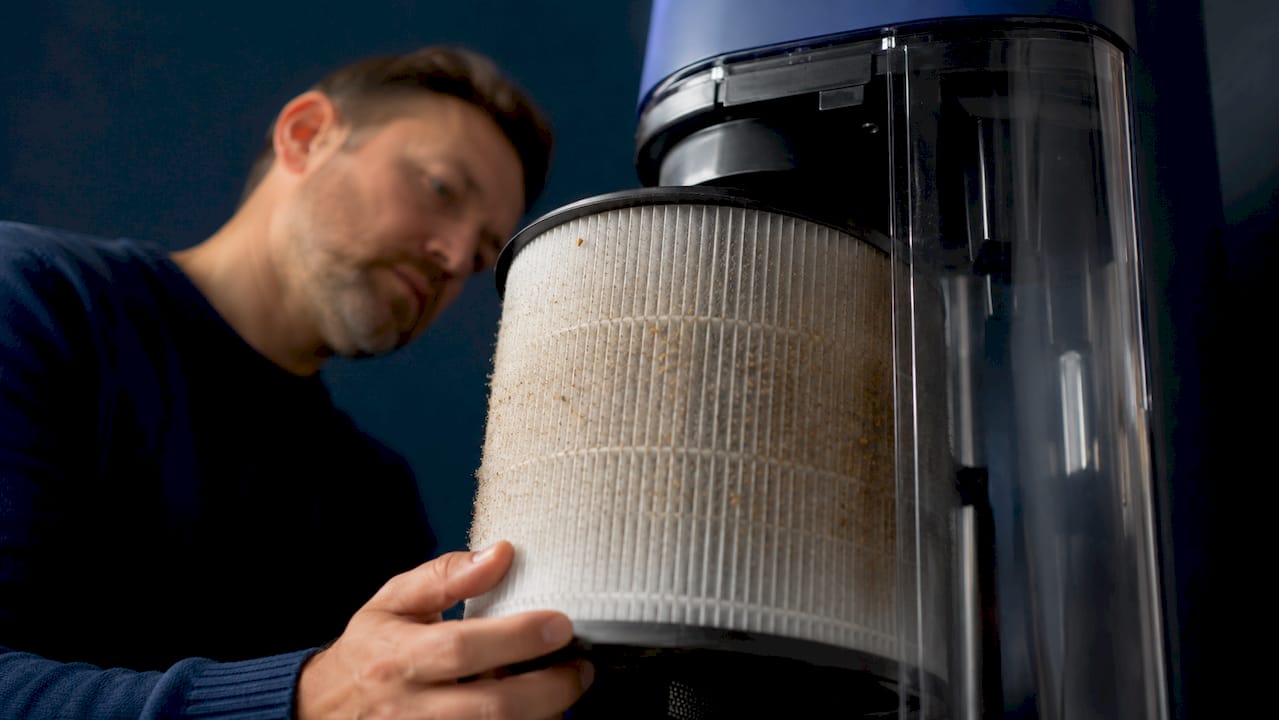
The problem is labelling. Products sold as “HEPA-type” or “HEPA-like” do not meet the True HEPA standard. HEPA-type labels are not regulated to the same performance threshold, and many users buy these units expecting clinical-grade results. The disappointment is predictable. Only the “True HEPA” designation guarantees 99.97% capture at 0.3 microns.
Filter housing matters too. Frame leakage can reduce filter efficiency by 1–5%, even in units with genuine True HEPA media. That loss is silent and invisible. Look for models with rubber gasket seals around the filter to prevent air from bypassing the media entirely.
Pro Tip: When buying an air purifier for hay fever, check the product specification sheet for the words “True HEPA” and look for AHAM verification. If the listing only says “HEPA-type” or “HEPA-style,” move on.
What does the evidence say about pollen reduction indoors?
The clinical case for air purifiers in allergy management is strong. Multiple studies show that True HEPA units reduce indoor pollen concentrations by 55–80% and improve allergy symptoms by 25–60%. Those are not marginal gains. For a hay fever sufferer, a 60% reduction in symptoms can mean the difference between a productive day and a miserable one.
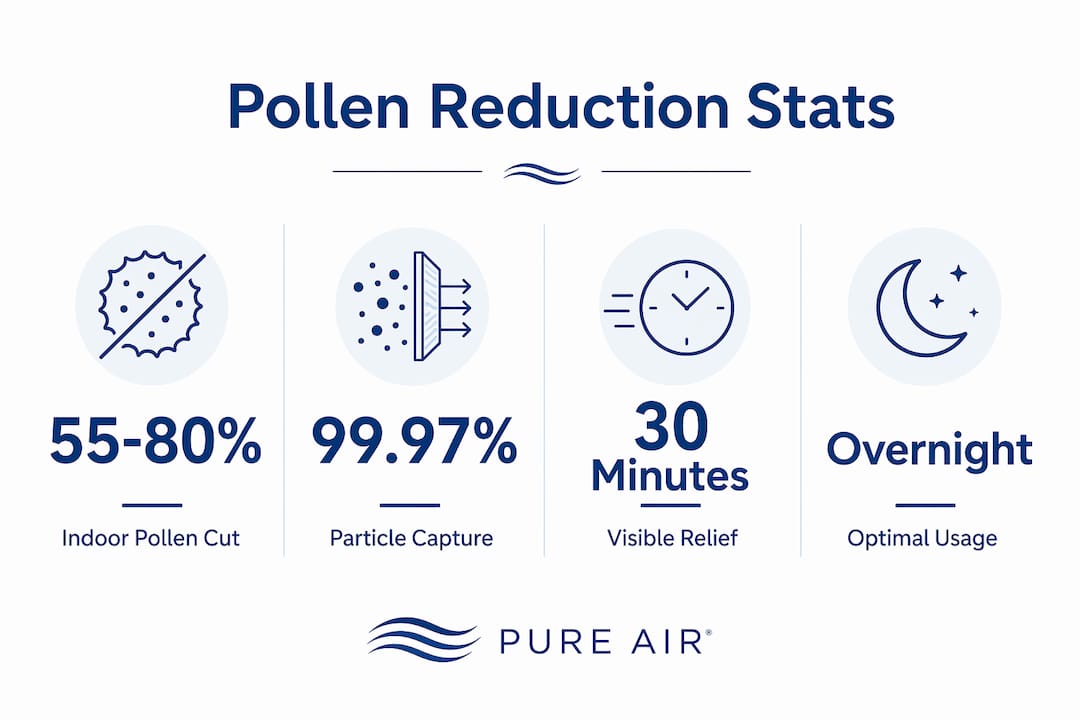
Timing is the most underrated factor in getting results. Continuous overnight use in bedrooms yields the greatest reductions in rescue medication use and measurable improvements in sleep quality. Eight or more hours of filtration while you sleep clears the air in your breathing zone at the time your body most needs recovery. Improved sleep quality is consistently the most reported benefit among allergy sufferers using air purifiers.
Speed of relief is also worth knowing. Certified units begin delivering measurable pollen relief within 30 minutes in standard-sized rooms. That means switching on a purifier before you go to bed, rather than hours earlier, still produces a meaningfully cleaner sleeping environment.
Placement shapes results as much as the unit itself. Key placement principles include:
- Position the purifier in open floor space, away from walls and furniture, to allow 360-degree air intake.
- Elevate the unit where possible, since warm air carrying pollen rises and circulates at mid-room height.
- Prioritise the bedroom over living areas during pollen season, since that is where you spend the most continuous hours.
- Avoid corners, where airflow is reduced by over 50% compared to open placement.
What mistakes reduce air purifier effectiveness for hay fever?
Most underperforming air purifiers are not faulty. They are misused. The following mistakes account for the majority of disappointing results.
-
Buying a unit without True HEPA filtration. This is the single most common error. A carbon filter or ioniser alone will not capture pollen at the level needed for hay fever relief. Only True HEPA media meets the standard.
-
Undersizing the purifier for the room. Follow the Two-Thirds Rule: the purifier’s CADR rating for smoke should be at least two-thirds of the room’s square footage in square metres. A unit rated for 15 square metres will not adequately clean a 30-square-metre bedroom. Under-sizing means the air changes per hour fall below the threshold needed for meaningful allergen reduction.
-
Placing the unit in a corner or behind furniture. Corners restrict airflow intake dramatically. A purifier tucked behind a bedside table or in a wardrobe alcove is working at a fraction of its rated capacity.
-
Expecting the purifier to clean surfaces. Air purifiers remove airborne particles. They do not remove pollen that has already settled on carpet, bedding, or curtains. Settled allergens become airborne again every time you move through a room. The purifier then has to re-capture them repeatedly.
-
Skipping complementary cleaning. Regular HEPA vacuuming and damp-dusting are required alongside air purifiers to remove allergens from surfaces. Without this, settled pollen keeps re-entering the air and the purifier’s workload never decreases.
Pro Tip: Replace your HEPA filter on schedule, not just when the indicator light activates. A clogged filter reduces airflow and drops capture efficiency well before the sensor triggers.
How to build a full hay fever management strategy at home
Air purifiers address airborne exposure. A complete approach to allergy control requires layering purification with cleaning, bedding protection, and humidity management. Each layer handles a different pathway by which allergens reach you.
Cleaning and surface management
HEPA vacuuming removes settled pollen from carpet and upholstery without throwing it back into the air. Standard vacuum cleaners without HEPA filtration exhaust fine particles back into the room, making the problem worse. Damp dusting with a microfibre cloth captures particles rather than redistributing them. For a practical room-by-room allergen reduction guide, combining these methods with air purification produces the greatest overall reduction.
Bedding and humidity control
Allergen-proof mattress and pillow encasements create a physical barrier between you and accumulated pollen, dust mite waste, and mould spores. Wash bedding weekly in hot water above 60°C to kill dust mites. Maintain indoor humidity between 30% and 50%. Below 30%, airways dry out and become more reactive. Above 50%, dust mite populations and mould growth accelerate, adding two more allergen sources on top of pollen.
Window management and ventilation
The table below shows how to balance fresh air with pollen control across different conditions.
| Condition | Recommended Action |
|---|---|
| High pollen day (above 50 grains/m³) | Keep windows closed, run purifier continuously |
| Low pollen morning or evening | Open windows briefly, then close and run purifier |
| After rain (pollen washed down) | Safe to ventilate for short periods |
| Bushfire smoke present | Keep all windows closed, run purifier on high |
Closing windows during peak pollen hours (typically 10am to 3pm in most Australian cities) and running your purifier continuously is the most effective combination. You can check daily pollen counts through the AusPollen network to time ventilation windows accurately.
Key takeaways
Air purifiers with True HEPA filtration are the most effective single tool for reducing indoor pollen exposure and managing hay fever symptoms at home.
| Point | Details |
|---|---|
| True HEPA is non-negotiable | Only True HEPA filters capture 99.97% of pollen particles; HEPA-type labels do not meet this standard. |
| Overnight use delivers the most benefit | Running a purifier for 8+ hours in the bedroom reduces rescue medication needs and improves sleep quality. |
| Sizing and placement determine results | Use the Two-Thirds Rule for CADR sizing and keep units away from corners for full airflow. |
| Purifiers work on air, not surfaces | Pair your purifier with HEPA vacuuming and damp-dusting to remove settled allergens. |
| Humidity control adds another layer | Keeping indoor humidity at 30–50% reduces dust mite and mould growth alongside pollen exposure. |
What i’ve learned from years of watching people use purifiers wrong
The clinical data on air purifiers is convincing. What the studies do not capture is how often people buy the right technology and then undermine it completely with poor habits.
The most consistent pattern I see is people running their purifier for a few hours in the evening and then wondering why their symptoms are still bad in the morning. The bedroom is where the gains are. Eight hours of clean air while you sleep does more for your immune response and daytime symptom load than any amount of daytime filtration in a living room you occupy for two hours. If you can only run one unit continuously, put it in the bedroom and leave it on all night.
The second pattern is filter snobbery in reverse. People spend good money on a quality unit and then delay filter replacement because the machine is still running. A clogged filter does not just reduce efficiency gradually. At a certain point, airflow drops sharply and the unit is moving air without cleaning it properly. Stick to the manufacturer’s replacement schedule.
My honest view is that air purifiers genuinely reduce rescue medication needs for many hay fever sufferers. That is not a marketing claim. It is what the randomised trial data shows and what I hear consistently from people who use them correctly. The catch is “correctly.” A True HEPA unit, properly sized, placed in the open, running continuously in the bedroom, combined with regular HEPA vacuuming and allergen-proof bedding covers. That combination works. Any one of those elements missing and the results drop off noticeably.
View the purifier as one layer in a system, not a standalone solution. The HEPA filtration benefits are real and well-documented. Getting them requires doing the other parts right as well.
— Lucas
Find the right purifier for your home with Pureair-au
Pureair-au specialises in True HEPA air quality solutions built for Australian conditions, including the high pollen loads and bushfire smoke events that make indoor air quality a genuine health concern here. Every unit in the range is AHAM verified, which means the performance ratings are independently confirmed rather than self-reported.
Whether you need a compact unit for a bedroom or a higher-capacity model for an open-plan living area, the Pureair-au catalogue includes options sized and certified for real hay fever relief. The Blueair Blue Max 3250i and the Blueair ComfortPure 3-in-1 T10i are two strong starting points for allergy sufferers. Use the Smart Finder tool on the site to match a unit to your room size, primary concern, and budget without guesswork.
FAQ
What type of filter do i need for hay fever relief?
You need a True HEPA filter, which captures at least 99.97% of particles at 0.3 microns. HEPA-type or HEPA-style filters do not meet this standard and will not deliver the same pollen reduction.
How quickly does an air purifier reduce pollen indoors?
Certified True HEPA units begin delivering measurable pollen relief within 30 minutes in a standard room. Full reduction to the 55–80% range requires continuous operation over several hours.
Where should i place my air purifier for the best results?
Place the unit in open floor space away from corners and furniture to allow unrestricted airflow. Prioritise the bedroom and keep the purifier elevated where possible for better air circulation.
Can an air purifier replace my hay fever medication?
Air purifiers reduce allergen exposure but do not replace prescribed medication. Evidence from randomised trials shows that continuous use can reduce rescue medication needs, but you should discuss any changes to your medication with your GP.
Do air purifiers help with bushfire smoke as well as pollen?
Yes. True HEPA filters capture fine smoke particles, and many units also include activated carbon layers that absorb smoke odour and gases. During bushfire events, keep windows closed and run your purifier on the highest setting.