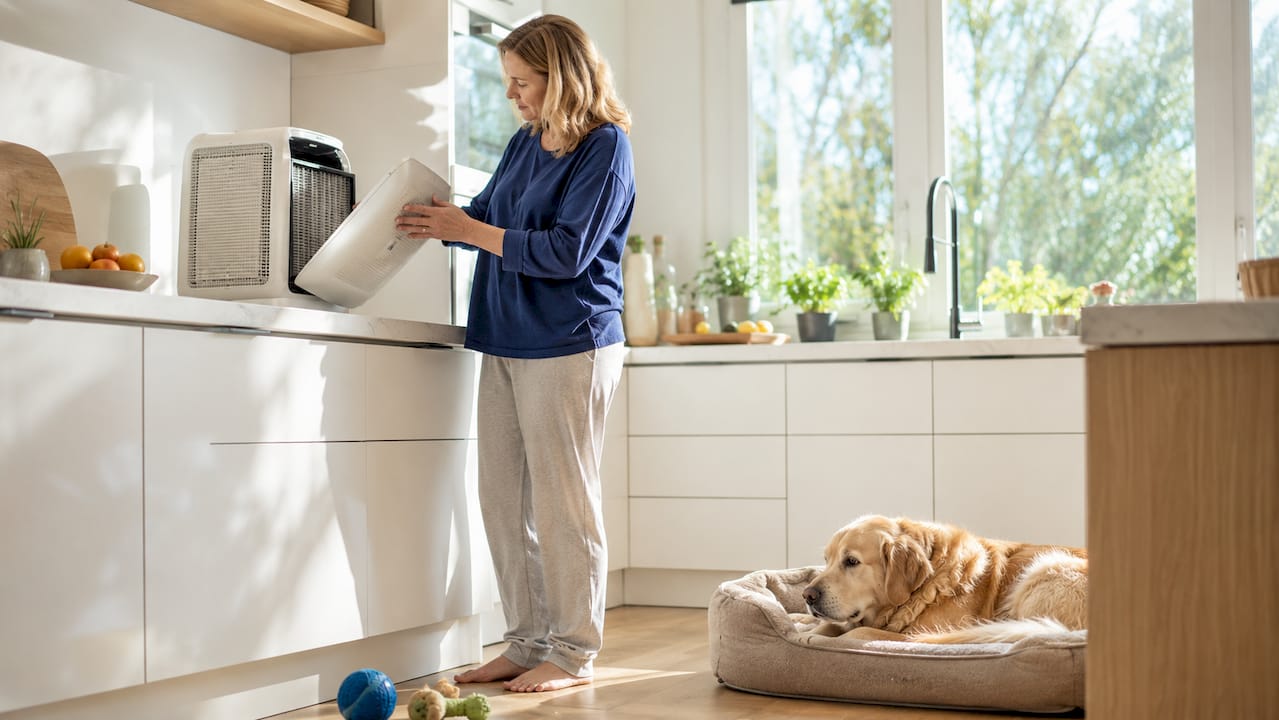
Air purifiers are one of the most effective tools for reducing pet dander, fur, and odours indoors, yet most pet owners use them incorrectly. A HEPA air purifier running continuously can reduce airborne pet allergens by 70–90% within 30–60 minutes. That result depends entirely on correct use. The mistakes pet owners make with air purifiers, from poor placement to wrong filter types, quietly cancel out those gains. Models like the Levoit Vital 100S and the Honeywell Air Touch P2 are built for pet homes, but even the best unit fails when used incorrectly.
1. The most common mistakes pet owners make with air purifiers
The single biggest error is treating an air purifier like a set-and-forget appliance. Pet homes generate a constant load of dander, fur, and odour molecules. Every mistake in this list compounds that load and reduces the air changes your purifier can deliver.
2. Placing the unit in the wrong spot
Poor placement is the fastest way to cut your purifier’s effectiveness. Placing a unit flush against a wall or in a tight corner restricts airflow, increases motor noise, and drops cleaning efficiency significantly.
The fix is straightforward:
- Keep at least 3–5 feet of clearance on all sides of the unit.
- Position the purifier at 3–5 feet off the ground to capture airborne dander before it settles.
- Place the unit in the room where your pet spends the most time, not in a hallway or corner.
- Avoid placing it behind furniture or curtains, which block intake vents.
Pro Tip: If your cat sleeps on the couch, put the purifier within two metres of that spot. Dander concentrates where pets rest, so your purifier should be close to the source.
3. Waiting too long to change the HEPA filter
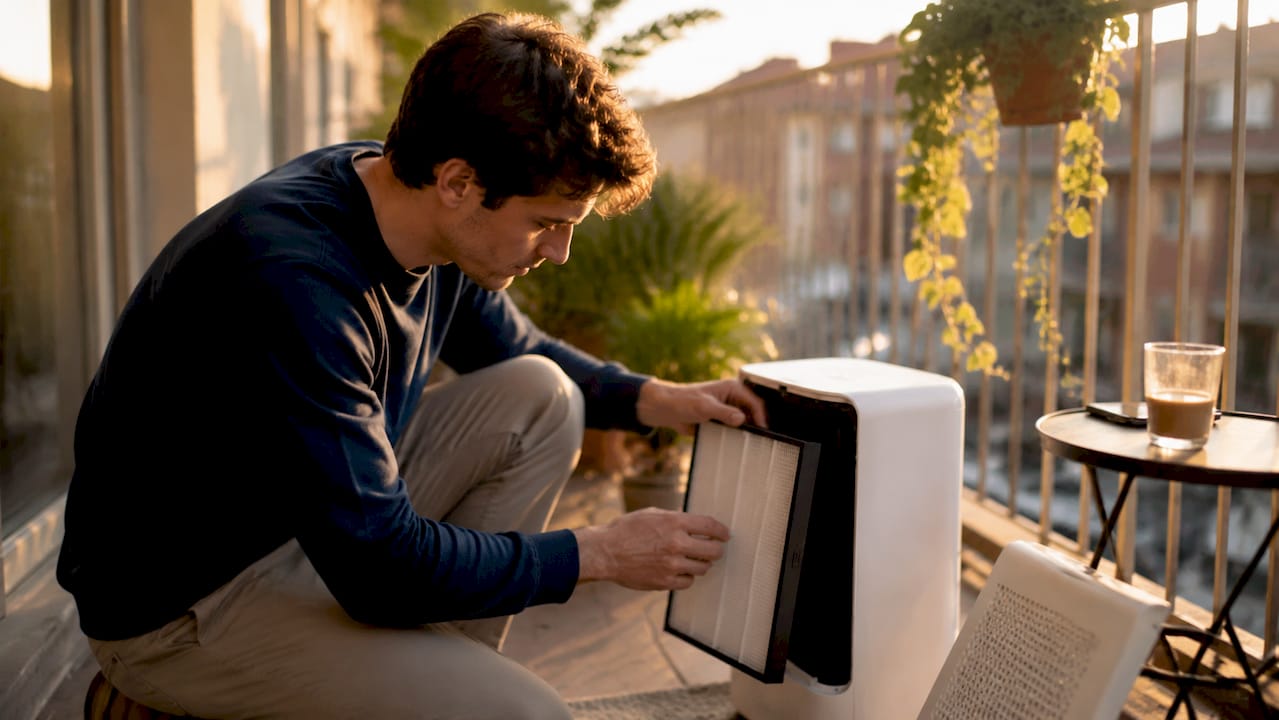
Filter neglect is the most expensive mistake pet owners make. Standard HEPA filters last 6–12 months, but in a pet home the same filter clogs in 3–4 months due to the extra particulate load from dander and fur.
A clogged filter does not just stop working. It restricts airflow so severely that the motor works harder, energy use rises, and the unit may begin recirculating trapped allergens back into the room. The signs are clear: reduced airflow from the outlet, a persistent pet smell even when the unit is running, and visible grey discolouration on the filter surface.
- Set a calendar reminder every three months to inspect your filter.
- Check the filter indicator light if your model has one, such as the Levoit Vital 100S.
- Hold the filter up to light. If you cannot see through it, replace it immediately.
- Keep one spare filter on hand so you never run the unit with a spent filter while waiting for delivery.
Pro Tip: Write the installation date on the filter frame with a marker. You will never have to guess how old it is.
4. Ignoring the pre-filter
The pre-filter is the first line of defence. It catches large pet hair, lint, and dust before they reach the HEPA layer. Dirty pre-filters reduce HEPA filter lifespan by 30–50% by forcing the finer filter to handle debris it was never designed to trap.
Most pet owners clean their pre-filter far too rarely. The correct schedule is every 2–4 weeks, depending on how much your pet sheds.
- Vacuum the pre-filter gently with a brush attachment. Do not use high suction directly on the filter material.
- If your model has a washable pre-filter, rinse it under cool water and let it dry completely before reinstalling. A damp pre-filter promotes mould growth inside the unit.
- Never skip the pre-filter step to save time. Replacing a HEPA filter early because the pre-filter was neglected costs far more than a two-minute clean.
5. Buying a purifier without activated carbon
HEPA filters capture particles. They do not remove odours. HEPA filtration alone cannot eliminate pet odours because odour molecules are gaseous compounds, not particles. Ammonia from litter trays and the wet-dog smell are both VOCs (volatile organic compounds) that pass straight through a HEPA filter.
Activated carbon adsorbs these molecules by trapping them in a porous carbon matrix. The quality of the carbon layer matters enormously.
| Filter type | What it removes | Pet odour performance |
|---|---|---|
| HEPA only | Particles, dander, dust | No odour removal |
| Carbon-coated mesh | Light odours | Short-lived, low capacity |
| Pelletised activated carbon | VOCs, ammonia, strong odours | Superior and long-lasting |
Pelletised activated carbon provides far greater surface area than a thin carbon-coated mesh sheet. When choosing air purifiers for pets, check the weight of the carbon layer. A few grams of carbon-coated mesh will not last a month in a home with a dog or a litter tray.
6. Turning the purifier off when you leave home
Switching the unit off to save power is a common pet owner error that costs more than it saves. Running a purifier only intermittently allows allergen levels to rebuild, and the unit then has to work at high speed to recover, using more energy than continuous low-speed operation would have required.
Dander, fur, and odour molecules accumulate constantly, whether you are home or not. Your pet does not stop shedding when you leave for work. Set the unit to auto or low mode and leave it running around the clock. The energy cost of continuous low-speed operation is minimal compared to the allergen load that builds in a closed room over eight hours.
7. Using a purifier that is too small for the room
Room size is the most overlooked factor when choosing air purifiers for pets. An undersized purifier cannot achieve the recommended 4–5 air changes per hour needed to keep allergen levels low. A unit rated for 20 square metres placed in a 40 square metre open-plan living area will run constantly at full speed and still fall short.
Check the CADR (Clean Air Delivery Rate) rating against your room’s floor area. For pet homes, choose a unit rated for at least 1.5 times your actual room size. This buffer accounts for the higher particle load that pets generate compared to a pet-free household.
8. Skipping the cleaning routine that supports your purifier
Air purifiers are supplemental tools. They do not replace source control measures like regular vacuuming, washing pet bedding, and keeping pets off certain furniture. A purifier working alongside a dirty environment is fighting a losing battle.
- Wash pet bedding weekly in water heated to at least 54°C (130°F). Hot water at this temperature destroys allergens embedded in fabric that a purifier cannot reach.
- Vacuum floors and upholstery at least twice a week using a vacuum with a HEPA filter. A pet-friendly cleaning routine dramatically reduces the particle load your purifier has to handle.
- Wipe hard surfaces weekly. Dander settles on benchtops, shelves, and skirting boards, and no air purifier can remove settled particles.
9. Misreading filter indicator lights
Filter indicator lights on models like the Levoit Vital 100S and Honeywell Air Touch P2 are time-based timers, not sensors. They count hours of operation and alert you at a preset interval. They do not measure actual filter saturation. In a heavy-shedding household, your filter may be fully clogged well before the light activates.
Use the indicator light as a minimum reminder, not a definitive guide. Inspect the filter physically every month and replace it when it looks clogged, regardless of what the light says.
10. Relying on multi-stage filtration claims without checking the detail
Many purifiers marketed for pets claim multi-stage filtration. Effective multi-stage filtration for pets requires at minimum a pre-filter, a true HEPA layer, and a substantial activated carbon stage. Some budget units include a thin carbon sheet that exhausts within weeks, leaving only the HEPA layer active.
Before purchasing, confirm the carbon weight or volume listed in the product specifications. If the manufacturer does not publish this figure, treat the carbon stage as minimal. Pureair-au lists full filter specifications for every model in its catalogue, which makes this comparison straightforward.
Key takeaways
Avoiding the mistakes pet owners make with air purifiers requires correct placement, timely filter maintenance, and choosing a unit with both HEPA and pelletised activated carbon filtration.
| Point | Details |
|---|---|
| Placement matters | Keep 3–5 feet of clearance and position the unit near where your pet rests. |
| Replace HEPA filters every 3–4 months | Pet homes clog filters faster than the standard 6–12 month cycle. |
| Clean pre-filters every 2–4 weeks | Neglected pre-filters reduce HEPA lifespan by 30–50%. |
| HEPA alone does not remove odours | Activated carbon, specifically pelletised carbon, is required for VOCs and ammonia. |
| Run the unit continuously | Continuous low-speed operation prevents allergen buildup and uses less energy than intermittent high-speed use. |
What I have learned from years of watching pet owners get this wrong
The mistake I see most often is not the one people expect. Pet owners obsess over which model to buy, and then place it in the corner behind the couch and forget to change the filter for a year. The unit becomes a very expensive ornament.
The second thing I have noticed is that people underestimate odour. They buy a purifier with a thin carbon sheet because the box says “activated carbon,” and then wonder why the house still smells like dog. Pelletised carbon is not a marketing term. It is a physical difference in how much odour the filter can actually hold before it saturates.
My honest recommendation is to run your purifier on auto mode, set a phone reminder for filter checks every eight weeks, and vacuum twice a week. That combination, not the brand of purifier, is what actually changes the air quality in a pet home. The right air purifier for pets is one you maintain correctly, not the most expensive one on the shelf.
— Lucas
Find the right purifier for your pet home at Pureair-au
Pureair-au stocks a curated range of HEPA air purifiers with genuine activated carbon filtration, chosen specifically for Australian homes dealing with pet dander, fur, and odours. Every product in the range is AHAM verified, and full filter specifications are listed so you can confirm carbon weight before you buy.
Replacement filters for 3–4 month cycles are available alongside each unit, and the Pureair-au Smart Finder tool matches you to the right model based on your room size and specific concerns. Whether you are starting fresh or upgrading an existing setup, the full product catalogue covers purifiers, humidifiers, and replacement filters at competitive Australian prices. The Levoit Vital 100S pet care purifier is a strong starting point for most pet households.
FAQ
How often should pet owners replace HEPA filters?
Pet owners should replace HEPA filters every 3–4 months. Standard filters last 6–12 months, but the higher particulate load from pet dander and fur clogs them much faster.
Do air purifiers actually remove pet odours?
HEPA filters do not remove pet odours. Activated carbon filtration is required to adsorb VOCs and odour molecules like ammonia. Choose a unit with pelletised activated carbon for lasting odour control.
Where is the best place to put an air purifier in a pet home?
Place the unit within 3–5 feet of where your pet spends the most time, with at least 3–5 feet of clearance on all sides. Elevated placement at around 3–5 feet off the ground improves airborne dander capture.
Should I turn off my air purifier when I leave the house?
No. Continuous operation on low or auto mode is more effective and more energy-efficient than switching the unit off. Allergens accumulate while you are away, and restarting at high speed uses more power than steady low-speed running.
Can an air purifier replace regular cleaning in a pet home?
No. Air purifiers are supplemental tools and work best alongside weekly vacuuming, washing pet bedding in water at 54°C or above, and wiping down hard surfaces. Source control and purification together produce the best results.