
A HEPA filter is defined as a pleated mechanical filter that removes at least 99.97% of airborne particles at 0.3 microns, the size at which particles are hardest to capture. The role of HEPA filter stages goes well beyond that single filter. Multi-stage filtration systems use a sequence of pre-filters, medium filters, and a final HEPA stage to progressively strip particles from the air, from large dust and lint down to fine allergens and smoke particles. The U.S. EPA recognises this staged approach as the standard for effective indoor air quality control. For Australian families dealing with bushfire smoke, pollen seasons, and pet dander, understanding how each stage works is the difference between a purifier that performs and one that clogs within weeks.
What is the role of HEPA filter stages in air purifiers?
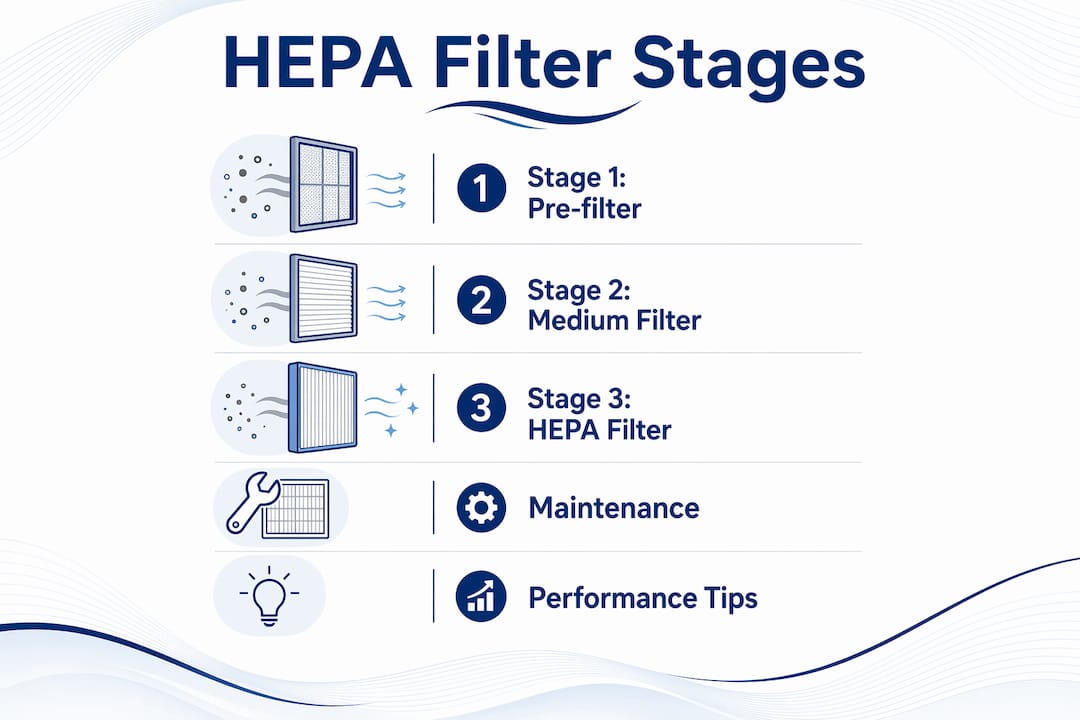
Multi-stage filtration divides the work of cleaning air across several filter layers, each targeting a different particle size range. This is not just an engineering preference. It is the reason pharmaceutical HVAC systems in GMP facilities use the same sequential design. Each stage protects the one after it, and the HEPA stage only sees what the earlier stages could not handle.
Stage 1: the pre-filter
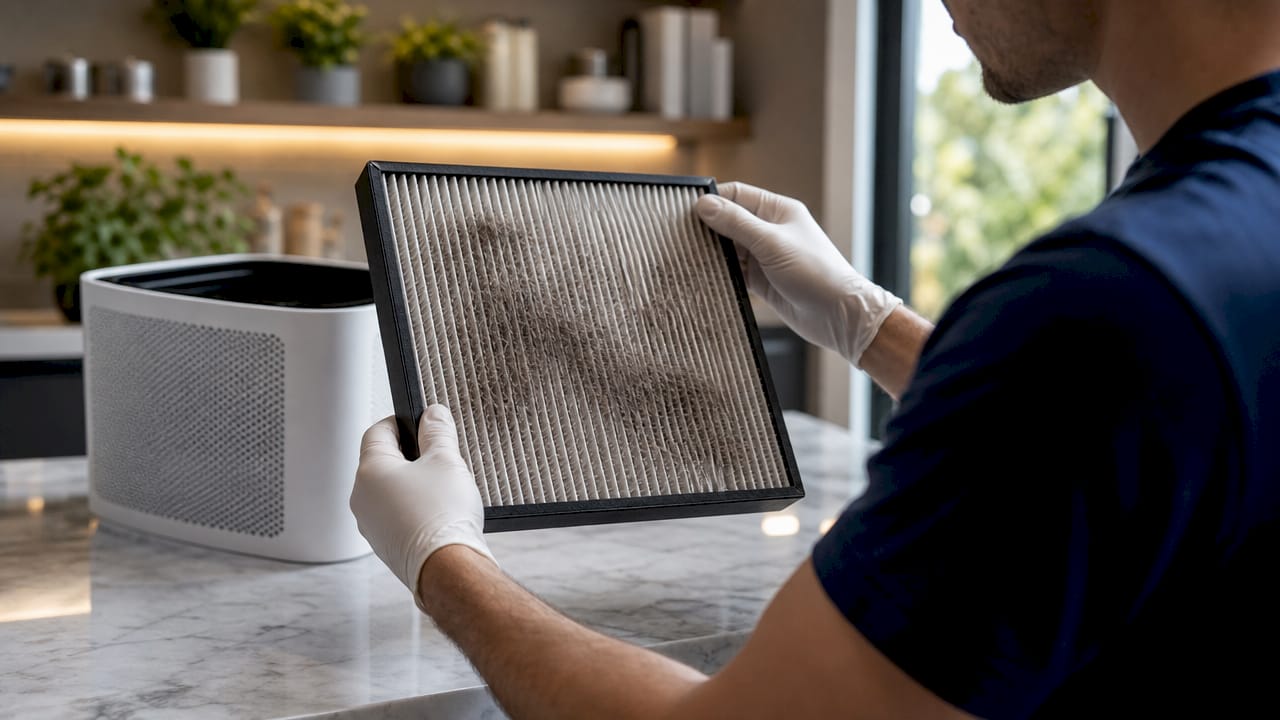
The pre-filter is the first line of defence. It captures large particles: dust, pet hair, lint, and visible debris. Without it, these particles would reach the HEPA media directly and clog it within days. Pre-filters are typically washable or replaceable at low cost, which makes them the most practical stage to maintain. Skipping pre-filter cleaning is the single most common reason a HEPA filter fails early.
Stage 2: the medium filter
Medium filters sit between the pre-filter and the HEPA stage. They capture finer particulates, including PM2.5 particles, that pass through the pre-filter but are too large to challenge the HEPA media efficiently. This stage acts as a load balancer. By distributing particle capture across multiple layers, upstream filter stages protect HEPA elements and maintain stable airflow throughout the system’s life.
Stage 3: the HEPA filter
The HEPA stage captures ultra-fine particles that earlier stages miss. It uses three overlapping physical mechanisms: impaction, interception, and diffusion. Together, these mechanisms deliver the 99.97% capture rate at 0.3 microns. The HEPA stage is the most expensive component in the system, which is exactly why protecting it with upstream stages is so important.
Pro Tip: Check your pre-filter every four weeks during high-pollution periods like bushfire season. A clean pre-filter can double the working life of your HEPA stage.
How do HEPA filters physically capture particles?
The physics behind HEPA filtration explain why it works so well across a broad range of particle sizes. The 0.3 micron rating represents the most penetrating particle size (MPPS), the point at which particles are most likely to slip through. HEPA filters are actually more efficient for particles both larger and smaller than this benchmark. That counterintuitive fact is the key to understanding why HEPA outperforms simpler filters for allergens, smoke, and pathogens.
Three distinct mechanisms work together to achieve this:
-
Impaction handles large particles. Particles with enough mass cannot follow airflow around fibres and collide directly with the filter media. This mechanism dominates for particles above roughly 1 micron, covering dust mites, pollen, and mould spores.
-
Interception captures mid-sized particles. These particles follow the airflow closely but still make contact with a fibre as they pass near it. Interception is most active in the particle size range that includes many common allergens and fine dust.
-
Diffusion targets the smallest particles, below 0.1 microns. At this scale, particles move erratically due to collisions with air molecules, a behaviour called Brownian motion. This random movement increases the chance of contact with a fibre. Diffusion dominates below 0.1 µm, making HEPA highly effective against ultrafine combustion particles from bushfire smoke.
The MPPS at 0.3 microns sits in the gap where impaction and diffusion are both weakest. That is why the rating standard uses this size as its benchmark. A filter rated at 99.97% at 0.3 microns performs better than that for every other particle size. For allergy sufferers, this means HEPA captures pollen, dust mite allergens, and pet dander with efficiency well above the headline number.
How do HEPA stages perform in smoke filtration and allergy reduction?
Real-world performance depends on more than filter ratings. A King County study on wildfire smoke found that portable HEPA units produced an average 4.5% indoor PM2.5 reduction during use, with substantial variation across households. That figure sounds modest, but the variation is the real story. Households with better building sealing and correct purifier placement saw far greater reductions. The filter was not the limiting factor. The building and the occupant’s behaviour were.
| Factor | Effect on HEPA performance |
|---|---|
| Building air leakage | High leakage allows outdoor smoke to continuously re-enter, limiting indoor PM2.5 reductions |
| Room size vs. purifier capacity | Undersized units cannot turn over air fast enough to keep pace with particle infiltration |
| Pre-filter condition | A clogged pre-filter reduces airflow and cuts the HEPA stage’s effective capture rate |
| Purifier placement | Units placed in corners or against walls recirculate already-filtered air rather than drawing in polluted room air |
| Activated carbon stage | HEPA alone does not remove VOCs or odours from smoke; a carbon stage is required for complete smoke treatment |
The last row in that table is worth pausing on. The U.S. EPA distinguishes particulate filtration by HEPA from gas-phase filtration, which requires activated carbon stages for effective removal of VOCs and odours. During bushfire events, smoke contains both fine particles and chemical gases. A purifier with only a HEPA stage will clear the visible haze but leave the chemical load behind. Multi-stage systems that combine HEPA with activated carbon address both problems.
For allergy sufferers, the picture is more straightforward. HEPA excels at removing allergen-relevant particles across a broad size spectrum, not just at the 0.3 micron benchmark. Pollen grains range from 10 to 100 microns. Dust mite allergens sit around 1 to 10 microns. Pet dander ranges from 0.5 to 10 microns. All of these fall in the size range where impaction and interception are strongest, meaning HEPA captures them at rates well above 99.97%.
Pro Tip: During bushfire season, close windows and run your purifier on its highest setting for at least two hours before reducing to a maintenance speed. This clears the initial particle load quickly and reduces the burden on your HEPA stage.
How do HEPA filter stages guide purifier selection and maintenance?
Knowing how each stage works changes how you shop for and maintain an air purifier. A purifier marketed on its HEPA rating alone tells you only part of the story. The pre-filtration design, the activated carbon stage, and the system’s airflow capacity all determine whether the HEPA stage can do its job.
When selecting a purifier, consider these factors:
- Pre-filter accessibility. A pre-filter you cannot easily remove and clean will not get cleaned. Look for units where the pre-filter is accessible without tools and is either washable or inexpensive to replace.
- Activated carbon inclusion. For smoke-affected households or anyone sensitive to chemical odours, a purifier without an activated carbon stage is incomplete. The role of HEPA in smoke filtration covers particles only; gases require a separate stage.
- Room coverage rating. Match the purifier’s CADR (Clean Air Delivery Rate) to your room size. An undersized unit running at maximum speed still cannot compensate for a room that is too large.
- Filter replacement indicators. Quality multi-stage purifiers include separate indicators for each filter stage. This prevents the common mistake of replacing the HEPA filter when the pre-filter is the actual problem.
- AHAM verification. The Association of Home Appliance Manufacturers (AHAM) verifies purifier performance claims independently. AHAM-verified ratings give you a reliable benchmark when comparing models.
Maintenance timing matters as much as the maintenance itself. Pre-filters reduce dust load on HEPA media and prevent rapid clogging. In a pet household or during high-pollen periods, pre-filter checks every two to four weeks are realistic. For HEPA filter replacement timing in homes with pets, the filter replacement guide from Pureair-au covers the specific intervals that apply to Australian conditions. For allergy sufferers wanting to understand how multi-stage filtration reduces hay fever symptoms, the hay fever guide from Pureair-au explains the connection in practical terms.
Key takeaways
Multi-stage HEPA filtration works because each stage targets a different particle size range, protecting the HEPA media and maintaining airflow so the system performs at its rated efficiency over time.
| Point | Details |
|---|---|
| HEPA captures 99.97% at 0.3 µm | This is the hardest size to trap; HEPA is more efficient for all other particle sizes. |
| Pre-filters protect the HEPA stage | Skipping pre-filter maintenance is the leading cause of early HEPA failure and reduced airflow. |
| Three mechanisms cover all sizes | Impaction, interception, and diffusion together explain HEPA’s broad particle capture range. |
| HEPA alone does not remove gases | Activated carbon stages are required alongside HEPA for complete smoke and VOC treatment. |
| Real-world results depend on setup | Building leakage, room sizing, and purifier placement affect outcomes as much as filter ratings do. |
What I have learned from watching HEPA systems work in Australian homes
The headline HEPA rating gets all the attention, but the pre-filter is where most systems succeed or fail in practice. I have seen purifiers with excellent HEPA media underperform badly because the pre-filter was saturated and airflow had dropped to a fraction of the rated capacity. The filter was technically fine. The system was not.
The other thing that surprises people is how much building behaviour matters. Indoor air quality improvements from HEPA filtration are often limited by building features and occupant patterns, not filter efficiency. Opening windows during a smoke event while running a purifier is the equivalent of bailing a boat with the plug still out. The filter cannot keep up with continuous outdoor air infiltration.
For Australian households, the bushfire smoke problem is real and recurring. A multi-stage system with HEPA and activated carbon is the right answer for smoke events. But the system only works if it is sized correctly for the room, the pre-filter is clean, and the windows stay closed when the air quality index is poor. The technology is sound. The gap is usually in how it is used.
My honest recommendation: do not buy a purifier based on the HEPA rating alone. Read the pre-filter design, check whether activated carbon is included, and verify the CADR against your actual room size. A well-maintained three-stage system in the right room will outperform a premium HEPA-only unit every time.
— Lucas
Multi-stage HEPA air purifiers available through Pureair-au
Pureair-au stocks a range of air purifiers built around multi-stage filtration, including models from Honeywell and Blueair that combine pre-filters, HEPA stages, and activated carbon layers in a single unit.
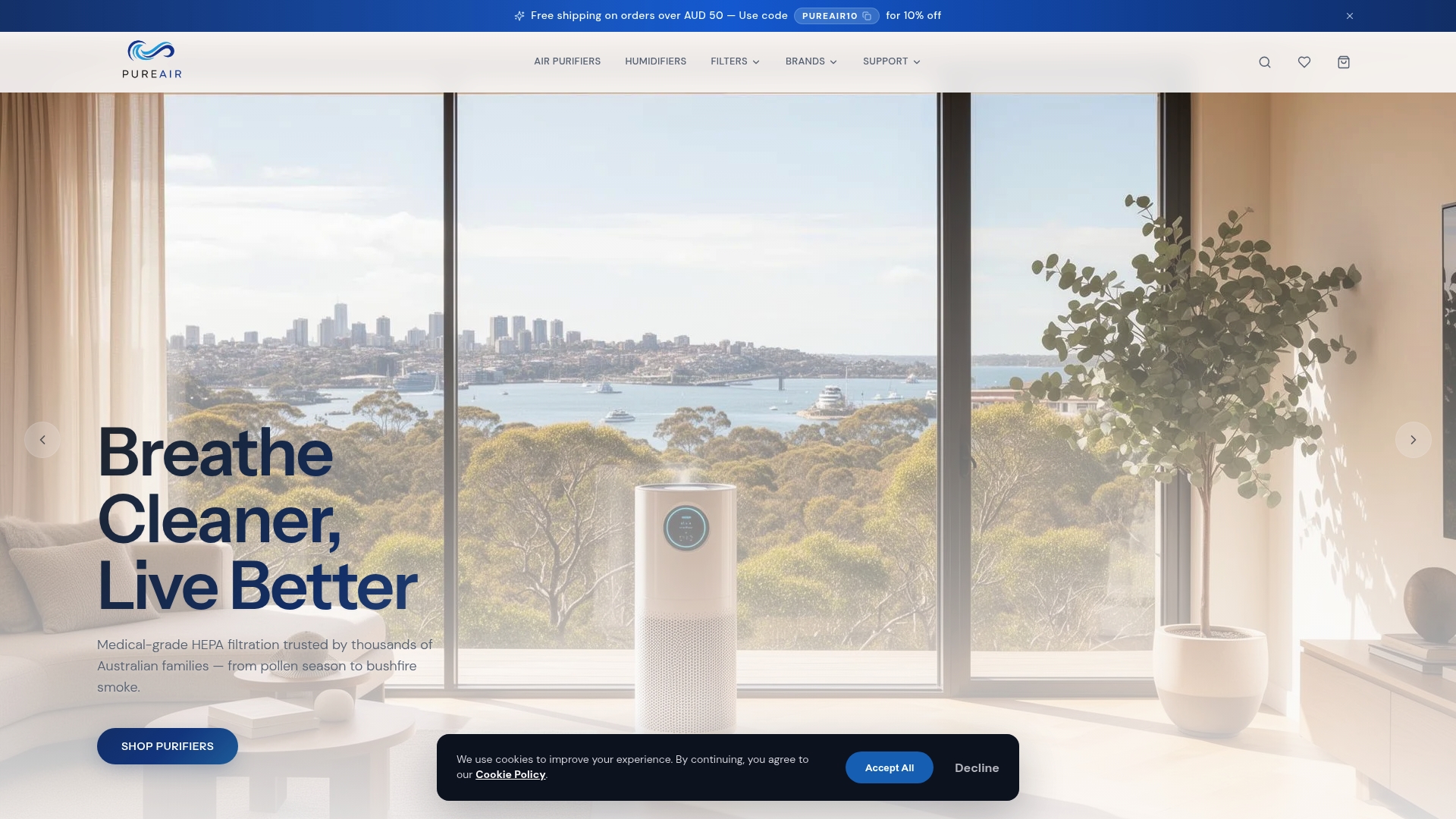
The Honeywell Air Touch P2 is a strong option for medium-sized rooms, combining a washable pre-filter with a true HEPA stage and activated carbon layer. For larger spaces or households dealing with both smoke and humidity, the Blueair DH3i combines purification and humidification in one unit. Browse the full Pureair-au product catalogue to compare models by room size, filtration stages, and AHAM-verified performance ratings. Australian delivery and customer support are available across all orders.
FAQ
What does a HEPA filter actually remove?
A HEPA filter removes at least 99.97% of airborne particles at 0.3 microns, including dust, pollen, mould spores, pet dander, and fine smoke particles. It does not remove gases or VOCs, which require an activated carbon stage.
Why do air purifiers need more than one filter stage?
Pre-filters and medium filters remove large and mid-sized particles before they reach the HEPA media. This prevents rapid clogging, maintains airflow, and extends the working life of the HEPA stage significantly.
How effective is HEPA filtration against bushfire smoke?
HEPA filtration removes fine smoke particles effectively, but real-world results depend on room size, building sealing, and purifier placement. A King County study recorded an average 4.5% indoor PM2.5 reduction, with much higher results in well-sealed, correctly sized rooms.
Does a HEPA filter remove smoke smell?
A HEPA filter alone does not remove smoke odour. Odours come from VOCs and chemical gases, which require an activated carbon stage. Multi-stage purifiers that combine HEPA with activated carbon address both particles and odour.
How often should I replace a HEPA filter?
Replacement intervals depend on air quality, room use, and whether a pre-filter is in place. In pet households or during high-pollution periods, pre-filters need checking every two to four weeks, while HEPA stages typically last six to twelve months with proper upstream maintenance.
Recommended
- Air Purifier with HEPA Filter: Complete Buyer’s Guide | Pure & Co
- Premium Air Purifiers, Humidifiers & HEPA Filters | Pure & Co
- Buy Levoit Core 300/300S HEPA 3-Stage Original Filter in Australia | Best Price $32.00 | Pure & Co
- Buy Levoit Core 400S HEPA 3-Stage Original Filter in Australia | Best Price $49.00 | Pure & Co