What is an activated carbon filter?
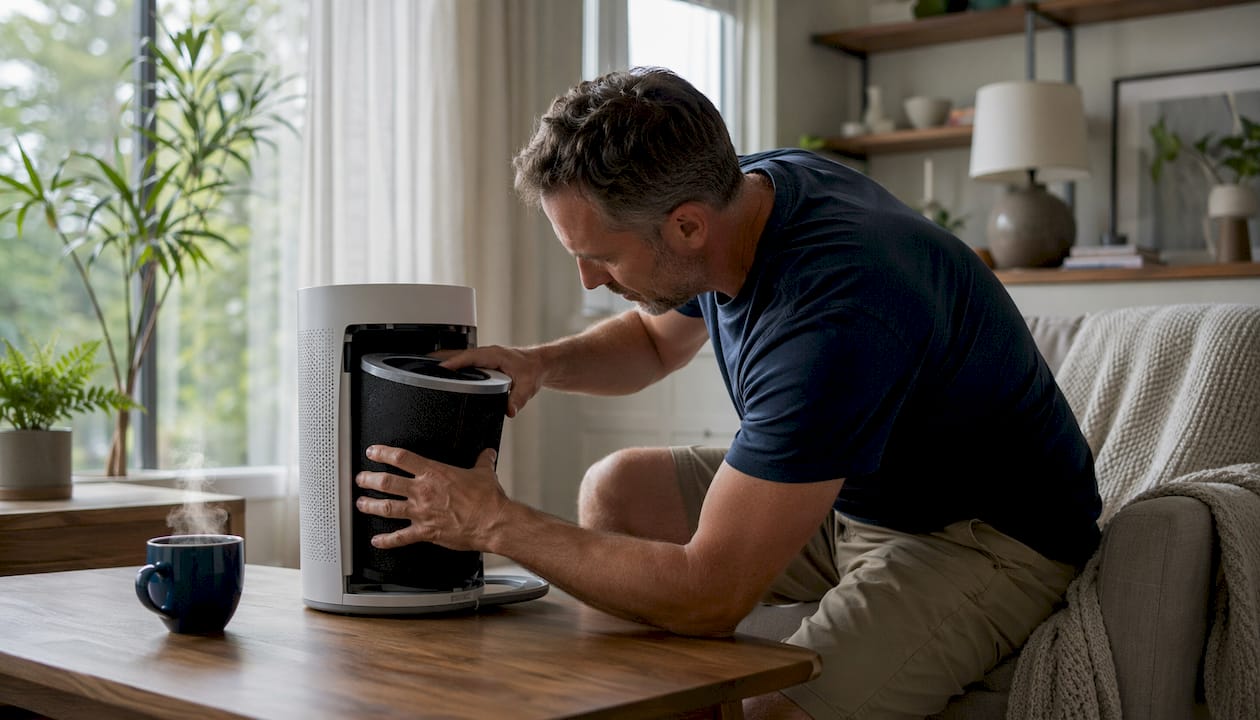
An activated carbon filter is a highly porous carbon material that traps chemicals, gases, and odours through a process called adsorption. You’ll find it inside drinking water systems, air purifiers, shower filters, and industrial treatment units across Australia. The term “activated charcoal” refers to the same material — both names describe carbon that has been processed to create an enormous internal surface area, making it far more effective than ordinary carbon at capturing contaminants.
The activation process is what sets these filters apart from standard carbon. Raw materials such as coconut shell, coal, wood, or nutshells are subjected to steam and high temperatures without oxygen, which opens up millions of tiny pores throughout the carbon structure. According to the Australian drinking water guidelines, activated carbon can reach a surface area of 1,000 m² per gram, roughly equivalent to several football fields packed into a single gram of material. That surface area is what does the work.
Activated carbon filters target a specific range of contaminants:
- Chlorine and chloramines — common in treated municipal water supplies
- Volatile organic compounds (VOCs) — including benzene, trichloroethylene, and formaldehyde
- Odours — hydrogen sulfide, cooking smells, smoke
- Some pesticides and herbicides — such as atrazine
- Trihalomethanes — disinfection byproducts found in chlorinated water
- Radon gas — particularly relevant for granular activated carbon (GAC) systems
What activated carbon filters do not remove is just as important to understand. They do not remove bacteria, nitrates, fluoride, or most dissolved minerals. They come in two main physical forms: granular activated carbon (GAC), which consists of loose carbon granules, and carbon block filters, which are compressed into a solid form. Each has distinct performance characteristics covered further below.
How does activated carbon filtration actually work?
The mechanism is adsorption, not absorption. Absorption means a substance soaks into a material the way a sponge takes up water. Adsorption is different: contaminant molecules bind to the surface of the carbon through chemical attraction and physical adhesion. They stick rather than soak.
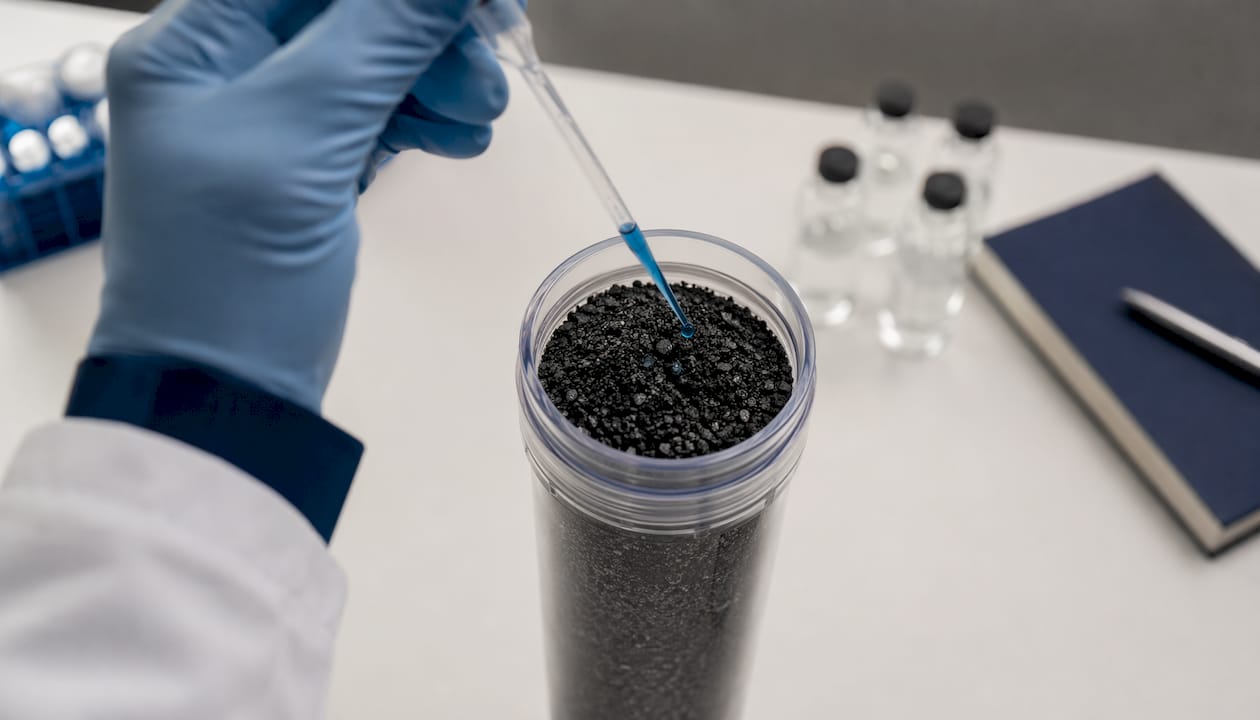
When water or air passes through an activated carbon filter, contaminants that are chemically drawn to carbon surfaces — particularly organic molecules that tend to avoid water — attach to the pore walls and stay there. The activation process dramatically expands this pore structure, multiplying adsorption capacity many times over compared to non-activated carbon. Contact time matters enormously here. If water flows too fast through a GAC filter, molecules pass through before they can bind, and filtration efficiency drops regardless of how large the surface area is.
There is a risk that most filter guides gloss over: adsorption is reversible. Under high humidity, elevated temperature, or once the carbon pores are fully saturated, trapped pollutants can desorb and re-enter the water or air stream. A filter that has reached the end of its life does not simply stop working — it can actively release contaminants back into the environment you were trying to clean.
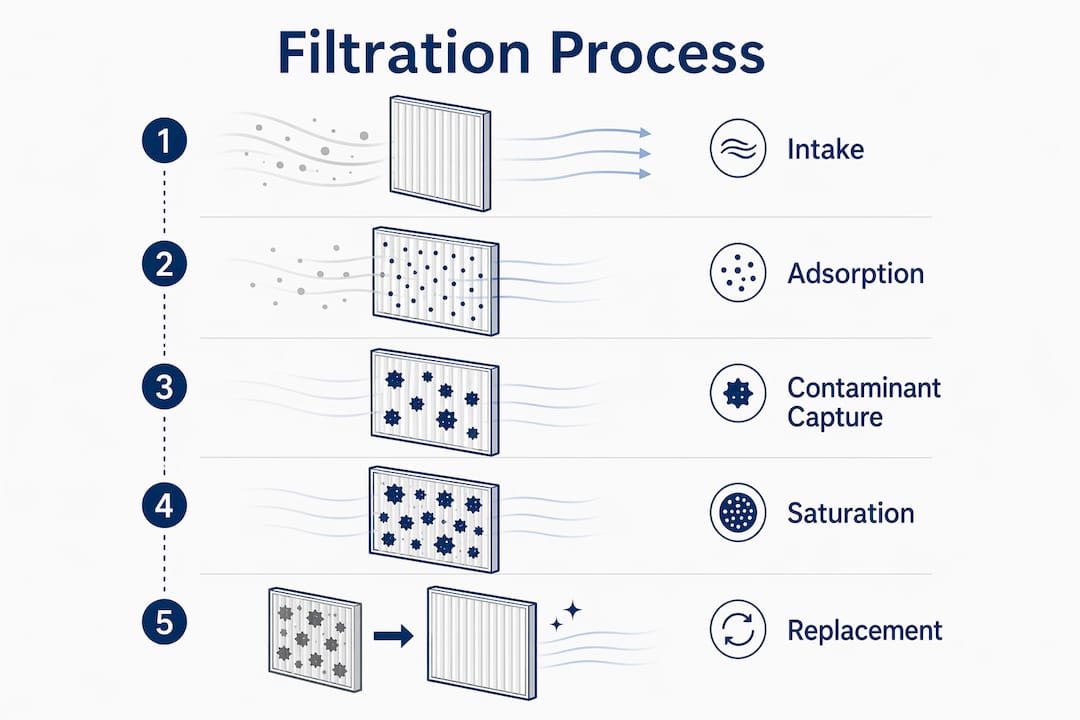
Pro Tip: Set a calendar reminder for filter replacement rather than waiting until you notice a change in taste or smell. By the time odour returns, the carbon is already saturated and desorption may have begun.
Solid carbon block filters perform differently from granular ones in this regard. Because the media is compressed, water is forced into closer, longer contact with the carbon surface, which improves adsorption of smaller molecules. GAC filters allow water to channel around granules, which can reduce contact time. The trade-off is flow rate: block filters are slower but more thorough.
Where are activated carbon filters used in Australia?
Australia’s environmental conditions create specific filtration demands that make activated carbon particularly relevant. Bushfire smoke seasons push fine particles and VOCs into homes across the country, while urban water supplies carry chlorine residuals that affect taste and health. Air purifiers with activated carbon filters have become a practical response to both problems.
Water purification applications:
- Under-sink and bench-top drinking water filters — the most common residential use, targeting chlorine, taste, and organic chemicals
- Whole-house point-of-entry (POE) systems — treat all water entering the home, useful where private bore water carries organic contamination
- Shower filters — reduce chlorine absorbed through skin and inhaled as steam
- Refrigerator and pitcher filters — typically use small GAC cartridges for taste improvement
Air purification applications:
- Standalone air purifiers — activated carbon layers capture VOCs, smoke compounds, and odours that HEPA filters cannot trap (HEPA targets particles; carbon targets gases)
- HVAC carbon pre-filters — protect the main filter and reduce household odours
- Bushfire smoke response — carbon layers in air purifiers for smoke adsorb the chemical compounds that give smoke its characteristic smell and irritant properties
Industrial and specialist uses:
- Aquaculture water treatment, where ammonia and organic waste must be controlled
- Food and beverage processing for taste and odour control
- EPA Victoria lists carbon filtration for odour control as an accepted method for managing industrial emissions
In most residential settings, activated carbon works alongside other technologies rather than alone. Pairing it with a HEPA filter covers both gaseous pollutants and fine particles. Combining it with reverse osmosis addresses the heavy metals and dissolved minerals that carbon cannot touch.
What are the different types of activated carbon filters?
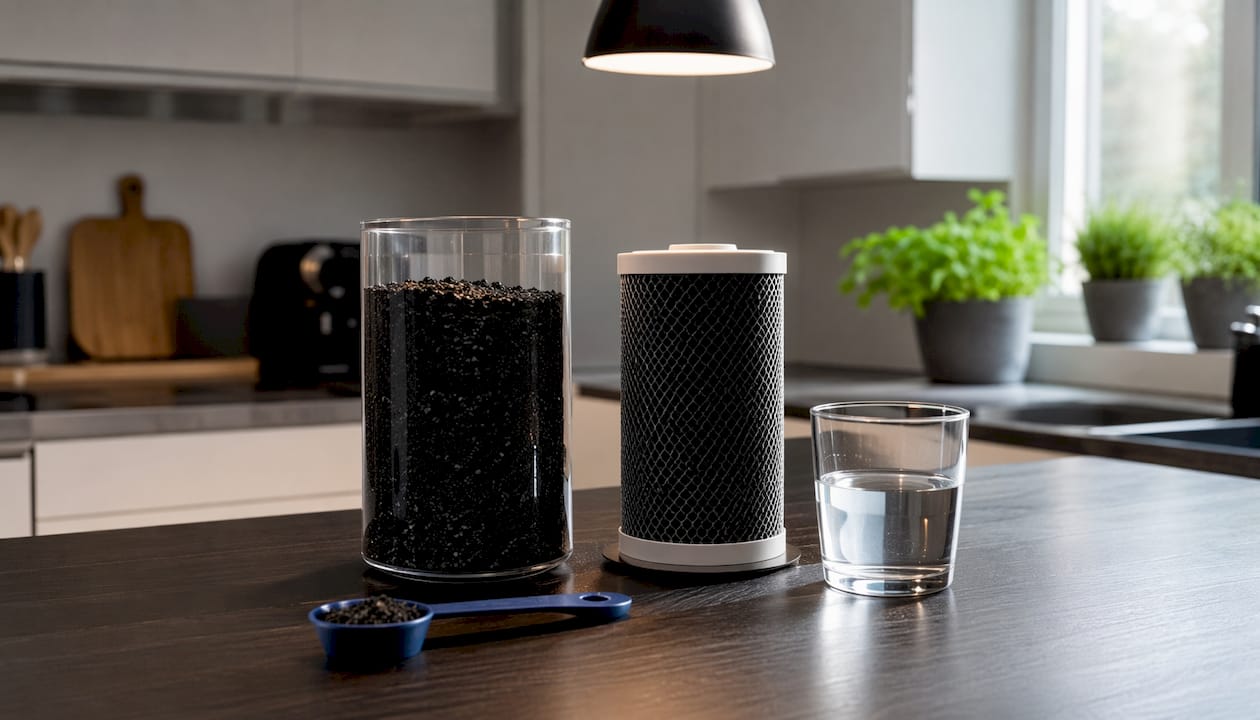
The two main types are granular activated carbon (GAC) and solid block activated carbon (SBAC). The differences between them go well beyond shape.
| Feature | Granular activated carbon (GAC) | Solid block activated carbon (SBAC) |
|---|---|---|
| Media form | Loose granules | Compressed block |
| Flow rate | Higher | Lower |
| Contact time | Shorter | Longer |
| Cyst removal | No | Yes (Giardia, Cryptosporidium) |
| Channelling risk | Yes | Minimal |
| Typical use | Municipal water, air scrubbers, whole-house pre-filters | Under-sink drinking water, residential point-of-use |
GAC filters suit high-flow applications where throughput matters more than absolute purity, such as municipal pre-treatment or whole-house sediment and taste improvement. SBAC filters are the better choice when you want the most thorough contaminant removal from drinking water, including physical filtration of parasitic cysts.
The source material also shapes performance:
- Coconut shell carbon — produces a harder, denser carbon with fine micropores, well suited to removing chlorine and VOCs from water
- Coal-based carbon — common in air filtration; broader pore distribution handles larger organic molecules
- Wood-based carbon — softer, higher surface area, often used in food and pharmaceutical applications
Pro Tip: For drinking water, look for a solid block filter made from coconut shell carbon. It combines the longest contact time with the finest pore structure, giving you the best performance against chlorine, VOCs, and cysts in one cartridge.
Powdered activated carbon (PAC) is a third form used in industrial batch treatment rather than household filters. It is added directly to water, allowed to adsorb contaminants, and then removed by sedimentation or filtration. You will not encounter PAC in a residential cartridge.
What are the benefits and limitations of activated carbon filtration?
Advantages:
- Removes chlorine, chloramines, and the taste and odour problems they cause
- Highly effective against VOCs, many pesticides, and organic chemicals
- Physically removes cysts (block filters only)
- Low maintenance compared to chemical treatment systems
- No chemicals added to the water supply
- Works at room temperature and pressure without electricity (for water filters)
Limitations:
- Does not remove bacteria, viruses, nitrates, fluoride, or most heavy metals
- Cannot remove dissolved minerals or hardness
- Saturation is irreversible — a spent filter cannot be regenerated at home
- Desorption risk if the filter is used past its service life
- Microbial growth can occur inside a moist, stagnant filter
The surface area figure puts the capacity in perspective. The NHMRC notes a surface area between 1,000 and 3,000 m² per gram for granular activated carbon, which sounds extraordinary until you realise that every gram of that surface eventually fills up. A filter handling high-chlorine municipal water will saturate faster than one treating lightly contaminated bore water.
Activated carbon filtration is not a standalone purification method for water with microbiological risk. The University of Nebraska’s drinking water guidance is clear that regular cartridge replacement is critical to prevent bacterial contamination of the filter itself. Stagnant moisture inside a carbon filter creates conditions where bacteria can colonise the media, turning a safety device into a contamination source.
How to choose the right activated carbon filter in Australia
Certification is the single most reliable guide when selecting a filter. The NSF International and the Water Quality Association (WQA) independently test and certify filters against specific contaminant removal claims. A filter certified to NSF/ANSI Standard 42 covers aesthetic improvements like taste and odour. Standard 53 covers health-related contaminants including VOCs and cysts. If a filter carries neither certification, its marketing claims are unverified.
Bacterial growth risk in uncertified or poorly maintained filters is a genuine concern, not a theoretical one. Certified filters are tested for this, which is why the certification matters beyond just contaminant removal performance.
Australian-specific considerations worth factoring in:
- Water source variability — bore water and tank water often carry different organic loads than metropolitan supplies; a filter selected for Sydney tap water may underperform on rural bore water
- Bushfire smoke seasons — air purifiers with activated carbon layers address the chemical compounds in smoke that HEPA alone misses; medical-grade air filtration designed for local conditions handles both particles and gases
- Chloramine vs chlorine — some Australian water utilities use chloramine rather than chlorine; not all carbon filters remove chloramine as effectively, so check the certification scope
Pro Tip: Before buying any water filter, get a basic water quality test for your supply. The results tell you which contaminants are actually present, so you can match the filter’s certified removal claims to your real needs rather than guessing.
Combining technologies gives the most complete protection. For water, pairing activated carbon with reverse osmosis covers heavy metals and dissolved solids. For air, pairing carbon with a HEPA filter addresses both gaseous pollutants and fine particles down to 0.3 microns. Pureair-au’s range of air purifiers for Australian homes includes units that combine both filtration layers, verified to AHAM standards for the local market.
How long do activated carbon filters last, and what maintenance do they need?
Filter lifespan depends on three variables: the volume of water or air processed, the concentration of contaminants in that water or air, and the physical size of the carbon bed. A small under-sink cartridge in a household with high-chlorine water will exhaust faster than the same cartridge in a home with lightly treated tank water.
General replacement guidelines for residential use:
- Under-sink and bench-top water filters — typically every 6–12 months, or per the manufacturer’s stated litre capacity
- Air purifier carbon filters — typically every 3–6 months, more frequently during bushfire season when VOC and smoke loads are high
- Whole-house carbon pre-filters — often every 6–12 months depending on water quality and flow volume
The filter replacement schedule should be treated as a hard deadline, not a suggestion. Once carbon pores are saturated, the filter provides no further adsorption. Worse, as noted earlier, desorption can occur, releasing previously trapped contaminants. There is no visual indicator for saturation in most residential filters — the water or air can look and smell fine while the carbon is already spent.
For water filters, flushing the cartridge with clean water before first use removes carbon fines and activates the media. Avoid leaving water stagnant in the filter for extended periods; if a system is unused for more than a few days, flush it thoroughly before drinking. For air purifiers, maintaining the carbon filter alongside the HEPA layer keeps both components working at rated capacity. Replacing only one and not the other defeats the purpose of a multi-stage system.
As part of broader preventive home maintenance, scheduling filter checks at the same time as other routine household tasks — smoke alarm testing, for example — makes it easier to stay on top of replacement cycles without relying on memory alone.
What happens to used activated carbon filters?
Used activated carbon filters are not straightforward to dispose of, and most Australian households simply bin them. That is generally acceptable for small residential cartridges, but it is worth understanding what you are discarding.
Spent carbon contains concentrated organic compounds, chlorine byproducts, and whatever else it adsorbed during its service life. In landfill, these compounds can leach into soil and groundwater over time, though the quantities from a single household cartridge are small. The plastic housing of most cartridges is the larger environmental concern, as it is rarely recyclable through standard kerbside collection.
Some options worth considering:
- Industrial regeneration — large-scale activated carbon used in municipal and industrial systems is often regenerated by heating to high temperatures, which burns off adsorbed contaminants and restores surface area. This is not available for residential cartridges.
- Carbon as soil amendment — spent carbon that has not adsorbed hazardous chemicals can be added to garden soil, where it improves drainage and provides a substrate for soil microbes. This applies only to filters used for taste and odour improvement, not those treating water with known chemical contamination.
- Manufacturer take-back programmes — a small number of filter manufacturers offer return programmes; check with your supplier before disposing.
The environmental footprint of activated carbon filtration is generally lower than bottled water alternatives, both in terms of plastic waste and transport emissions. Coconut shell carbon, the most common source material for residential filters, comes from a renewable agricultural byproduct. Coal-based carbon has a higher extraction footprint but is still widely used in air filtration applications where coconut shell carbon’s finer pore structure is less suited to the larger organic molecules found in air pollutants.
Pureair-au: activated carbon filtration for Australian homes
Australian homes face air quality challenges that most generic filtration products are not designed for. Bushfire smoke, high pollen seasons, and variable water quality across states and territories mean that a filter certified for one set of conditions may underperform in another. Pureair-au specialises in medical-grade air quality solutions built around these local realities, with AHAM-verified air purifiers that combine activated carbon and HEPA filtration in a single unit.
The Pureair-au air purifier catalogue includes units suited to different room sizes and contamination profiles, from compact bedroom purifiers to whole-room systems capable of handling bushfire smoke events. Every product is selected for Australian conditions, not adapted from overseas markets.
Key takeaways
Activated carbon filters work through adsorption, trapping chemicals and gases on a porous surface with a very large surface area per gram, but they must be replaced on schedule to prevent contaminant release.
| Point | Details |
|---|---|
| Adsorption, not absorption | Contaminants bind to carbon surfaces chemically; the process reverses if the filter saturates or conditions change. |
| Surface area drives capacity | Activated carbon reaches 1,000 to 3,000 m² per gram, enabling high-volume contaminant capture before saturation. |
| Two main filter types | GAC suits high-flow applications; solid block carbon offers longer contact time and removes cysts like Giardia. |
| Clear limitations | Carbon filters do not remove bacteria, nitrates, fluoride, or heavy metals; combine with HEPA or reverse osmosis for full coverage. |
| Certification matters | NSF and WQA certification verifies removal claims and reduces microbial risk from poorly maintained filters. |
Recommended
- Buy Levoit Vital 200S Toxin Absorber Carbon Filter in Australia | Best Price $49.00 | Pure & Co
- Buy Levoit Vital 100S Toxin Absorber Carbon Filter in Australia | Best Price $39.00 | Pure & Co
- Buy Philips Active Carbon Filter 1000i/2000i (FY1413/30) in Australia | Best Price $39.00 | Pure & Co
- Buy Blueair Pro Series Carbon Filter Add-on in Australia | Best Price $108.00 | Pure & Co