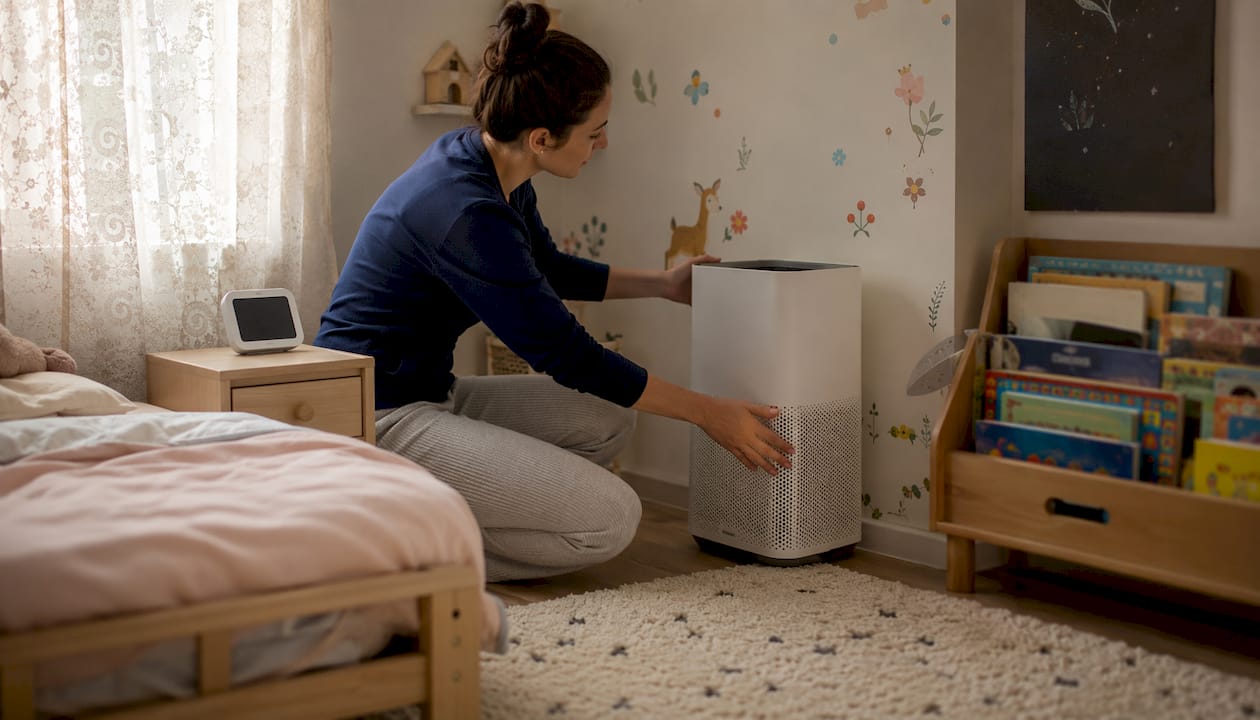
A toddler’s bedroom is safest when you combine proper ventilation, source control, and a true HEPA purifier sized for the room. Start tonight: open a trickle vent or leave the door slightly ajar, run a child-safe HEPA purifier on its lowest night mode, and remove any scented products or heavily fragranced laundry from the room.
Three things to do right now:
- Ventilate passively. Leave the bedroom door slightly ajar to reduce overnight CO2 build-up without exposing your child to hallway noise or draughts.
- Run a HEPA purifier. If you have one, set it to low or night mode and let it run continuously. If you don’t, a hygrometer and CO2 monitor will tell you what you’re dealing with before you buy.
- Remove scent sources. Plug-in air fresheners, scented candles, and fragranced fabric softener all release volatile organic compounds (VOCs) into the air your toddler breathes for 10–12 hours straight.
Pureair-au’s AHAM-verified range is built specifically for Australian conditions, including bushfire smoke and high-pollen seasons, and their Smart Finder matches a unit to your room size and specific concerns in under two minutes.
Table of Contents
- Why toddler bedrooms need special air-quality attention
- ## How air purifiers help and what to look for in a toddler’s room
- When to open windows and when to keep them shut
- Ideal humidity and temperature: what the numbers mean
- Cleaning routines and source control that actually make a difference
- Where to place your purifier and sensors, and how to run them
- What does it cost? Purchase and running costs for Australian parents
- What to avoid and the myths worth correcting
- How Pureair-au approaches toddler bedroom air quality
- Key takeaways
- Pureair-au helps you get this right from the start
Why toddler bedrooms need special air-quality attention
Toddlers breathe roughly twice as much air per kilogram of body weight as adults, and they spend the bulk of their day in one room. A closed bedroom overnight is a slow accumulation problem: CO2 rises, humidity shifts, and any VOCs off-gassing from mattresses, carpets, or soft toys have nowhere to go.
CO2 above roughly 1,000 ppm is linked to poorer sleep quality and measurable cognitive effects the following day. A standard bedroom closed from 7 PM can reach that level well before midnight.
That matters more for toddlers than for adults because their neurological development is still in progress. Restless sleep, frequent waking, and morning grogginess in a young child are sometimes blamed on teething or routine, when the air in the room is the actual culprit.
Common pollutant sources in a toddler bedroom include:
- Mattresses and bedding — new foam mattresses off-gas TVOCs for weeks; synthetic bedding compounds the problem
- Soft toys and carpets — dust mite reservoirs that release allergens with every movement
- Scented products — nappy disposal units with fragrance, plug-in fresheners, and scented wipes
- Poor ventilation — a sealed room traps CO2, humidity, and whatever particles are already present
Understanding indoor air pollutants in your home is the first step toward fixing them.
## How air purifiers help and what to look for in a toddler’s room
HEPA filtration captures 99.97% of airborne particles at 0.3 microns — that covers dust mite allergens, pollen, mould spores, pet dander, and fine particles from bushfire smoke. For gases and VOCs, you need an activated carbon layer alongside the HEPA filter. A purifier with only a HEPA stage handles particles well but leaves VOCs largely untouched.
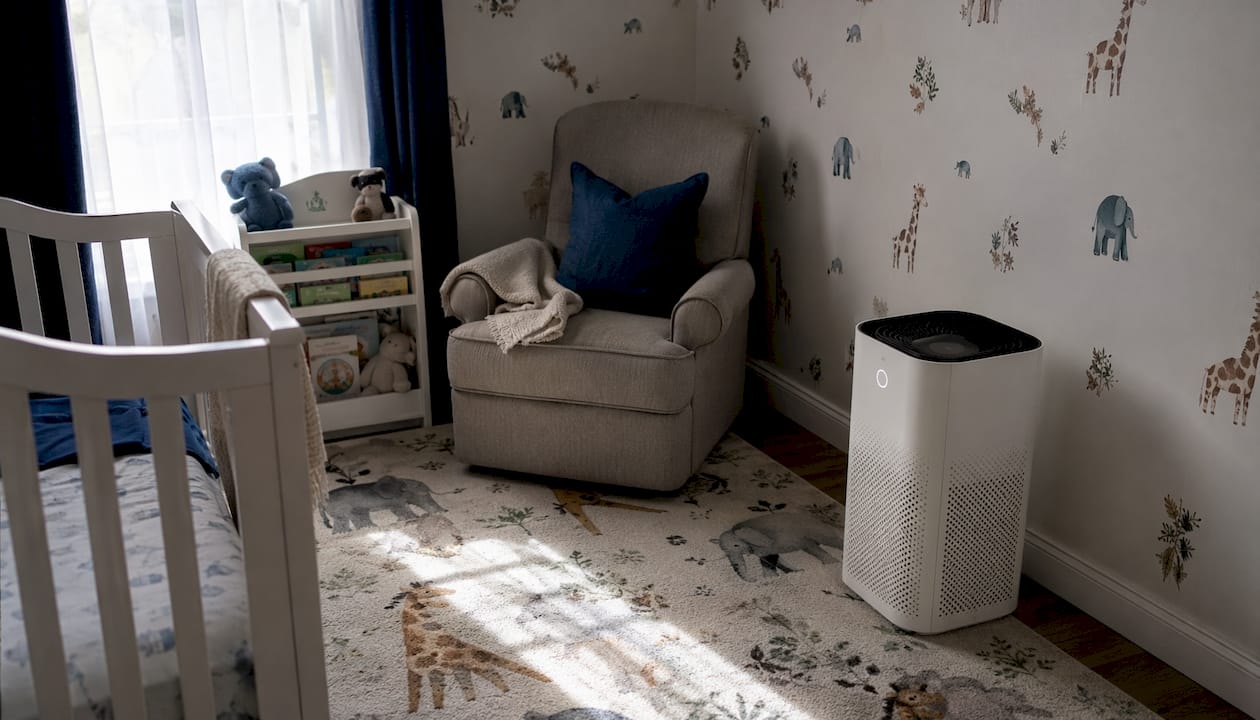
HEPA purifiers are safe for babies and toddlers when used correctly. The same source is clear that ozone-generating devices are not.
What to look for when choosing a unit:
- True HEPA filter (not “HEPA-style” or “HEPA-like”) combined with an activated carbon stage
- AHAM-verified CADR — the Clean Air Delivery Rate should equal at least two-thirds of the room’s floor area in square feet, or use the manufacturer’s stated room-size coverage as a guide
- Low noise or night mode — toddlers are light sleepers; a unit that runs quietly at 25–35 dB on its lowest setting won’t disturb them
- Child-safe design — no accessible vents at toddler height, cord management, and a stable base
- Filter replacement indicator — a light or app alert that tells you when the filter is spent, not just a calendar reminder
Pro Tip: Run the purifier continuously on its lowest speed rather than cycling it on and off. A slow, steady clean is more effective than short bursts at high speed, and it uses less electricity over a 10-hour night.
Avoid any unit marketed as an ioniser or ozone generator. Public health guidance is consistent: do not use air cleaners that produce ozone or use ionisation and plasma technology in spaces where children sleep.
When to open windows and when to keep them shut
The decision to ventilate with outdoor air comes down to one question: what’s the AQI outside right now? Check the Australian air quality index before opening windows, particularly during summer and autumn when bushfire smoke can push fine particle (PM2.5) levels into the unhealthy range with little warning.
The rule is simple: open windows when outdoor air quality is in the Good or Low category; keep them closed and rely on filtration when it’s Moderate or worse.
Practical ventilation steps:
- Morning airing — open windows for 10–15 minutes after the child is up and before making the bed; this flushes overnight CO2 and humidity before the room is sealed again
- Door ajar overnight — leaving the bedroom door open 3–5 cm increases the room’s effective air volume and reduces CO2 accumulation more reliably than a cracked window in still conditions
- Bushfire or high-pollen days — keep windows closed, run the purifier, and check the AQI at AirNow or the Australian state environment agency for your area
For ground-floor rooms, security is a real consideration. A door ajar is often safer than a window cracked open at night, and it does the same job for CO2 management.
During fires, keep windows and doors closed and run a HEPA purifier continuously. This is the single most protective step for toddlers during smoke events.
Ideal humidity and temperature: what the numbers mean
Humidity is the variable most parents overlook until something goes wrong. Below 40% relative humidity, nasal passages dry out and mucous membranes become more vulnerable to irritants. Above 60%, you’re creating conditions where dust mites thrive and mould can establish itself on walls and soft furnishings.
Maintain bedroom humidity between 40–60% and use a hygrometer to monitor it in real time. Place the hygrometer at roughly the same height as your toddler’s breathing zone — on a shelf or dresser, not on the floor.
For sleep temperature, 18–22°C is the commonly cited guidance for young children. Combine that with the humidity target and you have a clear pair of numbers to aim for.
| Measure | Target range | Device to use |
|---|---|---|
| Relative humidity | 40–60% | Hygrometer |
| Room temperature | 18–22°C | Thermometer or combo unit |
| CO2 concentration | Below 1,000 ppm | CO2 monitor |
Managing humidity in practice:
- Too dry (below 40%): A cool-mist or ultrasonic humidifier adds moisture without heating the room. Clean the water tank every 2–3 days to prevent mould and bacterial growth inside the unit.
- Too humid (above 60%): A compact dehumidifier draws excess moisture out; particularly useful in coastal or subtropical Australian climates.
Pro Tip: A combined hygrometer and thermometer costs under $30 at most hardware stores. Put one in the bedroom before you buy any other device — it tells you whether you need a humidifier, a dehumidifier, or neither.
Cleaning routines and source control that actually make a difference
The purifier handles what’s already airborne. Source control stops pollutants entering the air in the first place, and it’s the part of the equation most parents underinvest in.
HealthyChildren.org recommends HEPA-capable vacuuming, avoiding indoor smoking, and ventilating when outdoor air is safe — all three are relevant to a toddler’s room.
Weekly routine checklist:
- Wash all bedding at 60°C to kill dust mites (hot wash, not warm)
- Vacuum carpets and soft furnishings with a HEPA-filter vacuum; do this when the child is out of the room and let the air settle for 30 minutes before they return
- Wet-dust hard surfaces rather than dry-dusting, which just redistributes particles
- Limit stuffed toys on the bed to one or two; store the rest in a closed box or wash them regularly
- Check the indoor air quality checklist for a full room-by-room routine
Source control priorities:
- Remove plug-in air fresheners, scented candles, and fragranced room sprays. Scented products release VOCs that irritate young lungs even at low concentrations.
- Choose low-VOC paint for any repainting; let a freshly painted room air out for at least 72 hours before a child sleeps in it
- New mattresses and furniture off-gas significantly. Wash new bedding before first use and consider a certified low-VOC or OEKO-TEX encasement for the mattress to reduce overnight TVOC exposure in the breathing zone
- Store all cleaning products in a locked cupboard outside the bedroom; never leave spray bottles or surface cleaners in a toddler’s reach
- For pest control, use physical barriers (door seals, fly screens) rather than chemical sprays inside the bedroom. If a spray treatment is necessary, ventilate the room thoroughly and keep the child out for the period specified on the product label
- Houseplants can contribute marginally to air quality, but the effect is small in a real bedroom. A spider plant or peace lily won’t hurt, but don’t rely on them as a filtration strategy
Where to place your purifier and sensors, and how to run them
Placement determines whether a purifier actually cleans the air your toddler breathes or just recirculates air near the wall. Position the unit centrally in the room, or as close to the centre as practical, with at least 30 cm of clear space around the air inlet and outlet. Keep it away from curtains, bedding, and anywhere a toddler can reach the controls or tip it over.
The door-ajar approach works well alongside a purifier: the purifier handles particles and VOCs, while the gap under or around the door prevents CO2 from spiking overnight.
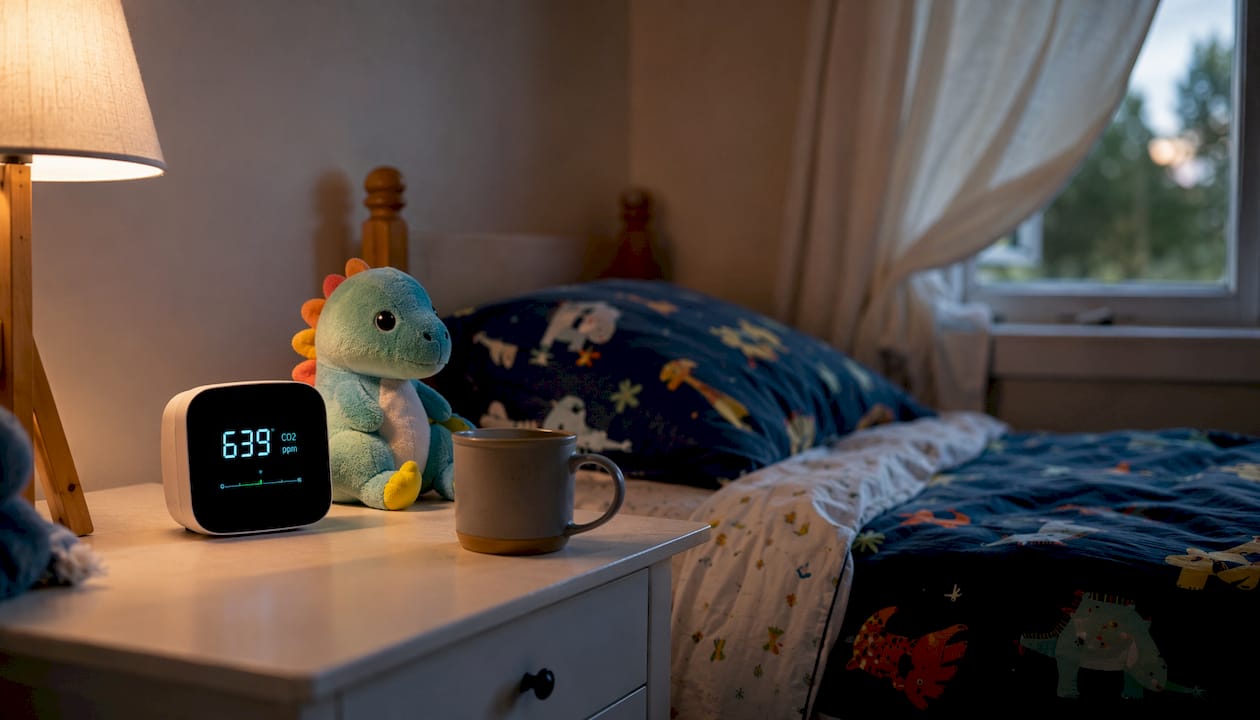
Pro Tip: Place a CO2 monitor on the bedside table or shelf for one week before making any changes. The readings will show you exactly when CO2 rises and by how much — and whether leaving the door ajar actually fixes it. Most parents are surprised how quickly levels climb after 9 PM.
A CO2 monitor reading above 1,000 ppm is the signal to act: open the door wider, improve ventilation, or both. Readings consistently above 1,500 ppm suggest the room needs a structural ventilation solution, not just a purifier.
For safe purifier placement in a nursery or toddler room, check the cord routing carefully — cords trailing across the floor are a trip hazard and a toddler’s first target.
What does it cost? Purchase and running costs for Australian parents
Budget honestly for both the upfront purchase and the ongoing filter costs, because a purifier with cheap filters replaced rarely is less effective than a mid-range unit maintained properly.
-
Entry-level bedroom purifiers ($100–$200 AUD): Suitable for rooms up to roughly 15–20 m². Filters typically need replacing every 6–12 months. Check that the unit carries a genuine HEPA filter, not a washable mesh marketed as HEPA.
-
Mid-range units ($200–$400 AUD): Cover 20–40 m², include activated carbon stages, and usually offer app connectivity and filter indicators. This is the sweet spot for most Australian toddler bedrooms.
-
Premium units ($400–$600+ AUD): Larger CADR ratings, quieter motors, and longer filter life. Worth considering if the room is large or if bushfire smoke is a recurring seasonal concern.
-
Filter replacement costs: HEPA filters for bedroom-sized units typically run $50–$90 AUD per replacement, with carbon pre-filters often cheaper. Most manufacturers recommend replacement every 6–12 months depending on use and local air quality. Replacement filters are available directly through Pureair-au.
-
Running costs: A bedroom-sized purifier on its lowest overnight setting typically draws 8–20 watts. At average Australian electricity rates, that’s a modest addition to the power bill — well under $50 AUD per year for continuous overnight use.
-
Humidifiers and dehumidifiers ($80–$300 AUD): Entry-level cool-mist humidifiers start around $80–$120; compact dehumidifiers suitable for a single bedroom sit in the $150–$300 range. Factor in the cost of distilled or filtered water for ultrasonic humidifiers if your tap water is hard.
What to avoid and the myths worth correcting
Ozone generators and ionisers. These are the single biggest mistake parents make when buying an air cleaner. Ozone is a lung irritant at concentrations that are easy to reach in a small bedroom, and toddlers are far more susceptible than adults. Physical-filter purifiers are the safe choice; ozone-generating devices are not.
Myth: houseplants will clean your toddler’s bedroom air. Plants do absorb some VOCs, but the quantities involved in a real bedroom are negligible compared to what a HEPA purifier processes in an hour. Plants are fine to have; they’re not a filtration strategy.
Myth: opening a window always fixes poor indoor air. On a calm night with no breeze, a cracked window does almost nothing for CO2 levels. A door ajar is more effective in still conditions. And during bushfire smoke or high-pollen periods, an open window actively makes things worse.
Essential oils and diffusers. Aromatherapy diffusers release fine particles and VOCs into the air. Even “natural” essential oils can irritate developing airways. Keep diffusers out of toddler bedrooms entirely and use unscented alternatives for everything from nappy cream to laundry detergent.
How Pureair-au approaches toddler bedroom air quality
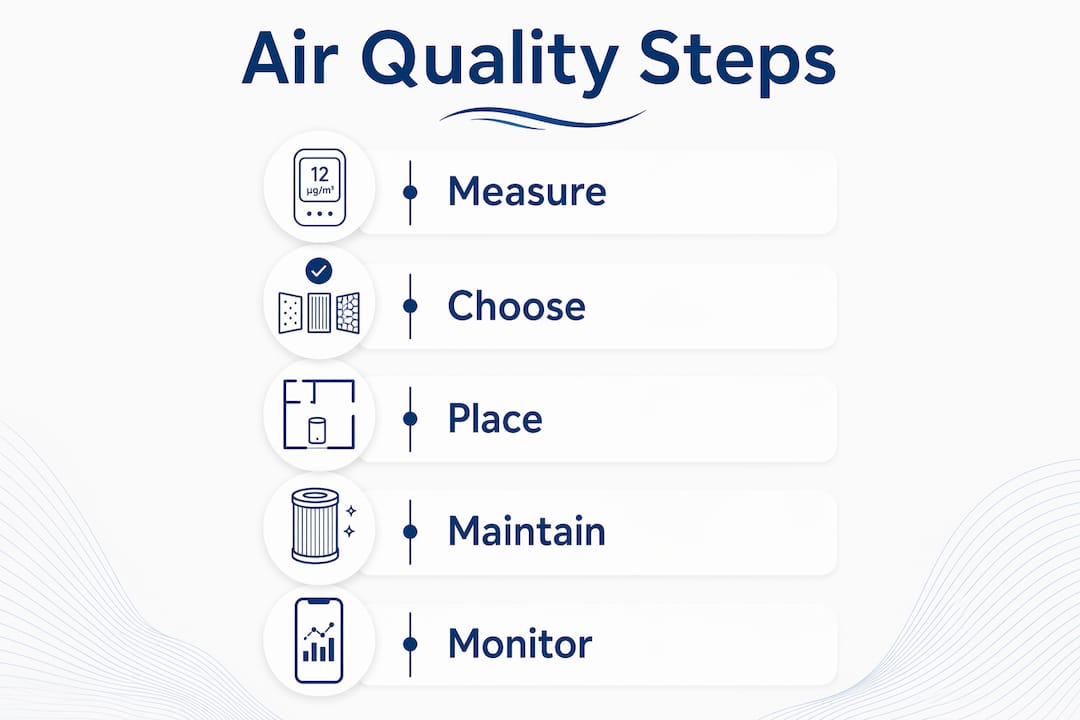
The practical workflow Pureair-au recommends for parents comes down to three steps: measure first, then choose the right unit, then run and maintain it properly.
Step 1 — Measure. A hygrometer and a CO2 monitor give you the baseline. You can’t fix what you haven’t measured, and the readings often reveal that humidity or CO2 is the primary problem, not particles.
Step 2 — Choose with the Smart Finder. Pureair-au’s Smart Finder asks about room size, specific concerns (bushfire smoke, pollen, mould, pet dander), and sleep noise sensitivity, then matches you to an AHAM-verified unit with the right CADR for the space.
Step 3 — Run and maintain. Set the purifier to continuous low or night mode. Replace filters on schedule. Check the hygrometer weekly.
Product features Pureair-au prioritises for toddler rooms:
- True HEPA filtration (99.97% capture at 0.3 microns)
- AHAM-verified CADR matched to the room’s floor area
- Activated carbon stage for VOC and odour removal
- Low-noise night mode (25–35 dB range)
- Child-safe design: stable base, no accessible vents at toddler height, cord management
- Filter replacement indicator so maintenance doesn’t get forgotten
All products in the Pureair-au range are AHAM verified, which means the CADR figures on the box are independently tested, not marketing estimates. For Australian families dealing with seasonal bushfire smoke or coastal humidity, that verification matters.
Key takeaways
A toddler’s bedroom air is safest when ventilation, humidity control, and true HEPA filtration work together — no single device replaces the combination.
| Point | Details |
|---|---|
| Ventilate passively every night | Leave the bedroom door slightly ajar to prevent CO2 rising above typical safe levels overnight. |
| Keep humidity at 40–60% | Use a hygrometer to monitor; add a humidifier or dehumidifier as needed to stay in range. |
| Choose a true HEPA purifier | Select an AHAM-verified unit with activated carbon; run it continuously on night mode. |
| Remove scent sources first | Plug-in fresheners, scented candles, and fragranced laundry products all release VOCs into a sealed bedroom. |
| Use Pureair-au’s Smart Finder | Match a verified unit to your room size and specific risks (smoke, pollen, mould) before buying. |
The one change most parents overlook
Most parents who come to Pureair-au have already bought a purifier. The unit is running, the filters are fresh, and the child is still waking at 2 AM. Nine times out of ten, the bedroom door is fully closed.
CO2 is the invisible variable. A sealed room with a toddler in it will cross 1,000 ppm well before midnight, and no purifier on the market removes CO2. The fix costs nothing: leave the door ajar. Add a CO2 monitor and you’ll see the difference within the first night.
Australian conditions add a layer of complexity that generic advice doesn’t account for. During bushfire season, the instinct to open windows is exactly wrong. Pureair-au’s experience working with Australian families through smoke events and high-pollen springs has shaped every product recommendation on the site, from CADR sizing to the activated carbon specifications that matter when PM2.5 is elevated outside.
The purifier matters. The filter schedule matters. But the single change that most improves a toddler’s sleep is free, and it’s the one most parents haven’t tried yet.
Pureair-au helps you get this right from the start
Getting the right unit for a toddler’s bedroom isn’t about buying the most expensive purifier. It’s about matching verified performance to your room size, your local air quality risks, and your child’s sleep needs. Pureair-au’s Smart Finder tool does exactly that: answer a few questions about room size, specific concerns like bushfire smoke or mould, and noise sensitivity, and it returns a shortlist of AHAM-verified units with the right CADR for the space.
Every product in the Pureair-au range carries AHAM verification, true HEPA filtration, and Australian warranty support. Replacement filters, humidifiers, and dehumidifiers are all available in one place, so you’re not hunting across multiple suppliers when it’s time for maintenance. Browse the full range of air purifiers and humidifiers and use the Smart Finder to find the right fit for your toddler’s room tonight.
Useful sources for Australian parents
- AirNow AQI basics — explains the Air Quality Index scale and what each category means for sensitive groups including children
- HealthyChildren.org — indoor air and children’s health — evidence-based guidance from the American Academy of Pediatrics on reducing indoor air pollution for children
- CHLA — protecting kids during fires — practical steps for keeping children safe indoors during fire smoke events
- US EPA — indoor air quality for child care providers — resources covering ventilation, filtration and pollutant sources in spaces used by young children
- CPSC — The Inside Story: a guide to indoor air quality — covers ventilation, source control and specific pollutant categories in plain language
For real-time Australian air quality and bushfire alerts, check your state environment agency’s AQI monitoring page (for example, NSW EPA’s Air Quality Index or EPA Victoria’s AirWatch). These give current PM2.5 readings for your area, which is the most reliable signal for deciding whether to open windows or keep the room sealed.
A hygrometer and CO2 monitor in the bedroom remain necessary regardless of what outdoor monitoring shows — outdoor readings don’t tell you what’s happening in the room where your child sleeps.