
Poor air quality worsens allergy symptoms by irritating airways and amplifying the immune system’s response to allergens. This is the core mechanism behind why allergy sufferers feel worse on high-pollution days, during bushfire smoke events, or in poorly ventilated homes. A 2026 clinical study found a strong positive correlation (r=0.62) between pollutant levels and allergy symptom severity, with combined pollution and allergen exposure significantly increasing disease severity (p<0.001). That finding confirms what many Australian allergy sufferers already suspect. Understanding why air quality worsens allergy symptoms is the first step toward doing something about it.
Why does poor air quality worsen allergy symptoms?
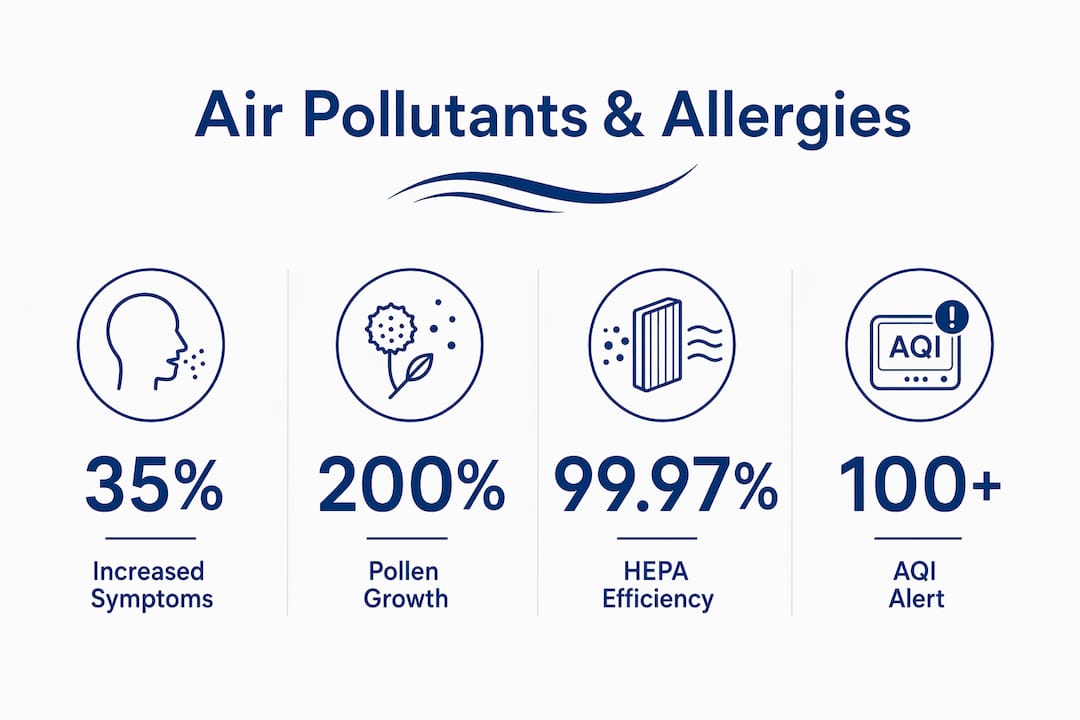
Poor air quality, defined clinically as elevated concentrations of airborne pollutants such as PM2.5, ozone, and particulate matter from smoke, directly inflames the airways and primes the immune system to overreact to allergens. The Air Quality Index (AQI) provides a practical threshold: allergy symptoms begin at the “Moderate” range (AQI 51–100) and worsen significantly at the “Unhealthy for Sensitive Groups” range (AQI 101–150). That means even days that appear “acceptable” on an AQI app can trigger real symptoms in sensitive people.

The mechanism is not simply additive. Heat, pollen, and air pollution interact synergistically, meaning combined exposures produce a far worse immune response than any single trigger alone. Think of it like a volume dial. Pollen alone might sit at a 4 out of 10 for your immune system. Add PM2.5 from traffic or bushfire smoke, and that same pollen now registers as an 8. The airways become inflamed, histamine release increases, and symptoms escalate from mild sneezing to chest tightness and wheezing.
Atmospheric CO2 compounds the problem over time. Rising CO2 levels may boost pollen production by approximately 200% by century’s end. Longer, more intense pollen seasons mean allergy sufferers face a growing baseline exposure, even before pollution is factored in.
How pollutants amplify allergic reactions
The three pollutants most relevant to allergy sufferers are PM2.5, ground-level ozone, and smoke particulates. Each affects the airways differently, but all share one outcome: they make allergens more potent and symptoms more severe.
| Pollutant | Primary source | Effect on allergy symptoms |
|---|---|---|
| PM2.5 | Traffic, bushfire smoke, industry | Penetrates deep into lungs, inflames airways, increases allergen uptake |
| Ground-level ozone | Vehicle exhaust reacting with sunlight | Irritates bronchial lining, worsens asthma and rhinitis |
| Smoke particulates | Bushfires, wood heaters | Carries allergens deeper into airways, triggers acute flare-ups |
| Nitrogen dioxide (NO2) | Gas appliances, traffic | Damages airway lining, reduces natural immune defence |
PM2.5 particles are smaller than 2.5 micrometres. They bypass the nose and throat entirely and lodge in the lower airways, where they trigger localised inflammation. That inflammation makes the airway lining more permeable, so allergens like pollen and dust mite proteins absorb more readily into the bloodstream.
Ground-level ozone is particularly problematic on hot, sunny days in Australian cities. It forms when vehicle exhaust reacts with sunlight, peaking in the afternoon. People who exercise outdoors during these hours inhale more ozone per breath, which directly worsens bronchial sensitivity.
Smoke from bushfires carries a complex mix of fine particles and chemical compounds. These particles can physically transport pollen fragments deeper into the lungs than pollen would travel on its own. After rainfall, the problem shifts. High humidity can rupture pollen granules into finer particles, increasing the inhalable allergen load unexpectedly. Many allergy sufferers report worse symptoms after a storm, and this is exactly why.
Pro Tip: Check your local AQI before opening windows on warm days. If the AQI sits above 100, keep windows closed and rely on filtered indoor air instead.
Signs that air quality is worsening your allergies
Recognising the signs that air quality is driving your symptoms is harder than it sounds. Symptoms from poor air quality can appear within minutes and closely mimic allergic rhinitis, including burning eyes, dry cough, and chest tightness. Without tracking patterns, it is easy to blame pollen when pollution is the real trigger.
Key signs that air quality is a factor in your symptom flare-ups:
- Symptoms appear or worsen on high-AQI days, even when pollen counts are low
- Burning or stinging eyes that develop quickly after going outdoors or opening windows
- Dry cough or throat irritation without nasal congestion, which points more to irritant exposure than allergen exposure
- Chest tightness or shortness of breath that eases when you move indoors or into air-conditioned spaces
- Headaches that correlate with smoky or hazy conditions outside
- Symptoms improve significantly indoors, especially in rooms with filtered air
The indoor improvement clue is one of the most useful diagnostic signals. If your sneezing, itchy eyes, or congestion ease noticeably within 20–30 minutes of entering a well-ventilated, filtered indoor space, air quality outdoors is likely a significant driver. Tracking this pattern over a week gives you far more useful information than a single pollen count reading.
Pro Tip: Keep a simple daily log noting your symptom severity, the outdoor AQI, and whether you spent time in filtered indoor air. After two weeks, patterns become obvious.
How indoor air quality affects allergy symptoms
Most allergy management advice focuses on outdoor pollen counts. That focus misses the bigger picture. People spend approximately 90% of their time indoors, which means indoor air quality has a far greater impact on total allergen exposure than outdoor conditions alone.
Australian homes face specific indoor air quality challenges. Common indoor allergen and pollutant sources include:
- Dust mites — thrive in bedding, carpets, and soft furnishings in humid conditions, producing allergen proteins that trigger rhinitis and asthma
- Pet dander — microscopic skin flakes from cats, dogs, and other animals that remain airborne for hours
- Mould spores — grow in bathrooms, kitchens, and wall cavities where moisture accumulates, releasing spores that provoke strong allergic responses
- Volatile organic compounds (VOCs) — released from paints, cleaning products, and synthetic furnishings, irritating airways and compounding allergen sensitivity
- Outdoor pollutant infiltration — fine particles from traffic and bushfire smoke enter through gaps in windows, doors, and ventilation systems
Poor ventilation is the common thread. Without adequate air exchange and filtration, these contaminants accumulate to concentrations far higher than outdoors. A sealed, unfiltered home during a bushfire smoke event can have indoor PM2.5 levels that rival outdoor readings. Understanding your indoor air pollutants is the foundation of effective allergy management.
Humidity control matters too. Dust mites reproduce rapidly above 50% relative humidity. Mould colonies establish themselves above 60%. Keeping indoor humidity in the 40–50% range reduces the viability of both allergen sources without drying out airways.
Effective strategies to reduce allergy symptoms through better air quality
The most effective approach combines mechanical filtration, humidity control, and behavioural changes. No single strategy works in isolation.
Choose the right air purifier
HEPA filtration is the standard for allergy relief. A true HEPA filter captures 99.97% of airborne particles at 0.3 micrometres, which covers dust mite allergens, pet dander, mould spores, and most pollen fragments. Pureair-au’s range of AHAM-verified HEPA air purifiers is specifically selected for Australian conditions, including bushfire smoke events.
Ionising air purifiers generate ozone as a byproduct, which is itself a respiratory irritant. For allergy sufferers, this means ionising units can make symptoms worse rather than better. Non-ionising HEPA-based purifiers are the safer and more effective choice.
| Air cleaning method | Removes allergens | Removes fine particles | Safe for allergy sufferers |
|---|---|---|---|
| True HEPA filter | Yes | Yes | Yes |
| Activated carbon filter | Partial | No | Yes (combined with HEPA) |
| Ionising purifier | Partial | Partial | No (produces ozone) |
| Standard fan/ventilation | No | No | Depends on outdoor AQI |
Control humidity and ventilation
A dehumidifier set to maintain 40–50% relative humidity removes the conditions that dust mites and mould need to thrive. Pureair-au’s dehumidifier and allergen control guide covers how to size and place a unit for maximum effect in Australian homes.
On low-AQI days, cross-ventilation with open windows is effective and free. On high-AQI or smoke days, close windows and run a HEPA purifier instead. This simple switch prevents outdoor pollutants from compounding indoor allergen loads.
Reduce exposure during commutes
Air recirculation mode in vehicles prevents outside polluted air from entering the cabin. Switching to recirculation on high-pollution days or during bushfire smoke events provides meaningful symptom relief during commutes. This is a simple, zero-cost change that most allergy sufferers overlook.
Pro Tip: Place your HEPA purifier in the room where you spend the most time, not necessarily the largest room. Bedroom placement during sleep hours delivers the highest cumulative benefit.
Key takeaways
Poor air quality worsens allergy symptoms by inflaming airways and amplifying immune responses to allergens, making both outdoor pollution control and indoor air management equally critical for relief.
| Point | Details |
|---|---|
| AQI thresholds matter | Symptoms begin at AQI 51–100 and worsen significantly above 101 for sensitive individuals. |
| Pollutants amplify allergens | PM2.5, ozone, and smoke make allergens more potent, not just more numerous. |
| Indoor air is the priority | People spend 90% of their time indoors, so indoor air quality drives most allergen exposure. |
| HEPA filtration is the standard | True HEPA filters capture 99.97% of particles; ionising purifiers can worsen symptoms by producing ozone. |
| Humidity control reduces triggers | Keeping indoor humidity at 40–50% limits dust mite and mould growth significantly. |
What most allergy advice gets wrong about air quality
The standard advice for allergy sufferers is to check the pollen count and take an antihistamine. That advice is incomplete, and in my view, it leaves people managing symptoms rather than addressing causes.
What I have observed consistently is that allergy sufferers who focus exclusively on outdoor pollen counts miss the 90% of their exposure that happens indoors. A high pollen day with clean indoor air is manageable. A moderate pollen day combined with poor indoor air quality, high humidity, and unfiltered bushfire smoke infiltration is genuinely debilitating.
The synergistic effect of combined exposures is also under-communicated. Most people understand that pollen causes hay fever. Far fewer understand that PM2.5 from a nearby road or a wood heater can double the severity of their reaction to the same pollen load. That interaction changes the entire calculus of allergy management.
My practical recommendation is to treat indoor air quality as the primary lever you can actually control. You cannot change the outdoor AQI. You can filter your bedroom air, control your home’s humidity, and choose a HEPA purifier over an ionising unit. Those three changes, applied consistently, produce measurable symptom improvement for most allergy sufferers. The room air quality steps that Pureair-au outlines are a solid starting framework for anyone ready to move beyond symptom management.
— Lucas
Pureair-au’s range for Australian allergy sufferers
Allergy management requires the right equipment matched to your specific environment.
Pureair-au specialises in medical-grade air quality solutions designed for Australian conditions, from bushfire smoke seasons to humid coastal climates. Every product in the Pureair-au catalogue is AHAM verified, meaning performance claims are independently tested rather than self-reported. The range covers HEPA air purifiers, dehumidifiers, and humidifiers, with a Smart Finder tool that matches you to the right unit based on your specific concern, whether that is pollen, mould, pet dander, or smoke. If you are ready to move from symptom management to source control, the catalogue is the right place to start.
FAQ
What AQI level triggers allergy symptoms?
Allergy symptoms can begin at the “Moderate” AQI range of 51–100 and worsen significantly above 101, which falls into the “Unhealthy for Sensitive Groups” category. Checking your local AQI before outdoor activity is a practical daily habit for allergy sufferers.
Can indoor air quality be worse than outdoor air quality?
Yes. Without adequate filtration and ventilation, indoor pollutants including dust mites, mould spores, pet dander, and infiltrating outdoor particles can accumulate to concentrations higher than outdoor levels. This is particularly common in tightly sealed homes during bushfire smoke events.
Are ionising air purifiers safe for allergy sufferers?
Ionising air purifiers produce ozone as a byproduct, which is a respiratory irritant that can worsen allergy and asthma symptoms. Non-ionising HEPA-based purifiers are the recommended choice for allergy-sensitive households.
Why do allergy symptoms worsen after rain?
High humidity following rainfall can rupture pollen granules into finer particles, increasing the inhalable allergen load. This explains why many allergy sufferers report worse symptoms after a storm despite lower visible pollen counts.
How does vehicle air recirculation help with allergies?
Switching your car to air recirculation mode prevents outside polluted or high-pollen air from entering the cabin. This reduces allergen and pollutant intake during commutes, providing meaningful symptom relief on high-AQI or high-pollen days.