A properly sized dehumidifier, running continuously, arrests the moisture-driven processes that cause progressive structural deterioration in Australian homes. Target indoor relative humidity (RH) within a moderate range that discourages mold and moisture damage. Verify you’re hitting that range with an independent hygrometer, look for AHAM-verified units, and use the Pure Air Smart Finder to match a unit to your specific space.
Act now if:
- Your home smells musty, walls feel damp, or paint is bubbling — these are signs moisture is already inside the building fabric.
- RH readings consistently sit above a certain threshold where mould can begin colonising porous materials within a few days.
Table of Contents
- How does high humidity actually damage your home’s structure?
- How dehumidifiers interrupt the damage process
- How do you choose the right dehumidifier for your home?
- Installation, operation and maintenance checklist
- Signs that dehumidification alone isn’t enough
- Key takeaways
- Why structural protection and healthy air are the same goal
- Ready to find the right dehumidifier for your home?
How does high humidity actually damage your home’s structure?
Moisture doesn’t need a burst pipe to wreck a building. Sustained elevated humidity produces the same damage as a discrete flood event, just spread over months or years, especially in poorly ventilated homes with cold surfaces.
The physics is straightforward. When warm, humid air meets a cooler surface — a concrete slab, an uninsulated external wall, a subfloor bearer — water vapour condenses. That liquid water is then drawn deeper into porous materials by capillary action. Timber swells, plaster softens, masonry absorbs, and the cycle repeats every time humidity rises.
What each material does under sustained moisture:
- Timber: Fungal decay (wood rot) becomes active above roughly 20% timber moisture content, which corresponds to sustained ambient RH above 80%. Below that threshold (80% RH), timber stays structurally sound, though repeated wetting and drying cycles may still cause some cumulative movement.
- Plaster and gypsum board: Absorb moisture readily, losing compressive strength and providing an ideal substrate for mould. Gypsum board that stays damp rarely recovers its original rigidity.
- Masonry and render: Moisture cycling causes spalling, efflorescence, and freeze-thaw cracking (less common in most of Australia, but relevant in alpine and southern highland areas).
- Paint and coatings: Bubbling, peeling, and staining are surface signals that moisture is already moving through the substrate beneath.
| Material | Risk threshold (RH) | Typical damage timeline |
|---|---|---|
| Timber framing | Above 80% sustained RH | Several weeks to months for fungal colonisation |
| Gypsum board | Above a moderate sustained RH | Days to weeks for strength loss |
| Masonry/render | Above a cycling RH threshold | Months to years for spalling |
| Paint/coatings | Above a sustained RH threshold | Days to weeks for adhesion failure |
Mould germination can begin rapidly when materials remain above a relative humidity threshold. That window is shorter than most families realise.
How dehumidifiers interrupt the damage process
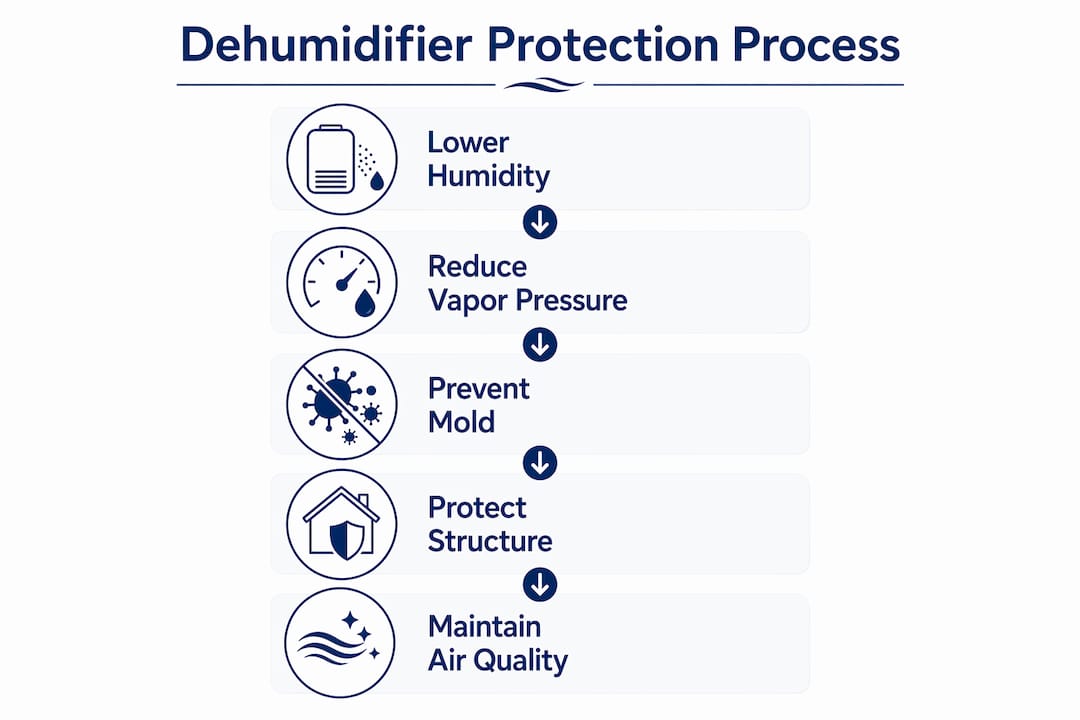
The core mechanism is vapour pressure. A dehumidifier lowers the RH of the surrounding air, which creates a vapour pressure differential that pulls moisture out of porous materials and into the air, where the unit then condenses and removes it. Stop the dehumidifier and the differential collapses — moisture redistributes back into walls and floors.
This is why intermittent use doesn’t protect structure. Dehumidification must run continuously until materials reach target moisture levels. Switching a unit on for a few hours each day allows humidity to recover overnight, reversing any drying progress.
Fans are a common misunderstanding. They accelerate evaporation from wet surfaces by stripping the saturated boundary layer of air sitting directly above the material. But if the room air itself is already humid, fans alone simply redistribute that moisture to other surfaces, potentially spreading mould risk rather than reducing it. Fans and dehumidifiers work together: fans move moisture from material to air, dehumidifiers remove it from the air entirely.
Refrigerant vs desiccant: which suits your home?
| Type | Best conditions | Limitations |
|---|---|---|
| Refrigerant (compressor) | Temperatures above 15°C, typical coastal and inland Australian homes | Efficiency drops sharply in cold subfloors or alpine areas |
| Desiccant | Cold spaces (subfloors, alpine homes), very low RH targets | Higher running cost; generates more heat |
Pro Tip: If your concern is a cold subfloor or a poorly heated room in a southern Australian winter, a desiccant unit will outperform a refrigerant model at low temperatures — refrigerant coils struggle to condense moisture when the air is already cold.
How do you choose the right dehumidifier for your home?
Sizing is where most families go wrong. An undersized unit runs constantly without ever pulling RH below 60%, giving a false sense of protection while moisture damage continues quietly.
A rough guide: a lightly damp room of moderate size typically needs a unit with a moderate daily moisture removal rating under AHAM conditions. Heavily damp spaces or whole houses with damp subfloors require units with higher removal capacity. AHAM ratings matter here because they standardise test conditions — a unit rated at 30 L/day under saturation conditions may only remove 12–15 L/day under real-world AHAM conditions.
For homes with central air, a whole-home dehumidification system provides more consistent protection than multiple portable units. It treats the entire conditioned space, integrates with your HVAC, and avoids the coverage gaps that portable units leave in hallways, subfloors, and wall cavities. ENERGY STAR guidance supports whole-home systems for consistently humid climates, noting energy and comfort benefits when the system is correctly sealed and installed.
Australian-specific considerations:
- Coastal Queensland and NSW homes face year-round high ambient humidity — prioritise higher L/day capacity and continuous-drain models.
- Older, uninsulated homes in Victoria and SA have cold external walls that act as condensation surfaces — address insulation alongside dehumidification (well-sealed doors and windows reduce cold-surface condensation risk significantly).
- Subfloor spaces in older Australian homes are a major hidden moisture source; a dedicated subfloor unit or whole-home system is often more effective than a portable unit in the living area.
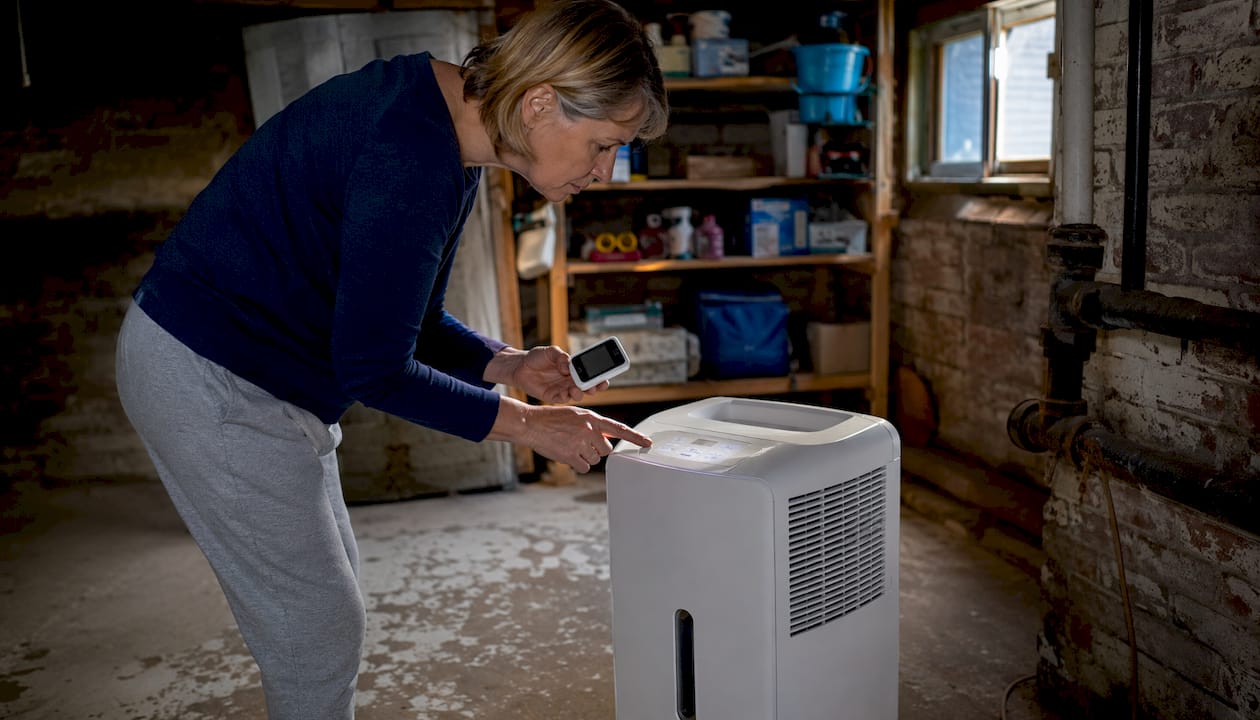
Pro Tip: Buy an independent hygrometer (separate from the dehumidifier’s built-in sensor) and place it in the dampest room. Without independent verification, you can’t confirm whether your unit is actually hitting the 30–50% RH target — the built-in sensor is often optimistic.
Use the Pure Air Smart Finder to identify which unit suits your space, dampness class, and health concerns, including allergen control for families managing asthma or allergies.
Installation, operation and maintenance checklist
Getting the unit right is half the job. Running it correctly is the other half.
- Position centrally in the target space, at least 30 cm from walls and furniture, so air can circulate freely through the intake and exhaust.
- Set up a continuous drain wherever possible. Daily emptying of a full water tank is unsustainable for long-term structural control, and a missed empty means the unit shuts off and RH climbs. Gravity drain to a floor waste, or a pump-equipped model, solves this.
- Set the target RH to 45–50% as a starting point. Once the space stabilises, you can fine-tune based on your independent hygrometer readings.
- Ground the unit properly and keep the power cord clear of water pathways. Route drain hoses away from electrical fittings.
- Clean the tank and filter every 1–2 weeks. Consumer Reports guidance is explicit on this cadence: a dirty filter reduces airflow and efficiency, and a neglected tank becomes a mould source inside the unit itself.
- Inspect the drain hose monthly for kinks, blockages, or mould growth inside the hose.
- Check AHAM-verified models for energy efficiency ratings. For whole-home systems, ENERGY STAR-rated units reduce running costs meaningfully over the months of continuous operation required for structural protection.
Pro Tip: For set-and-forget operation in a subfloor or roof space, choose a pump-equipped model with a high-water alarm. You’ll know immediately if the pump fails, rather than discovering it weeks later when RH has crept back up.
Signs that dehumidification alone isn’t enough
Some situations call for a professional. Knowing the difference saves money and prevents hidden damage from spreading.
Call a professional when you see:
- Persistent RH above 60% despite a correctly sized, continuously running dehumidifier.
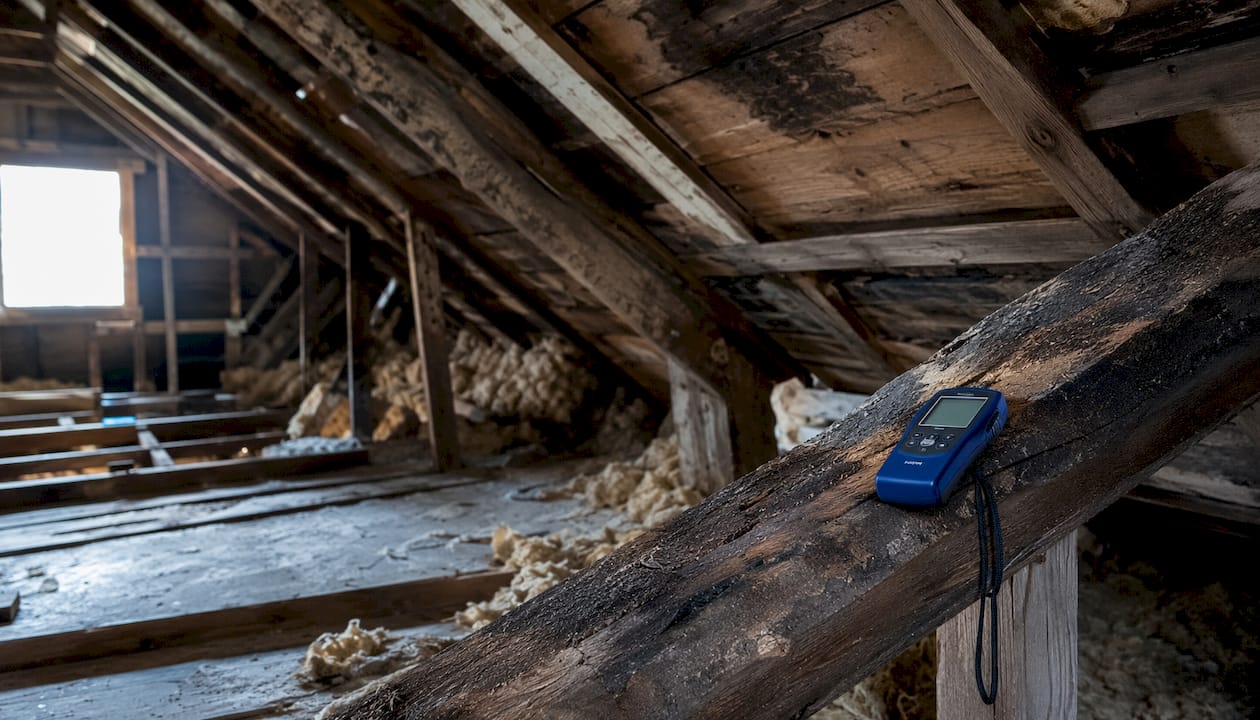
- Visible timber rot, soft spots in flooring, or plaster that crumbles when pressed.
- Mould that returns within days of cleaning, indicating the moisture source is inside the building fabric, not just on the surface.
- Rising damp on internal walls, or moisture staining that appears from below skirting boards.
- A room that still feels muggy days after an apparent leak or flood, even with a dehumidifier running.
Before calling, take independent hygrometer readings in multiple rooms and, if you have one, a moisture meter reading on affected timber or flooring. These readings give the restoration professional a baseline and help them deploy the right equipment.
What professionals bring is different in kind, not just degree. Commercial LGR (Low Grain Refrigerant) units achieve far lower grain depression than consumer models, pulling RH down to levels that force moisture out of concrete slabs and wall cavities that a household unit simply cannot reach. They pair these with air movers, psychrometric monitoring, and targeted systems like injectidry panels for wall cavities.
Key takeaways
A properly sized, continuously operating dehumidifier holding indoor RH at 30–50% is the single most effective measure an Australian family can take to prevent progressive moisture damage to timber, plaster, and masonry.
| Point | Details |
|---|---|
| Target RH range | Keep indoor RH at 30–50%; above 60% RH, mould can begin within a few days. |
| Size correctly | Match L/day capacity to room area and dampness class using AHAM-rated figures, not saturation ratings. |
| Monitor independently | Use a separate hygrometer to verify RH targets are met; the unit’s built-in sensor is often inaccurate. |
| Maintain regularly | Clean tank and filter every 1–2 weeks; use a continuous-drain or pump model for unattended operation. |
| Pureair-au Smart Finder | Use the Pure Air Smart Finder to select an AHAM-verified unit matched to your home’s specific conditions. |
Why structural protection and healthy air are the same goal
Most families think about dehumidifiers as a comfort measure. The structural protection angle tends to get treated as a separate, more serious problem — something for builders or restorers. That framing is wrong, and it leads families to underinvest in the right equipment.
The conditions that damage timber and plaster are the same conditions that drive mould spore counts, dust mite populations, and respiratory irritants indoors. Holding RH at 30–50% doesn’t just protect your walls. It creates the indoor environment that reduces child illness risk from mould and allergens, supports better sleep, and reduces the load on air purifiers working to capture airborne particles.
The mistake most families make is treating these as separate purchases: a dehumidifier for the damp room, an air purifier for allergies. A properly selected, AHAM-verified dehumidifier addresses both simultaneously. Pure Air’s approach, matching medical-grade air quality goals to the right verified unit through the Smart Finder, reflects exactly that integrated thinking. The structural protection is a consequence of getting the indoor air right.
Ready to find the right dehumidifier for your home?
Choosing the wrong unit is expensive twice: once when you buy it, and again when the moisture damage it failed to prevent shows up in your walls.
Pureair-au’s AHAM-verified dehumidifier range includes portable units for targeted room control and whole-home systems for complete structural protection. Every unit in the catalogue is matched to Australian climate conditions. Use the Pure Air Smart Finder to answer a few questions about your space and get a specific recommendation, or browse the full range to compare continuous-drain and pump-equipped models suited to unattended operation. For families managing humidity across a whole house, the humidity control guide walks through sizing, placement, and what to look for in an AHAM rating before you buy.