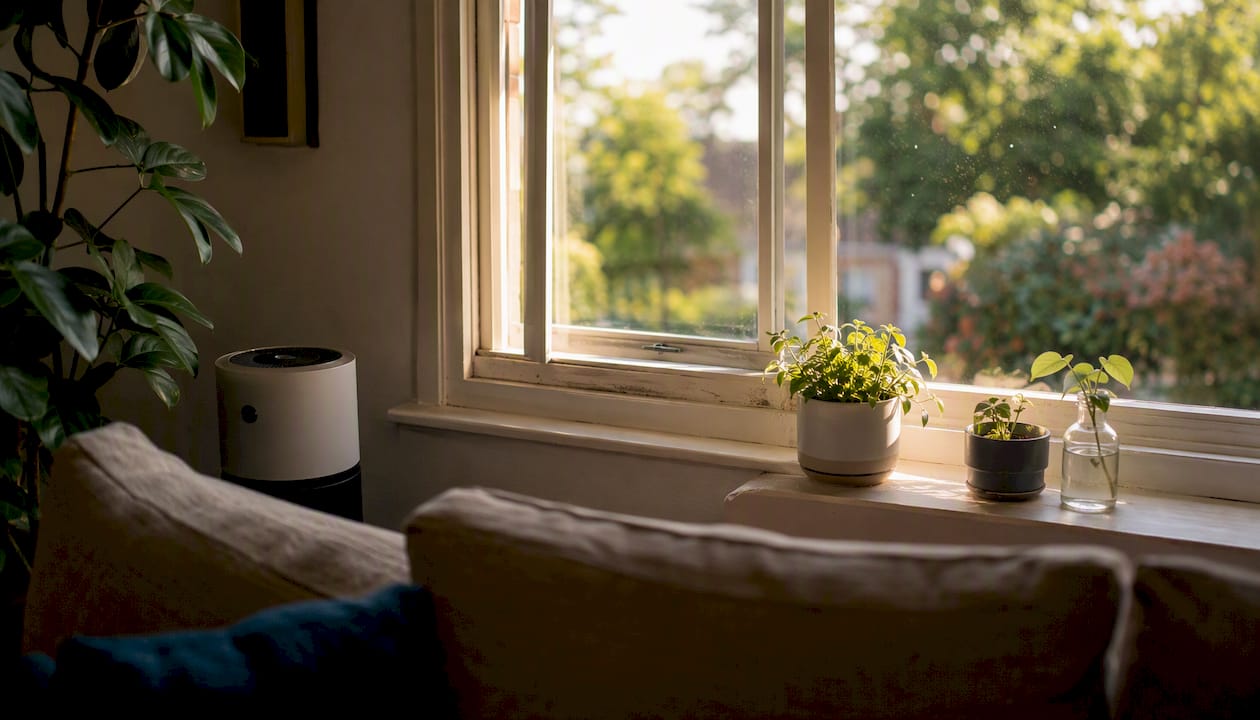
Yes, opening windows can worsen your indoor air quality, and it happens faster than most people expect. When outdoor pollution levels are high, from bushfire smoke, heavy traffic, or a bad pollen day, cracking a window lets that same polluted air straight into your lungs while you sleep or work.
Do this: check your local air quality index before opening anything, especially during fire season or peak pollen months.
Don’t do this: leave windows wide open overnight during high-AQI events just because the house feels stuffy. That stuffiness is fixable with a small gap, not a wide-open sash.
The World Health Organization treats ambient air pollution as a serious health risk in its own right, which is exactly why the US EPA’s indoor air quality guidance recommends natural ventilation only with real caution when outdoor pollution sources are nearby. Pure Air deals with this trade-off daily, helping households figure out when fresh air genuinely helps and when it does more harm than good. Later sections cover how to check outdoor conditions in under a minute and why a small gap, rather than a wide-open window, is often the smartest overnight compromise.
Key Takeaways
Opening windows worsens indoor air quality whenever outdoor pollution, from bushfire smoke to peak traffic to high pollen counts, exceeds what’s already inside your home.
| Point | Details |
|---|---|
| Check before you open | Look up local AQI and watch for haze or smoke smell before airing any room. |
| Use CO2 as your guide | Levels above roughly 1,000 to 1,500 ppm signal it’s worth airing out, if outdoor air is clean. |
| Favour micro-ventilation overnight | A small trickle gap cuts CO2 while limiting how much outdoor pollution gets in. |
| Keep filtration running as backup | A HEPA purifier from Pure Air maintains cleaner air on days when windows should stay shut. |
Table of Contents
- Which outdoor pollutants get inside when you open a window?
- When does opening windows worsen indoor air quality?
- When does opening windows actually help?
- How do you check outdoor air quality before opening a window?
- Is a small gap better than a wide-open window at night?
- How does opening windows affect HVAC and filtration systems?
- What can you do to limit pollutant entry and manage indoor air?
- Should you open your windows right now? A quick checklist
- Why this guidance holds up
- A homeowner’s balancing act
- What to do when windows need to stay shut
- Sources
Which outdoor pollutants get inside when you open a window?
Every open window is a doorway for whatever happens to be floating around outside at that moment. Some of it dilutes indoor stuffiness in a good way. A lot of it doesn’t.
| Pollutant | How it behaves indoors |
|---|---|
| PM2.5 (fine particles) | Penetrates readily through open windows and gaps; the biggest health concern due to lung and bloodstream penetration |
| PM10 (coarser particles) | Enters but settles faster than PM2.5, often depositing on surfaces near windows |
| Pollen | Enters freely on windy days; concentrations spike during flowering seasons |
| NOx (nitrogen oxides) | Traffic-linked gas that infiltrates quickly, especially near busy roads |
| Ozone | Forms outdoors in sunlight and reacts with indoor surfaces and materials |
| VOCs | Can move both ways, entering from outdoor sources like traffic or leaving from indoor products |
| Smoke and ash | Rapid indoor buildup during bushfire events, even with windows only slightly open |
| Microbial material | Mould spores and bacteria travel on airborne particles and settle on indoor surfaces |

Particle size decides how deep pollution travels into your body, which is why PM2.5 dominates health warnings. Anything under 2.5 microns bypasses your nose and throat’s natural filtering and lodges in the smaller airways and, in some cases, the bloodstream. Experimental ventilation studies measuring particles between 0.3 and 5 microns found indoor-to-outdoor ratios that shift substantially depending on particle size and how the window is opened, confirming that smaller particles pass through open windows and gaps with far less resistance than larger, heavier ones.
Season changes which pollutant dominates. Bushfire smoke spikes PM2.5 and ash in summer and autumn. Spring brings pollen surges that hit hardest on windy, dry afternoons. Peak traffic hours push NOx and ozone up in cities regardless of season, which matters if your bedroom window faces a main road.
When does opening windows worsen indoor air quality?
Certain conditions turn a well-meaning attempt at fresh air into a genuine health risk. Recognising them takes seconds once you know what to look for.
Active bushfire smoke nearby is the clearest case. Smoke particles are small, they travel for kilometres, and they don’t need much of a gap to get indoors. Peak-traffic periods, typically early morning and late afternoon in most cities, push NOx and PM2.5 concentrations well above their daily average near busy roads. High-AQI days generally, heavy pollen days during spring, and urban smog events during temperature inversions (when a warm air layer traps pollution close to the ground) all create the same basic problem: outdoor air is worse than indoor air, and opening a window reverses the direction pollution should flow.
The mechanism is straightforward once you see it. Mechanical filtration inside a home, whether that’s a purifier or an HVAC system with a decent filter, only cleans air that passes through it. Open a window and you create a bypass route straight past that filtration, letting unfiltered outdoor pollutants mix directly with your indoor air. Research on natural ventilation and outdoor pollutant infiltration confirms that indoor particle concentrations climb measurably during poor outdoor air episodes when windows stay open, and reporting from Imperial College’s research on indoor pollution dynamics points to how quickly indoor spaces lose their protective buffer once that barrier is removed.
Practical guidance from home air quality resources generally lands on the same threshold: once outdoor AQI climbs past 100, keeping windows closed is the safer default, and during active wildfire smoke events, that threshold gets even more conservative.
When does opening windows actually help?
Fresh air isn’t the enemy here, and shutting every window permanently creates its own problems. There are genuine, evidence-backed reasons to open up.
- Reducing CO2 buildup: closed bedrooms overnight can climb well past comfortable levels, and airing the room brings that down fast.
- Diluting indoor VOCs: paint fumes, cleaning product residue, and off-gassing furniture all build up indoors and benefit from air exchange.
- Cutting airborne infection risk: dilution ventilation lowers the concentration of airborne viral particles in shared indoor spaces.
- Clearing cooking odours and moisture: short bursts of airflow after cooking or showering prevent smells and humidity from lingering.
CO2 is a useful proxy for how “used up” indoor air has become, since it climbs with every breath in a closed room. Levels around 1,000 to 1,500 ppm are a reasonable signal that airing out would help, though these figures are guidance rather than a strict cutoff, and readings vary by room size, occupancy, and ventilation history.
The trade-off is real, though, and it cuts both ways. Ventilation dilutes whatever’s building up indoors, but it does that by mixing indoor air with whatever is outside your window. On a clean-air day, that’s a straightforward win. On a smoky or high-pollen day, you’re trading one problem for a worse one.
How do you check outdoor air quality before opening a window?
A minute of checking beats an hour of regret. Most homes do not need expensive equipment to make a reasonably confident call.
Start with your local air quality index. Government environment agencies and free apps report AQI in bands: Good, Moderate, and Unhealthy (with finer gradations above that for sensitive groups and everyone). EPA guidance on indoor air quality points to official monitoring as the most reliable check available, well ahead of guesswork. Check before you open anything, not just once in the morning, since conditions shift through the day.
A cheap indoor sensor adds a second layer of confidence. Compare indoor CO2 and PM2.5 readings against outdoor figures from your nearest monitoring station. If indoor CO2 is climbing and outdoor PM2.5 is low, opening a window is a clear win. If outdoor PM2.5 is spiking while indoor readings sit low, that’s your signal to stay closed.
When you don’t have a sensor handy, your senses still work. Visible haze on the horizon, the unmistakable smell of smoke, or a stronger-than-usual chemical or exhaust odour outside are all reliable enough to act on. Simple sensory checks like these tend to align closely with official AQI readings, which makes them a genuinely useful backup when you’re deciding in a hurry.
Is a small gap better than a wide-open window at night?
Micro-ventilation, small trickle vents or a window locked into a narrow “night latch” position, splits the difference between stale air and pollutant exposure. Instead of a full opening that lets outdoor air pour in freely, a few centimetres of gap allows steady, limited exchange.
The benefit shows up clearly in bedroom air studies. Measurements of micro-ventilation performance found that trickle openings pulled very high closed-room CO2 levels, sometimes above 2,000 ppm, down toward roughly 1,500 ppm overnight, all while limiting the volume of outdoor air (and whatever it’s carrying) that gets in compared to a fully open sash. Energy loss stayed moderate too, which matters in winter when a wide-open window means a cold room by 3am.
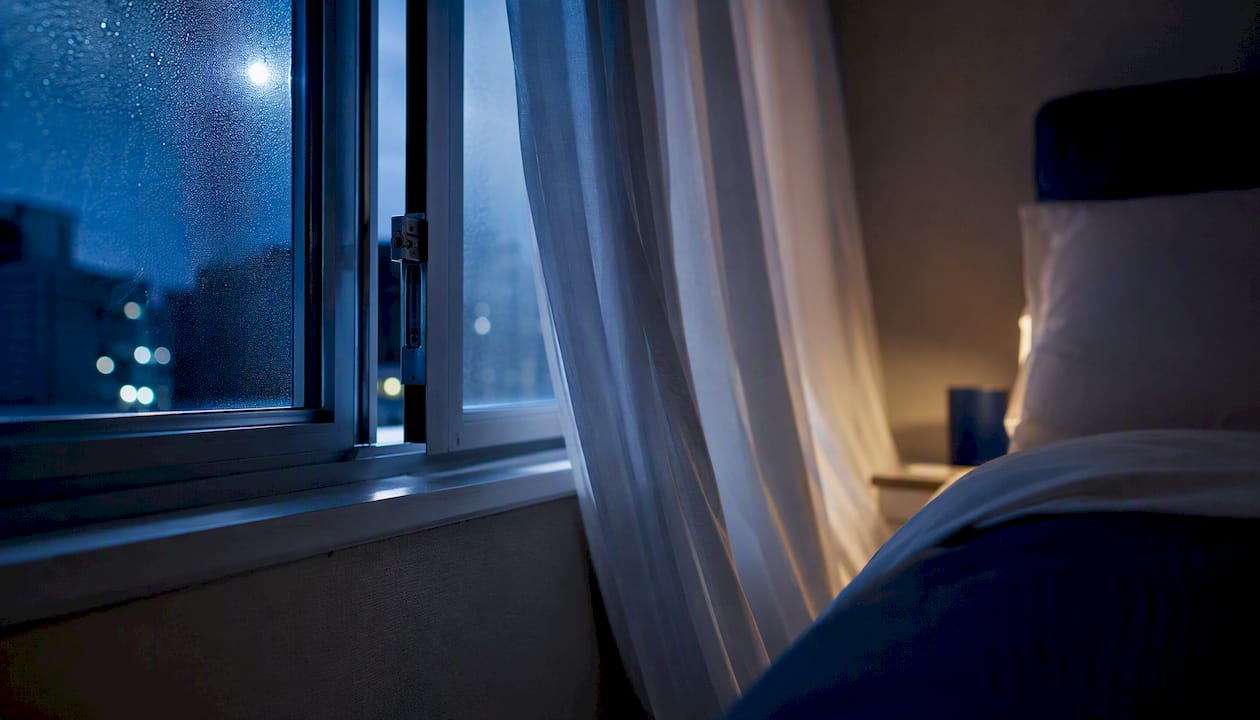
This is the compromise most bedrooms need, particularly for children’s rooms where air quality and sleep are closely linked. Full window opening still wins on raw ventilation speed, but only when outdoor air is genuinely clean, and few nights guarantee that.
Pro Tip: Set your trickle vent or night latch to the smallest gap that still lets you hear outdoor sound faintly, position it away from direct street-facing exposure if possible, and open it just before bed rather than hours earlier, so you’re not needlessly airing the room during the day’s dirtier traffic and pollen hours.
How does opening windows affect HVAC and filtration systems?
Mechanical ventilation systems fall into two broad categories, and the difference matters more than most homeowners realise. Single-flow extraction systems pull stale air out without actively filtering incoming replacement air, which sneaks in through gaps and vents. Balanced ventilation systems, by contrast, filter both incoming and outgoing air and often recover heat from the outgoing stream before it’s lost.
- Balanced systems with filtration keep indoor PM2.5 dramatically lower than single-flow setups under the same conditions.
- Opening windows while a balanced system runs creates a bypass that lets unfiltered air in, undermining the filtration you’re paying for.
- Heat recovery effectiveness drops sharply once windows are open, which shows up directly in higher energy bills during heating or cooling seasons.
- Running mechanical ventilation with windows closed preserves both filtration performance and energy efficiency.
A multi-climate modelling study on ventilation systems found balanced ventilation with filtration produced roughly a nine-fold reduction in indoor PM2.5 compared with single-flow systems, and that opening windows increased heat losses while cutting into that heat recovery advantage. If your home relies on balanced ventilation for air quality, opening windows on a bad air day essentially cancels out what you’re paying the system to do. A well-maintained HVAC system also matters here, since dirty ducts or filters reduce whatever filtration benefit you’d otherwise get.
The practical rule: run mechanical ventilation with windows closed whenever outdoor air is questionable, and reserve open windows plus portable HEPA filtration for situations where you need rapid air exchange and outdoor conditions are genuinely clean.
What can you do to limit pollutant entry and manage indoor air?
Timing and mechanical backup do most of the heavy lifting once you’ve decided fresh air is worth the risk on a given day.
Airing your home during low-traffic hours, typically midmorning or early afternoon rather than commuter peaks, reduces NOx exposure substantially. Pollen counts often peak midday on warm, dry days, so allergy-prone households do better airing out in the early morning or evening instead. Ozone builds through the afternoon in sunny weather, so evening ventilation tends to avoid its worst concentrations. Cross-ventilation, opening windows on opposite sides of the house for a short, targeted burst, exchanges stale air fast without leaving the house open all day.
- Seal obvious gaps around window frames and door thresholds to cut unintentional infiltration between planned airing sessions.
- Keep interior doors partly closed during ventilation to limit whole-house air exchange to the rooms that actually need it.
- Run a portable HEPA purifier during and after airing sessions to catch particles that snuck in.
- Replace purifier and HVAC filters on schedule, since a clogged filter loses much of its capture efficiency.
- Wipe down surfaces near windows regularly, since deposited particles settle on sills and nearby furniture even after the air itself clears.
Sealing gaps around windows does double duty, cutting both energy loss and uncontrolled pollutant entry between deliberate airing sessions. A monitoring study across UK nurseries found portable air purifiers cut PM2.5 by a mean of roughly 63% with windows closed, dropping to around 46% with windows open, which confirms that purifiers still help during ventilation, just not as much as when the house is sealed.
Pro Tip: Run cross-ventilation in short, deliberate bursts, ten to fifteen minutes, during a low-AQI window you’ve already confirmed, rather than leaving windows open indefinitely “just in case” it stays clean outside.
Should you open your windows right now? A quick checklist
Work through this in order and you’ll have an answer inside a minute.
- Check current outdoor AQI. Below 50 is generally safe to ventilate freely; 50 to 100 warrants caution for sensitive households; above 100 means keep windows closed or limit to micro-ventilation only.
- Look and smell for obvious warning signs. Visible haze, a smoky smell, or unusually strong outdoor odours override a borderline AQI reading, since local conditions can shift faster than reported figures.
- Consider who’s in the house. Young children, older adults, and anyone with asthma or respiratory sensitivity need a more conservative threshold than a healthy adult household.
- Check your indoor CO2, if you can. Above roughly 1,000 to 1,500 ppm and outdoor air is clean, airing out is worth doing.
- Confirm filtration is available as a backup. If windows need to stay closed, a portable HEPA purifier or your home’s balanced ventilation system should be running instead.
If the checklist points to closed windows, don’t just sit with stale air. Run a purifier, bump up mechanical ventilation if your system allows it, and cut back on indoor pollutant sources like candles, harsh cleaning products, or frying without extraction.
Why this guidance holds up
The strongest evidence backing this comes from three places. WHO’s global air pollution data establishes ambient pollution as a serious health risk independent of any single household’s choices. Peer-reviewed work on particle penetration through natural ventilation and on balanced ventilation versus single-flow systems quantifies exactly how much protection filtration provides and how much of it disappears once a window opens. Performance data on portable air purifiers during window operation rounds it out by showing filtration still helps, just less, when windows are open.
Lucas, writing on behalf of Pure Air, draws this guidance together from that evidence base and from the practical questions Australian households ask when bushfire season or a bad pollen week arrives. The citation list below points to every source used in this article for readers who want to check the primary data themselves.
A homeowner’s balancing act
Most nights during pollen season, I’ll leave a bedroom window on its night latch rather than fully open, accepting a slightly warmer room in exchange for meaningfully less pollen drifting in while I sleep. During an active bushfire smoke event, the choice gets easier: windows stay shut, the purifier runs, and I check the AQI obsessively until the smoke clears.
There’s no single rule that fits every home, every season, or every household’s sensitivity. A retiree with mild asthma needs a more conservative threshold than a fit adult with no respiratory issues. A home two blocks from a highway needs different timing than one backing onto a park. What actually works is treating the decision as a daily check rather than a fixed habit, using a cheap sensor or a free AQI app, and adjusting as conditions change rather than defaulting to “windows open” out of routine.
What to do when windows need to stay shut
Some days, the smartest move is keeping every window shut and letting filtration do the work instead. That’s exactly the gap Pure Air’s medical-grade air purifiers are built to fill, using HEPA filtration that captures 99.97% of airborne particles, including the fine bushfire smoke and pollen that slip through an open window on a bad day.
Every product in the range is AHAM verified, meaning independent performance testing backs the claims rather than marketing copy alone. If you’re not sure which unit suits your household, whether that’s bushfire smoke, seasonal allergies, or a pet-heavy home, the Smart Finder tool on Pure Air’s homepage walks you through it in a couple of minutes. For a compact option that suits most bedrooms, the Honeywell Air Touch P2 is a solid starting point, and replacement filters like the Philips HEPA NanoProtect range keep existing units performing at their rated capacity. Run the Smart Finder now and get a unit matched to your home before the next high-AQI day arrives.
Sources
- Who
- Improving Indoor Air Quality | US EPA
- Effects of Outdoor Air Pollutants on Indoor Environment Due to Natural Ventilation
- The functionality of micro-ventilation — measurement evaluation
This article is general information, not a substitute for advice from a qualified doctor. Consult a qualified healthcare professional about your own circumstances before acting on anything here.