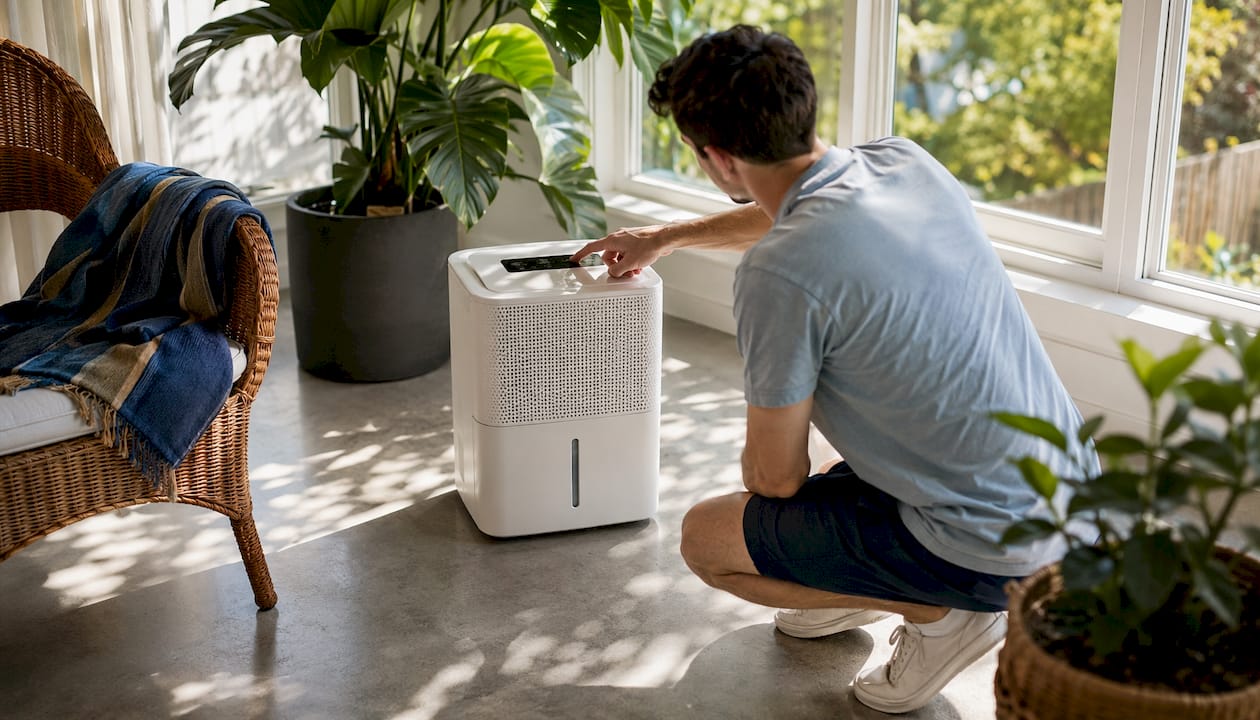
Dehumidifier capacity is the volume of water a unit can remove from air over a set period, almost always measured across 24 hours. In Australia, you’ll see this expressed as litres per day (L/day). Some US-spec products still use pints per day, but the underlying measurement is the same. A 12 L/day unit removes up to 12 litres of moisture from the air daily — under the specific laboratory conditions used to produce that number.
Table of Contents
- What does dehumidifier capacity mean on the spec sheet?
- Why your unit won’t hit its rated output at home
- How to choose the right capacity for your space
- Marketing traps that distort the capacity number
- How long will it run and what will it cost?
- Quick conversions and practical examples for Australian shoppers
- Key takeaways
- The number on the box is only half the answer
- Finding the right dehumidifier doesn’t have to be complicated
What does dehumidifier capacity mean on the spec sheet?
The figure on the box comes from a standardised laboratory test under set temperature and humidity conditions. Technicians run the unit for 24 hours, collect the condensed water, and record the volume. That’s the rated capacity.
These conditions matter because they define what you’re comparing. The AHAM (Association of Home Appliance Manufacturers) publishes the industry-standard sizing guidelines used across most markets, including Australia. When a product carries an AHAM-verified label, the capacity figure was produced under those 18.3°C / 60% RH conditions.
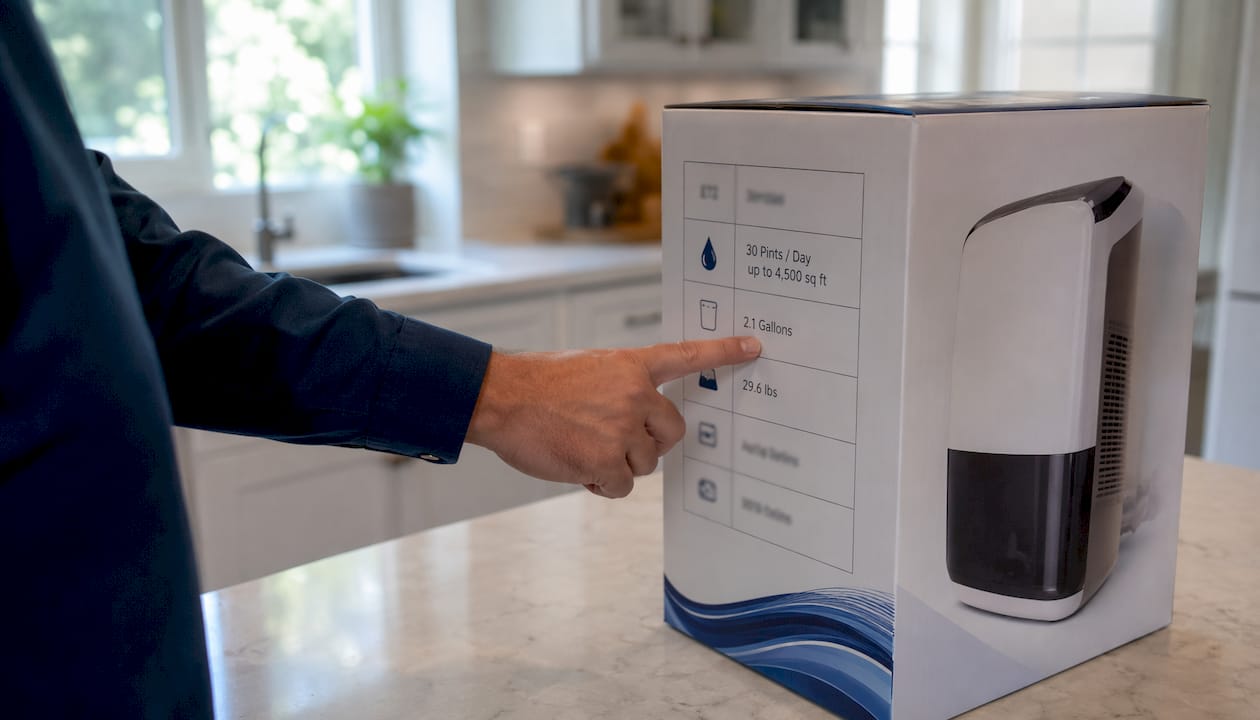
Australian specs use litres per day. Many US products list pints per day. One US pint equals approximately 0.473 litres, so a “50 pint” unit corresponds to a common capacity size.
Pro Tip: When comparing models, always check whether both specs use the same test standard. A 30 pt rating from a pre-2020 spec sheet is not the same as a 30 pt rating from a post-2020 sheet — more on that below.
Why your unit won’t hit its rated output at home
Rated capacity is a laboratory result, not a guarantee. Real extraction rates vary, sometimes significantly, depending on conditions in your home.
The core physics: warmer air holds more moisture, so a dehumidifier working in a hot, humid laundry room will pull out more water per hour than the same unit running in a cool bedroom. Coil temperature and airflow also play a role. A unit tucked into a corner with restricted airflow will cycle less efficiently than one placed centrally with clear space around it.
The 2020 test-condition change is the biggest source of confusion for shoppers. ENERGY STAR updated testing from the old 80°F / 60% RH standard to the current 65°F / 60% RH. Many models were re-rated lower as a result, even though the hardware didn’t change. A unit sold as “50 pints” before 2020 might carry a 35-pint rating today — same machine, different test temperature. That is, post-2020 capacity ratings are roughly 30% lower than pre-2020 for the same physical unit.
Other real-world factors that reduce output below the rated figure:
- Room temperature below 18°C — extraction slows noticeably in cool rooms, especially in winter
- Relative humidity below 60% — the unit has less moisture to extract and will cycle off more often
- Poor placement — walls, furniture, or enclosed spaces restrict airflow across the coils
- Open doors and windows — constantly introducing outside air resets the moisture load
- Frequent cycling — units that switch on and off repeatedly log lower average daily extraction than continuous-run figures suggest
Capacity numbers are a benchmark for comparison, not a performance promise. Treat them as a relative guide, not an absolute output.
How to choose the right capacity for your space
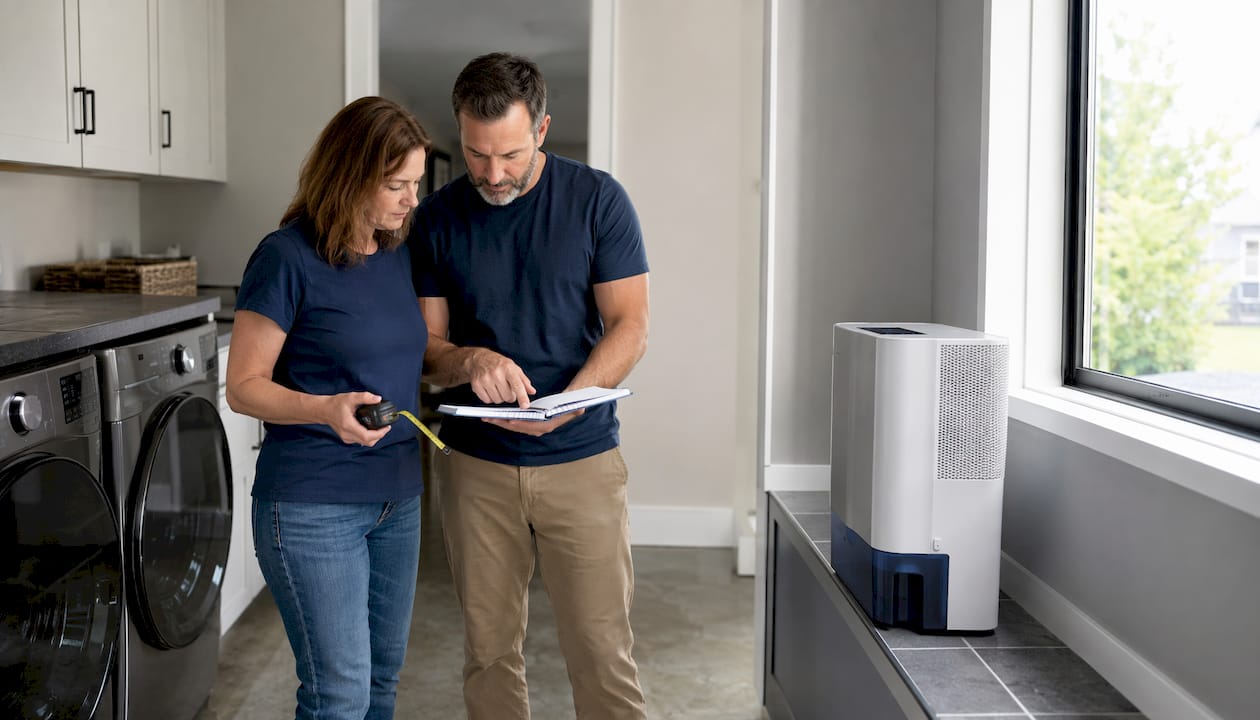
Picking the right size comes down to two inputs: room dimensions and moisture load. Room size alone is not enough. A bathroom with persistent condensation needs more capacity than a bedroom of the same size that just feels slightly stuffy. Consumer Reports and Better Homes & Gardens both flag moisture severity as the primary driver, not square metres alone.
- Measure the room. Note floor area in square metres and ceiling height. High ceilings mean more air volume, so adjust upward.
- Assess the moisture condition. Use these three levels as a guide:
- Slightly to moderately damp (50–75% RH): the space occasionally feels damp or has a faint musty smell
- Very damp (75–90% RH): consistently damp feel, visible condensation on walls or floors
- Wet (90–100% RH): visible water seepage, laundry drying indoors, or recent flooding
- Match capacity to condition. For a small-to-medium room, the capacity needed varies with moisture severity from low to higher litre/day ranges.
- Add for special factors. Below-ground spaces, rooms without vapour barriers, or high-occupancy rooms all need extra capacity.
- Round up, not down. A unit slightly oversized for the space will reach target humidity faster, then cycle off. An undersized unit runs continuously and still underperforms.
Pro Tip: If you’re drying laundry indoors regularly, or you’re in a coastal area with persistent high indoor humidity, treat the space as “very damp” regardless of how it looks. Laundry alone can add several litres of moisture to a room in a single drying cycle.
Oversizing is the safer call when you’re unsure. A larger unit handles humidity spikes and cycles off, often using less energy overall than a smaller unit running flat-out.
Marketing traps that distort the capacity number
Not every capacity claim on a box reflects the AHAM/DOE standard. Two traps catch buyers regularly.
“Saturation” or “maximum” ratings are measured at extreme heat and humidity, often 30°C or higher with relative humidity above 80%. HVAC professionals note these figures are poor comparators for typical Australian home conditions. A unit rated at “35 L/day saturation” might deliver 18–20 L/day under real-world conditions. The number isn’t wrong, but the test conditions are nothing like your laundry or bathroom.
Pre-2020 pint labels are still circulating on older stock and some imported products. Because the test temperature dropped from 80°F to 65°F, a unit labelled “50 pints” under the old standard performs closer to a 35-pint unit by today’s measure. Post-2020 capacity ratings are roughly 30% lower than pre-2020 for the same physical unit.
Red flags to watch for: no test-condition disclosure anywhere on the packaging, capacity listed only as “up to X litres” with no standard cited, and pint ratings with no litre equivalent or test basis. Check for AHAM verification and compare models using the same test standard.
How long will it run and what will it cost?
A worked example makes the numbers concrete.
Say you want to remove 6 litres of excess moisture from a laundry after a drying session. You have a 12 L/day unit.
- Convert daily capacity to hourly: 12 L ÷ 24 hours = 0.5 L/hour
- Estimate run time: 6 L ÷ 0.5 L/hour = 12 hours to remove 6 litres under rated conditions
- Calculate running cost: wattage (kW) × hours × electricity tariff ($/kWh)
| Variable | Example value |
|---|---|
| Hours run | 12 hours |
Real run time will be longer in cooler or drier conditions, shorter in hot and humid ones. Check your actual electricity tariff on your bill — rates vary across Australian states and retailers. Duty cycle matters too: a unit that cycles on and off will take longer than continuous-run figures suggest.
Quick conversions and practical examples for Australian shoppers
| Spec as listed | Litres/day | Litres/hour |
|---|---|---|
| 12 L/day | 12 L | 0.5 L/hr |
| 20 L/day | 20 L | — |
| 50 pints/day | ~— | — |
| — | ~— | — |
Three quick examples:
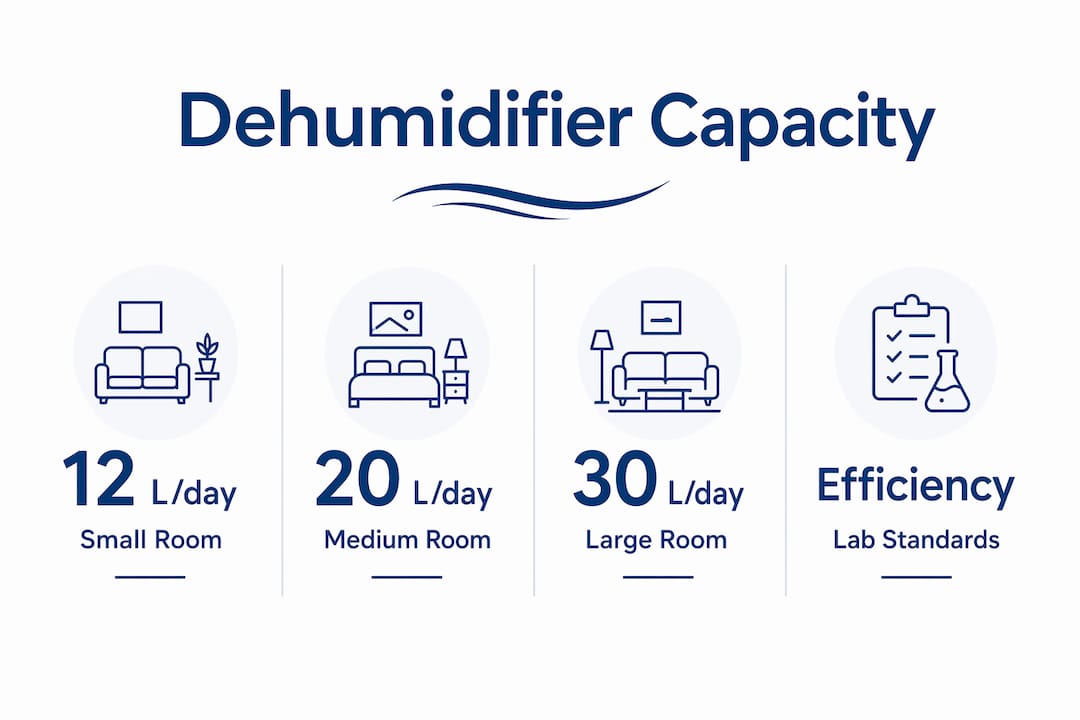
Small bathroom (approx. 5 m²), slightly damp: A 10–12 L/day unit is sufficient. Persistent condensation after showers is a moisture-load problem, not a size problem — step up to 16 L/day if the room stays damp between uses.
Living room or bedroom (approx. 20–30 m²), moderately damp: A 16–20 L/day unit covers most scenarios. If the space is coastal or you’re running it through a humid Queensland summer, lean toward 20 L/day.
Garage or basement (approx. 40–60 m²), very damp to wet: You’re looking at 20–30+ L/day. Below-ground spaces and garages without vapour barriers need the upper end of that range. For very large or persistently wet spaces, a whole-home dehumidification system may be more practical than stacking portable units.
When shopping, look for the AHAM-verified label and confirm the test conditions are stated. Comparing specs on the same test basis is the only way to make a fair comparison between models.
Key takeaways
Dehumidifier capacity measures litres removed per day under standard test conditions, and matching that figure to your room’s moisture load, not just its size, is what determines whether a unit actually works.
| Point | Details |
|---|---|
| Capacity definition | Litres of water removed per 24 hours under standard lab conditions (18.3°C / 60% RH). |
| Units for Australia | Australian specs use litres/day; US specs use pints/day (1 pint ≈ 0.473 L). |
| Test conditions matter | Post-2020 ratings use 65°F / 60% RH — roughly 30% lower than pre-2020 figures for the same unit. |
| Match moisture load | Slightly damp, very damp, and wet conditions each require different capacity ranges, regardless of room size. |
| Pureair-au’s range | Pureair-au stocks AHAM-verified dehumidifiers suited to Australian conditions, with a Smart Finder tool to match capacity to your specific moisture problem. |
The number on the box is only half the answer
Most buyers focus entirely on the litre-per-day figure and stop there. That’s understandable — it’s the most visible number. But after working through how these ratings are produced, the more useful question is: what are the conditions in your space, and how far do they differ from the 18.3°C / 60% RH lab test?
A coastal home in northern Queensland running at 85% RH in February will pull far more water per hour than the rated figure, affected by factors like local climate conditions as explained in how San Antonio’s heat and humidity affect interior doors. A cool Melbourne garage in winter will pull considerably less. The rating is a starting point for comparison, not a performance contract.
The practical heuristic worth keeping: size for your worst-case moisture load, not your average day. Laundry drying, post-flood drying, or a wet season in a tropical climate are the conditions that expose an undersized unit. A unit with headroom handles those spikes and then cycles off. For persistent mould, visible water intrusion, or post-flooding situations, a dehumidifier alone isn’t the answer — those need a building professional to address the source before any appliance can hold the result. The connection between humidity control and allergen reduction is real, but only when the unit is sized and placed correctly.
Finding the right dehumidifier doesn’t have to be complicated
Pureair-au carries a range of AHAM-verified dehumidifiers built for Australian conditions, from compact units for bathrooms and bedrooms through to higher-capacity models for garages, basements, and open-plan living spaces. Every unit in the range has its test conditions clearly disclosed, so you’re comparing like for like.
The Smart Finder tool on the Pureair-au site lets you input your room size, moisture concern (mould, condensation, laundry, coastal humidity), and get a matched recommendation in under a minute. No guesswork, no wading through spec sheets. You can also browse the full dehumidifier and air quality catalogue to compare models side by side. If you need ongoing moisture control, Pureair-au’s team can advise on drainage options and filter maintenance to keep your unit running at rated capacity for longer. Head to pureair-au.com to use the Smart Finder or shop the range directly.
Further reading
- ENERGY STAR — Dehumidifier testing and capacity: the primary source for current test conditions and why ratings changed in 2020
- ENERGY STAR — Dehumidifiers product list: searchable database of verified models with current capacity ratings
- AHAM sizing chart and calculator — HVAC Base: practical room-size and moisture-severity sizing tool using the AHAM standard
- The confusing world of dehumidifier capacity — Energy Vanguard: detailed technical explainer on why rated and real-world capacity diverge
- Pint rating explained — Pure Air Adviser: plain-English guide to reading dehumidifier specs and checking test disclosures