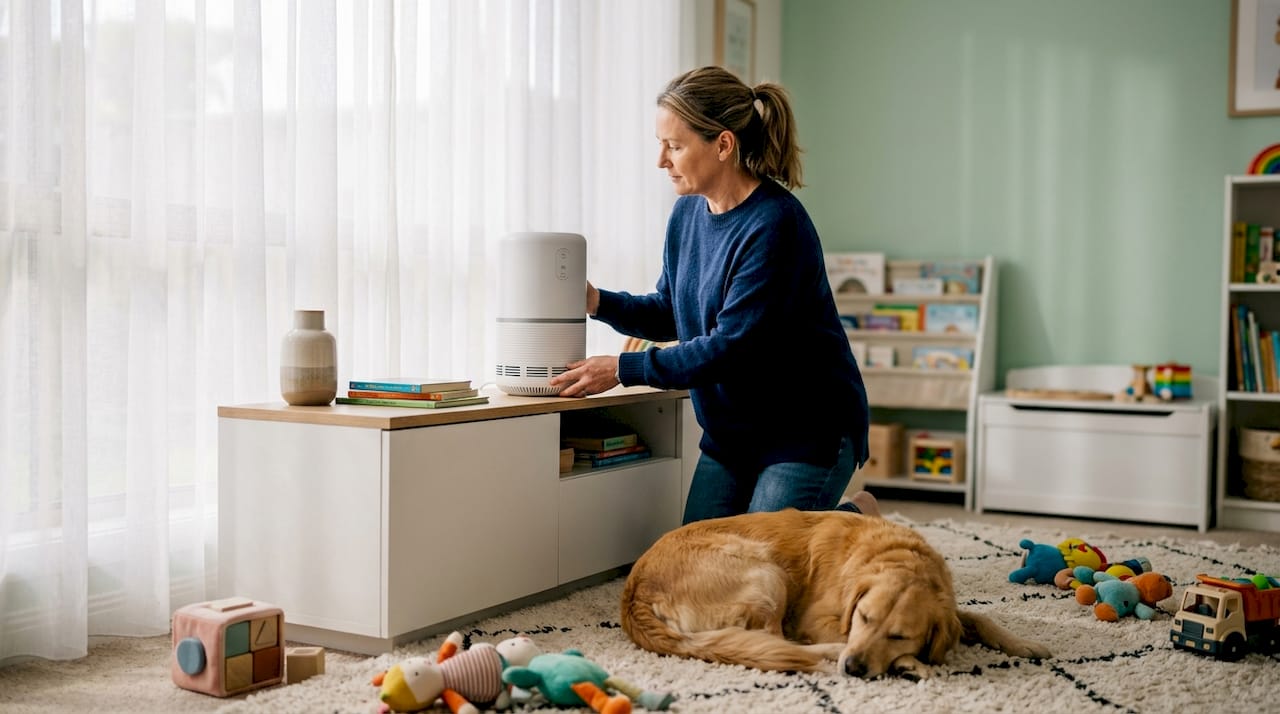
Pet-safe air solutions are defined as filtration and purification methods that remove airborne allergens, odours, and pollutants without exposing pets to toxic chemicals or harmful byproducts. The most effective examples of pet-safe air solutions combine True HEPA filtration, activated carbon layers, and pet-focused structural design. True HEPA filters capture 99.97% of airborne particles, making them the industry standard for households with dogs, cats, or birds. Australian pet owners face added challenges from bushfire smoke and high pollen seasons, which push indoor air quality well below safe levels without proper filtration.
1. What are examples of pet-safe air solutions?
Multi-stage mechanical air purifiers are the gold standard for pet households. A three-stage filtration system typically includes a pre-filter for hair and lint, an activated carbon layer for gaseous odours, and a True HEPA filter for microscopic particles. Each stage targets a different category of pet-related pollutant, so no single stage can do the job alone.
Hospital-grade units achieve 99.99% efficiency at particles as small as 0.003 microns. That level of performance captures not just pet dander but also bacteria, mould spores, and bushfire smoke particles. True HEPA filters do not emit ozone or harmful byproducts, unlike ionisers or some chemical-based products.
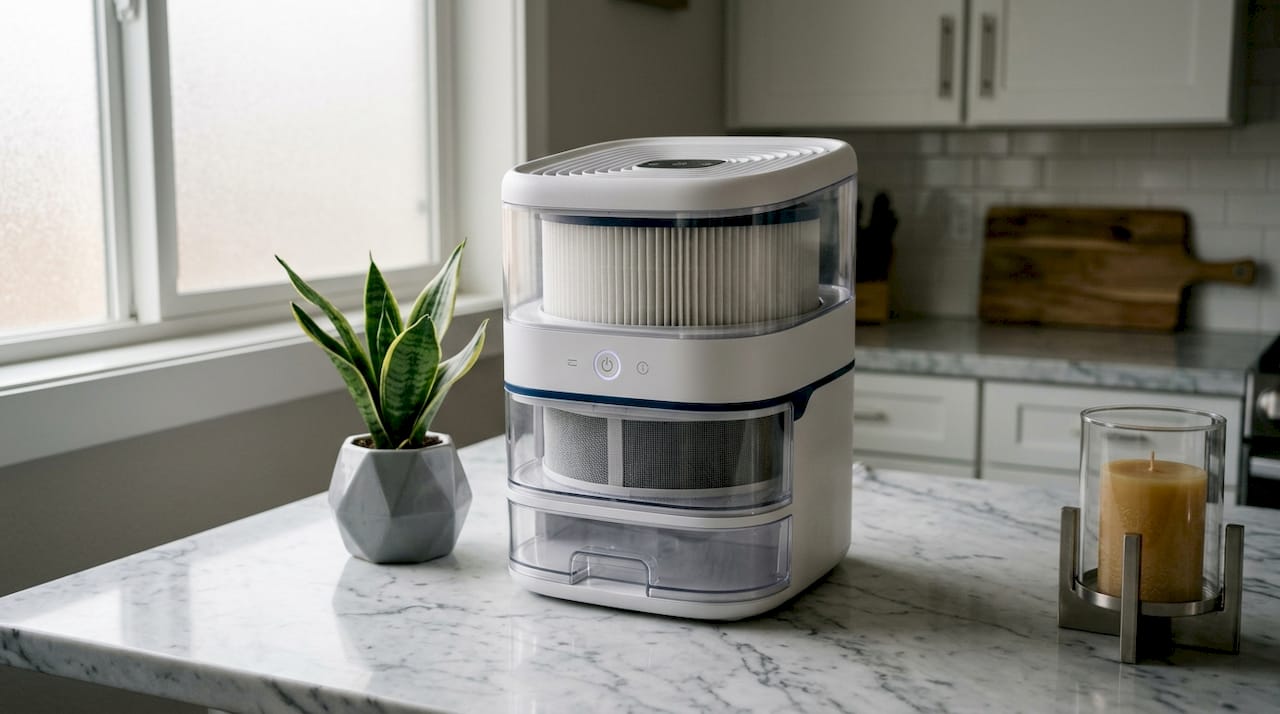
Pro Tip: Always check the label says “True HEPA” rather than “HEPA-type” or “HEPA-like.” Those marketing terms lack rigorous certification standards and will not deliver the same protection for your pets or family.
2. Multi-stage air purifiers: the most effective pet-safe option
Multi-stage air purifiers address every major pet-related air quality problem in one unit. The pre-filter catches visible pet hair and lint before it clogs the finer layers. This extends the life of the more expensive True HEPA and carbon filters significantly.
The activated carbon layer handles what HEPA cannot. HEPA filters alone cannot neutralise gaseous pet odours such as ammonia from litter boxes or the sulphur compounds in dog odour. Carbon filtration absorbs these gases at a molecular level, which is why multi-stage systems outperform single-filter units in real pet homes.
The True HEPA stage then captures the microscopic particles that pass through the pre-filter: dander, pollen, dust mite debris, and fine smoke particles. True HEPA purifiers remove over 99% of smoke particles and allergens within 30 minutes on a high setting. That speed matters during bushfire season or high-pollen days when windows stay closed.
Pro Tip: Run your purifier on its highest setting for the first 30 minutes after vacuuming. Pet hair disturbance sends a burst of dander and fine particles into the air, and a high-speed cycle clears it faster than continuous low-speed operation.
3. Pet-friendly structural design features to look for
Filtration technology is only half the story. A purifier sitting on the floor in a home with a curious dog or a climbing cat faces real physical risks. Pet-safe air purifiers incorporate chew-resistant cords, stable bases, and protective covers to prevent hazards and extend device life.
Key structural features worth prioritising include:
- Anti-chew power cords: Anti-tear nylon or reinforced cable sleeves prevent dogs from chewing through the cord, which is both a fire risk and a safety hazard.
- Stable, wide bases: A low centre of gravity prevents tipping when a large dog brushes past or a cat jumps onto the unit.
- Protective outer surfaces: Scratch-resistant or jute-covered panels reduce damage from cats and keep the unit looking presentable longer.
- Quiet operation modes: Pets, particularly cats and birds, are sensitive to high-frequency noise. Units with a silent or sleep mode reduce stress for noise-sensitive animals.
- Enclosed intake grilles: Narrow grilles prevent curious paws from reaching internal components.
Pro Tip: Place your purifier on a low shelf or in a corner with the cord routed behind furniture. This single step removes most chewing and tipping risks without needing any additional accessories.
For a detailed breakdown of pet-safe purifier features, Pureair-au’s 2026 owners guide covers the most relevant design criteria for Australian households.
4. Natural and non-toxic air purification options
Mechanical filtration is the most effective approach, but several natural options complement it well. Spider plants, orchids, and Boston ferns are listed by the ASPCA as safe for both cats and dogs, and they contribute to passive air improvement by absorbing some airborne compounds. They will not replace a True HEPA unit, but they add a layer of natural air improvement without any chemical risk.
Enzymatic odour eliminators are another strong option. These products use naturally occurring enzymes to break down the organic compounds in pet urine, faeces, and vomit at the source. They do not mask odours with fragrance. They destroy the molecules causing the smell, which means the odour does not return once the source is treated.
Passive reed diffusers with pet-safe essential oil formulations deliver fragrance without heat or aerosolisation. This matters because ultrasonic diffusers disperse oil droplets into the air, which pets inhale directly. Passive evaporation releases fragrance at a much lower concentration, reducing respiratory exposure. Oils such as eucalyptus, tea tree, and pennyroyal are toxic to cats and must be excluded from any pet-safe formulation.
5. Why chemical air fresheners are risky for pets
Chemical air fresheners are the most common source of avoidable indoor air pollution in pet homes. A study of 25 consumer air fresheners found that 24 emitted compounds classified as toxic or hazardous under US law. Australian regulatory standards differ, but the underlying chemistry is the same.
| Product type | Risk level for pets | Safer alternative |
|---|---|---|
| Aerosol sprays | High: direct VOC inhalation | Enzymatic odour eliminators |
| Plug-in fresheners | High: continuous VOC emission | True HEPA with activated carbon |
| Ultrasonic diffusers | Moderate to high: aerosolised oils | Passive reed diffusers (pet-safe oils only) |
| Scented candles | Moderate: soot and fragrance compounds | Beeswax candles in ventilated rooms |
| Mechanical air purifiers | None: no chemical emissions | Already the safe option |
Cats are particularly vulnerable because they lack the liver enzymes needed to metabolise many synthetic fragrance compounds and essential oils. Birds are even more sensitive, and a single aerosol spray in a room with a bird can cause acute respiratory distress. Mechanical filtration and source control are the safest approach to reducing pet-related indoor air pollutants, rather than masking odours with chemicals.
6. How to choose and maintain the best air solutions for pet households
Choosing the right unit starts with the True HEPA label. Avoid “HEPA-type” or “HEPA-like” claims and look specifically for “True HEPA” certification. Pair that with an activated carbon layer to address gaseous odours, and you have the two non-negotiable filtration stages for a pet home.
Follow these steps when selecting and maintaining your setup:
- Match the unit to your room size. Check the manufacturer’s Clean Air Delivery Rate (CADR) and coverage area. A unit rated for 30 square metres will underperform in a 60-square-metre open-plan living area.
- Replace filters on schedule. Pet homes generate more particulate load than average households. Filter replacement every 6–12 months is the standard guidance, but homes with multiple pets or heavy shedders may need replacement closer to the six-month mark.
- Position the unit for maximum airflow. Place it in the room where your pets spend the most time. Keep at least 30 centimetres of clearance on all sides. Avoid corners or behind furniture where airflow is restricted.
- Clean the pre-filter regularly. Most pre-filters are washable. Rinsing them monthly in a pet home prevents clogging and maintains airflow through the more expensive inner filters.
- Combine purification with source control. Vacuum pet bedding and upholstery twice a week. Groom pets outdoors when possible. Regular cleaning paired with mechanical purification delivers better results than either approach alone.
Key takeaways
Multi-stage True HEPA air purifiers combined with pet-safe structural design and regular maintenance provide the most effective and safest approach to indoor air quality in Australian pet households.
| Point | Details |
|---|---|
| True HEPA is non-negotiable | Only “True HEPA” certified filters capture 99.97% of particles; “HEPA-type” labels do not meet the same standard. |
| Carbon filters handle odours | HEPA alone cannot remove gaseous pet odours; an activated carbon layer is required for ammonia and VOC removal. |
| Structural design matters | Chew-resistant cords, stable bases, and quiet operation protect both pets and the device from damage. |
| Avoid chemical fresheners | Most aerosols and plug-ins emit VOCs harmful to pets; enzymatic eliminators and passive reed diffusers are safer alternatives. |
| Maintenance drives performance | Replace filters every 6–12 months and clean pre-filters monthly to maintain airflow and filtration efficiency in pet homes. |
What I’ve learned from living with pets and air purifiers
The advice I give most often gets ignored the most: buy the right size unit. Pet owners consistently purchase a purifier rated for a small bedroom and run it in an open-plan kitchen and living area. The unit runs constantly, the filters clog in three months, and the owner concludes that air purifiers “don’t work.” They work. The sizing was wrong.
The second thing I’ve noticed is that people treat mechanical purification and natural methods as competing choices. They are not. A True HEPA unit with activated carbon handles the heavy lifting: dander, smoke, ammonia, and fine particles. Spider plants and enzymatic cleaners handle the edges: residual odour at the source, passive air improvement in rooms without a purifier. Using both is not redundant. It is thorough.
The chemical freshener habit is the hardest to break. People associate fragrance with cleanliness, and a purifier running silently in the corner does not feel like it is doing anything. The reality is that a well-maintained True HEPA unit removes the compounds causing the smell. The room does not smell like lavender. It smells like nothing, which is exactly what clean air smells like. That shift in expectation is the most useful thing a pet owner can internalise before spending money on any product.
— Lucas
Pureair-au’s range for pet households
Australian pet owners need air quality solutions built for local conditions: bushfire smoke, high humidity in coastal areas, and year-round shedding from dogs and cats. Pureair-au stocks a curated range of True HEPA and activated carbon air purifiers verified by AHAM standards, selected specifically for performance in Australian homes.
The Levoit Core P350 pet care air purifier and the Levoit Vital 100S are two examples from the Pureair-au catalogue designed with pet households in mind. Both feature True HEPA filtration with activated carbon and quiet operation modes suited to noise-sensitive animals. Browse the full Pureair-au catalogue to find the right unit for your room size, pet type, and budget.
FAQ
What is the safest type of air purifier for pets?
True HEPA mechanical air purifiers are the safest option for pet households. They remove allergens and particles without emitting ozone, VOCs, or other harmful byproducts.
Can I use essential oil diffusers around my pets?
Ultrasonic diffusers aerosolise oils and pose a respiratory risk, particularly for cats and birds. Passive reed diffusers using pet-safe oil formulations are a lower-risk alternative, provided toxic oils such as tea tree and eucalyptus are excluded.
How often should I replace filters in a pet home?
Filter replacement every 6–12 months is standard, but homes with multiple pets or heavy shedders should replace filters closer to the six-month mark to maintain performance.
Are indoor plants safe to use as air purifiers around pets?
Spider plants, orchids, and Boston ferns are ASPCA-listed as safe for cats and dogs and provide passive air improvement. They complement mechanical purifiers but cannot replace True HEPA filtration.
Do chemical air fresheners harm pets?
Most aerosol and plug-in air fresheners continuously emit VOCs that are harmful to pets, especially cats and birds. Enzymatic odour eliminators and mechanical filtration are the recommended alternatives for pet-safe indoor air quality.