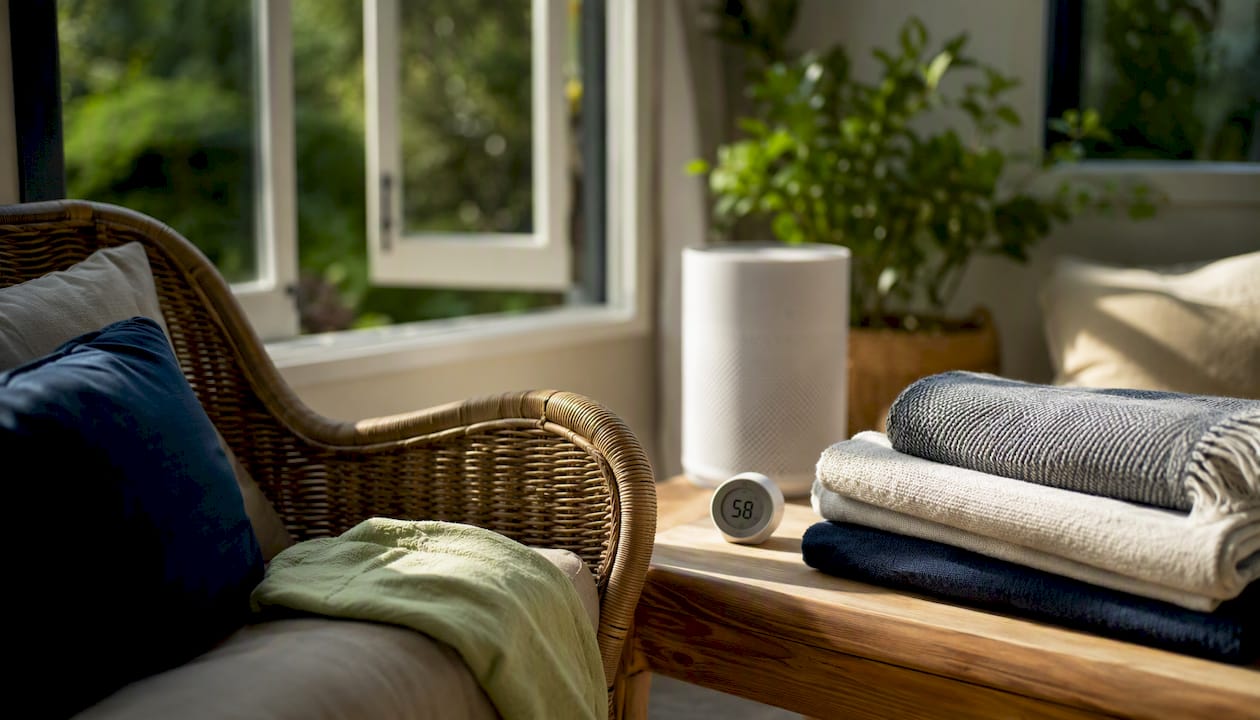
Here is your allergen reduction checklist for renters, ready to use today. Work through these 10 steps, and you will have addressed the four main indoor allergen categories: particles, moisture, fumes, and odours.
- Encase your mattress and pillows in allergen-proof covers. (Tenant action)
- Wash all bedding weekly at ≥54 °C (130 °F) to kill dust mites. (Tenant action)
- Keep indoor relative humidity between 30–60% using a hygrometer to monitor. (Tenant action)
- Run a HEPA air purifier continuously on low in the room you use most. (Tenant action)
- Vacuum with a HEPA-filter vacuum weekly in the bedroom and living room. (Tenant action)
- Run exhaust fans while cooking and showering, and leave them on for a few minutes after. (Tenant action)
- Keep pets out of the bedroom and wash pet bedding weekly. (Tenant action)
- Dry towels fully and wipe condensation from bathroom walls and windows after every shower. (Tenant action)
- Report structural leaks, broken exhaust fans, or visible mould to your landlord in writing. (Landlord responsibility)
- Replace purifier filters on schedule and keep a visible reminder on the unit. (Tenant action)
Numeric targets to remember: bedding at a temperature sufficient to kill dust mites, indoor relative humidity in a controlled range, true HEPA filtration (no ioniser), CADR matched to room size.
A practical renter framework separates indoor air problems into particles, moisture, fumes, and odours, and the evidence consistently points to repeatable daily habits over occasional deep cleans as the more effective long-term strategy.
Key takeaways
Consistent daily habits — controlling moisture, laundering bedding at ≥54 °C weekly, and running a HEPA purifier continuously on low — deliver more lasting allergen reduction than any single deep clean.
| Point | Details |
|---|---|
| Bedding temperature | Wash sheets and pillowcases weekly at ≥54 °C to reliably kill dust mites. |
| Humidity target | Keep indoor RH between 30–60% using a hygrometer; act with a dehumidifier above 60%. |
| HEPA filtration | Use a true HEPA purifier (no ioniser) sized to your room’s CADR and run it continuously on low. |
| Landlord escalation | Structural leaks, inside-venting exhaust fans, and building-defect mould are landlord responsibilities — document and request in writing. |
| Repeatable habits win | Small daily actions (ventilate, wipe, launder) outperform occasional intensive cleans for long-term allergen control. |
What actually keeps a rental healthier long-term
The advice in most allergen guides focuses on what to buy. The harder truth is that the biggest gains come from what you do every day, not what you own.
Running a purifier on low overnight costs almost nothing in electricity and delivers more consistent particle reduction than switching it to maximum for an hour on the weekend. Keeping a hygrometer on the bedside table means you notice a humidity spike before mould appears, not after. These are not dramatic interventions. They are small, repeatable habits that compound over months.
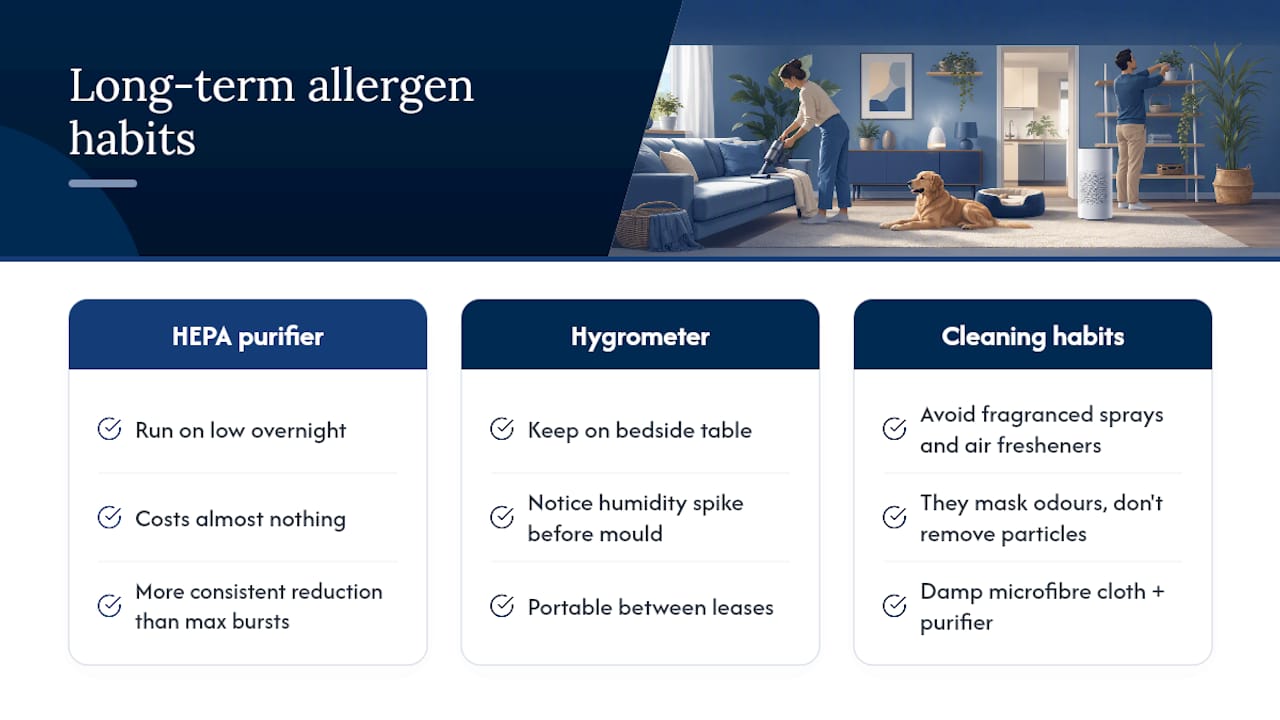
One habit worth dropping: heavy use of fragranced cleaning sprays and air fresheners. They mask odours without removing particles, and many contain volatile organic compounds that add to the indoor chemical load rather than reducing it. A damp microfibre cloth and a running purifier do more for air quality than any scented product.
The renter’s advantage is portability. A good HEPA purifier, a hygrometer, and allergen-proof encasements move with you from lease to lease. You are not investing in the building; you are investing in the air around you.
This article is general information, not a substitute for advice from a qualified doctor. Consult a qualified healthcare professional about your own circumstances before acting on anything here.
Table of Contents
- Room-by-room allergen reduction checklist for renters
- Your cleaning schedule: daily, weekly, and monthly tasks
- Moisture, mould, and humidity control for Australian rentals
- Pets and animal dander: renter-friendly strategies
- Ventilation and cooking: reducing fumes in small rental kitchens
- Air purifiers and filtration: what renters should look for
- Choosing a purifier or dehumidifier as a renter in Australia
- What to ask your landlord: requests, documentation, and escalation
- Pureair-au: HEPA solutions for Australian renters
- Sources
Room-by-room allergen reduction checklist for renters
Bedroom
The bedroom is where most Australians spend roughly a third of their day, so it is the highest-priority room for allergen control.
- Fit allergen-proof encasements on your mattress, pillows, and quilt. Wash the encasements monthly.
- Wash sheets, pillowcases, and blankets weekly at a minimum of 54 °C (130 °F). Cold or warm washes do not reliably kill dust mites.
- Reduce soft toys on the bed; wash any that stay there at the same temperature or seal them in a bag in the freezer overnight weekly.
- Use low-pile or washable rugs rather than thick carpet where possible.
- Place your HEPA purifier in the bedroom with at least 30 cm of clear space around the intake and output vents.
Pro Tip: Position the purifier near the head of the bed, not in a corner. Airflow across the sleeping zone matters more than proximity to the door.
Living room
- Vacuum upholstery and cushions weekly using a HEPA vacuum or a wet-vacuum function.
- Wash cushion covers and throw blankets every two to four weeks.
- Swap heavy drapes for washable curtains or blinds that can be wiped down.
- Reduce fabric clutter: the fewer soft surfaces, the fewer places dust mites and dander settle.
Pro Tip: Check behind and under the sofa when you vacuum. Dander and dust accumulate there faster than anywhere else in the room.
Kitchen
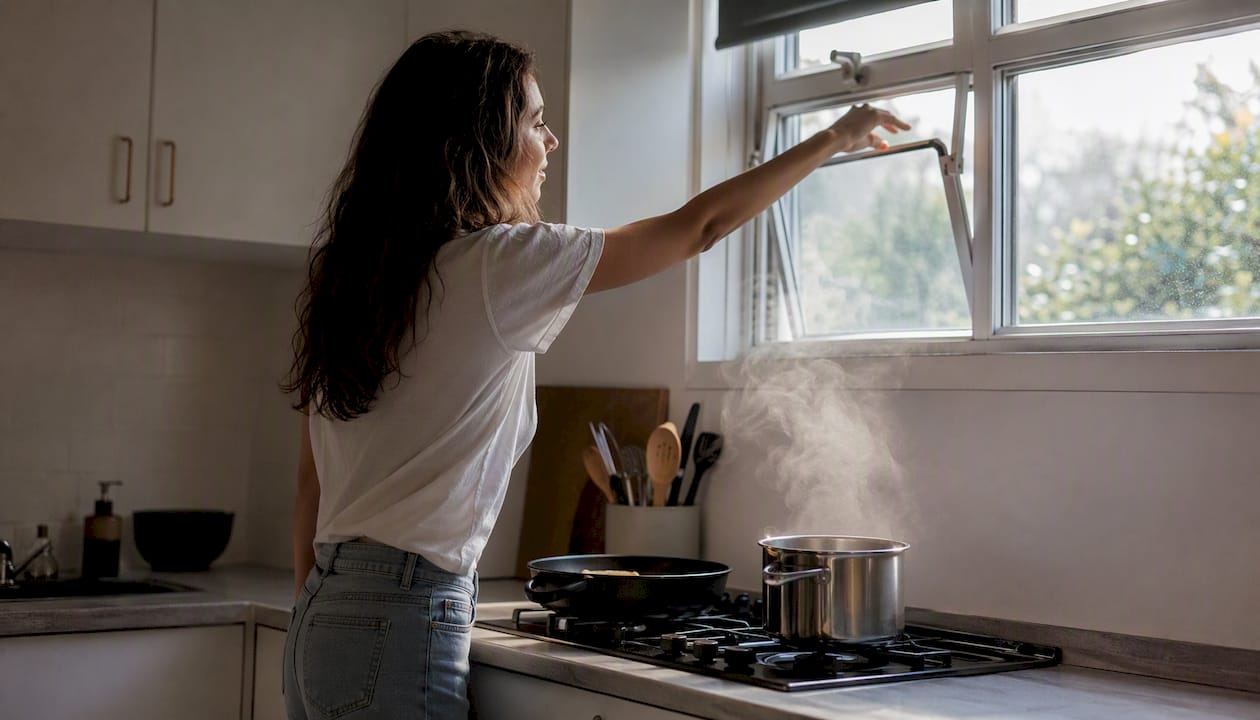
- Run the rangehood or exhaust fan every time you cook, and keep it running for at least five minutes after the hob is off.
- Close windows when outdoor pollen counts or bushfire smoke are high; use the rangehood instead.
- Wipe stovetop grease immediately after cooking. Grease residue traps particles and becomes a persistent odour source.
- Check under the sink and around the dishwasher for slow leaks monthly.
Bathroom
- Run the exhaust fan during every shower and for at least 10 minutes after.
- If there is no extractor, leave the door open and a window ajar to move moisture out.
- Dry towels completely between uses; damp towels left on hooks are a reliable mould starter.
- Wipe condensation from windows, tiles, and walls after showering. A small squeegee kept in the shower takes about 30 seconds.
Pro Tip: Check the silicone seal around the bath and shower base for dark spots. Early-stage mould in grout is a tenant-fixable problem; mould behind tiles from a structural leak is not.
Your cleaning schedule: daily, weekly, and monthly tasks
Consistency beats intensity. A short daily habit prevents the build-up that makes a monthly deep clean necessary.
Daily
- Ventilate the kitchen and bathroom after cooking and showering.
- Spot-wipe benches and the stovetop.
- Empty kitchen and bathroom bins.
- Launder face towels and kitchen cloths as needed (aim for every two to three days at minimum).
Weekly
- Wash all bedding at ≥54 °C.
- Vacuum bedroom and living room floors and upholstery with a HEPA vacuum.
- Mop hard floors with a damp mop (dry mopping just redistributes particles).
- Wash pet bedding and any soft toys that live on the bed.
- Wipe bathroom surfaces and check for new mould spots.
Monthly
- Clean rangehood grease filters (soak in hot soapy water or run through the dishwasher).
- Vacuum behind and under furniture, including behind the fridge.
- Check your hygrometer readings against the 30–60% RH target.
- Inspect your purifier’s filter indicator and replace the filter if due.
Pro Tip: Tape a small sticky note to the inside of a kitchen cupboard with your monthly task list. Shared houses benefit from a simple written agreement about who handles which tasks — it removes ambiguity and keeps the routine going when housemates change.
Moisture, mould, and humidity control for Australian rentals
Asthma Australia recommends keeping indoor relative humidity between 30% and 60% to prevent both dust-mite growth (which thrives above 60% RH) and the dry-air irritation that comes below 30%. A basic digital hygrometer costs under $20 at most hardware stores and gives you a real number to act on rather than guessing.
Why it matters: Dust mites cannot survive when relative humidity stays consistently below 50%. Mould spores need sustained moisture above 60% RH to colonise surfaces. Keeping your home in the 30–60% band addresses both triggers at once.
Practical steps to bring humidity down:
- Use the dry mode on a reverse-cycle air conditioner if your rental has one.
- Run a portable dehumidifier in rooms that stay persistently damp, sized to the floor area. For guidance on choosing the right unit, the dehumidifiers and allergen control guide covers room-size matching in detail.
- Avoid drying clothes indoors where possible; if you must, run the exhaust fan or open a window.
- Use moisture-absorbing products (calcium chloride crystals) in wardrobes and enclosed spaces.
When to escalate to your landlord:
- Visible mould that returns within days of cleaning, suggesting a structural moisture source.
- Exhaust fans that vent into the ceiling cavity rather than outside.
- Water stains on ceilings or walls, or a persistent damp smell after dry weather.
These are building defects, not tenant maintenance issues. Document them with photos and dates before contacting your landlord.
Pets and animal dander: renter-friendly strategies
Pet dander is one of the stickiest allergens in a home. It clings to soft surfaces, circulates in air currents, and persists for months after a pet leaves a space. These steps keep it manageable without requiring structural changes.
- Create a pet-free sleep zone. Keep the bedroom door closed at all times. Even a week of consistent exclusion produces a measurable drop in airborne dander in that room.
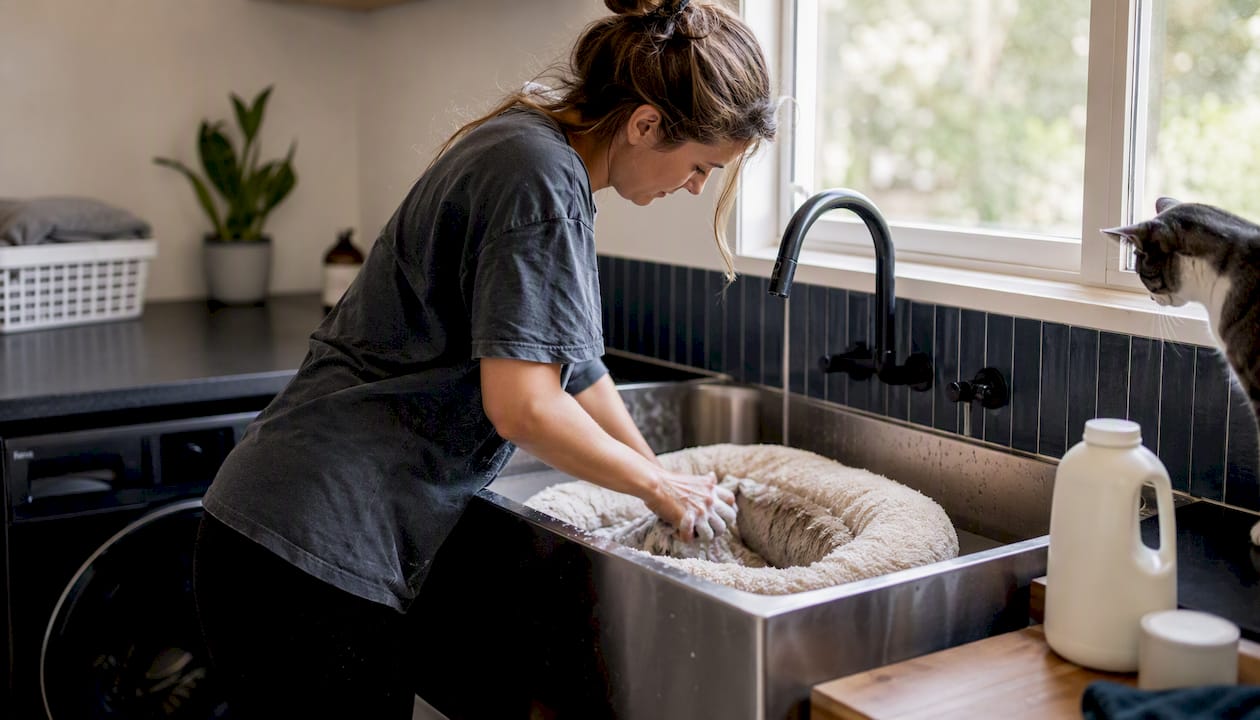
- Wash pet bedding weekly at the highest temperature the fabric allows.
- Bathe dogs every one to two weeks where the breed and temperament allow. Cats can be wiped down with a damp cloth.
- Vacuum upholstery and floors more frequently when pets are present. A HEPA vacuum is worth the investment because standard bags and filters recirculate fine dander particles back into the air.
- Use washable covers on sofas and armchairs. Fitted covers can be laundered weekly and protect the upholstery underneath.
Pro Tip: If you are moving into a rental with a history of pets, request a professional carpet clean from the landlord before you move in. Dander from previous tenants’ animals can trigger reactions for months. Get the request and any agreement in writing.
For shared houses, a brief written agreement about pet-access zones and cleaning frequency prevents friction and keeps allergen levels consistent across the whole property.
Ventilation and cooking: reducing fumes in small rental kitchens
Asthma Australia flags gas cooking emissions — specifically nitrogen dioxide (NO₂) and fine particulate matter (PM2.5) — as triggers that can worsen or contribute to asthma. The risk is highest in small, poorly ventilated kitchens, which describes a large proportion of Australian rental apartments.
Practical steps:
- Always run the rangehood or exhaust fan from the moment you turn on the hob, not after the smoke appears.
- Keep it running for at least five minutes after you finish cooking to clear residual fumes.
- Open a window when outdoor air quality allows. On high-pollen or smoke days, rely on the rangehood alone.
- Consider a portable induction cooktop for heavy cooking sessions if your rental has gas. Running it near an open window or under an exhaust fan reduces NO₂ exposure significantly.
- Run your HEPA purifier in the kitchen or adjacent living area during and after cooking.
Ventilation note: In apartments where windows face a busy road or a bushfire smoke corridor, check the Bureau of Meteorology’s air quality forecasts before opening windows. On poor air-quality days, a purifier with a sealed HEPA filter is a better option than outdoor ventilation.
For small floor plans where the kitchen opens directly to the living area, a purifier placed on the kitchen bench or counter during cooking can capture a meaningful share of cooking particles before they settle.
Air purifiers and filtration: what renters should look for
Portable air cleaners sized to the room you use most, run continuously on a low setting, consistently outperform multiple undersized units or occasional high-power blasts. That single habit is the most reliable filtration strategy for renters.
What to look for:
- True HEPA filtration. This is the non-negotiable. HEPA filters capture 99.97% of particles at 0.3 microns, covering dust mite debris, pollen, pet dander, and fine smoke particles.
- No ioniser or ozone-generating function. Asthma Australia warns that ionising units can produce ozone, which may worsen asthma symptoms. Check the product specifications before buying.
- CADR matched to room size. The Clean Air Delivery Rate (CADR) tells you how much filtered air the unit delivers per hour. Match it to the square meterage of the room, not the whole apartment.
- Low noise level. A unit you can sleep through is one you will actually leave running overnight.
- Transparent filter replacement cost. Budget for replacement HEPA filters annually; a cheap unit with expensive or hard-to-source filters is a false economy.
- Portability. Renters move. A unit with a carry handle and a compact footprint goes with you.
Pro Tip: Place the purifier with at least 30 cm of clear space on all sides. Tucking it into a bookshelf or behind a curtain cuts its effective output by a third or more.
For a detailed guide to choosing a HEPA air purifier matched to room size, filter type, and budget, the Pureair-au buyer’s guide covers the full decision process.
Choosing a purifier or dehumidifier as a renter in Australia
Australian rentals face a specific combination of challenges: high coastal humidity in cities like Sydney and Brisbane, bushfire smoke events that can last weeks, and a high proportion of gas-cooking apartments. A purifier or dehumidifier that works well in a temperate European climate may not be sized or sealed appropriately for these conditions.
Renter buying checklist:
- Portability first. You need a unit you can move between rooms and take when you leave.
- AHAM-verified CADR. The AHAM (Association of Home Appliance Manufacturers) verification gives you an independently tested airflow figure, not a marketing claim.
- Certified true HEPA. Not “HEPA-style” or “HEPA-like.” The filter must meet the H13 or H14 standard.
- Quiet operation. Check the decibel rating at the lowest setting; anything above 35 dB will disrupt sleep.
- Local filter availability. Confirm replacement filters are stocked in Australia before you buy the unit.
- Dehumidifier capacity. For a coastal or high-humidity rental, look for a unit rated for the room’s floor area with a litre-per-day extraction rate appropriate for the climate zone.
Pureair-au’s Smart Finder tool lets you input your specific concern (allergies, mould, bushfire smoke, pet dander) and room size to identify a matched unit from their AHAM-verified range. All products are available with Australian delivery and local filter supply.
For renters in humid coastal areas or those dealing with persistent mould, a combined purifier and dehumidifier approach addresses both particle and moisture triggers simultaneously. Pureair-au stocks units suited to both needs, including options designed for the humidity profiles common along Australia’s eastern seaboard.
What to ask your landlord: requests, documentation, and escalation
Some allergen problems are tenant-fixable with portable devices and cleaning habits. Others are structural, and no amount of vacuuming will resolve them without landlord action.
Tenant responsibilities (you handle these):
- Routine cleaning, ventilation habits, and running portable devices.
- Reporting problems promptly and in writing.
- Keeping the property reasonably clean to prevent mould caused by condensation.
Landlord responsibilities (request these in writing):
- Repairing water leaks, roof damage, or rising damp causing structural moisture.
- Fixing or replacing exhaust fans that vent into the ceiling cavity rather than outside.
- Remediating mould caused by building defects (not tenant condensation).
- Arranging professional pest control for cockroach or rodent infestations.
- Providing a professional carpet clean at move-in if the previous tenants had pets.
Sample request phrasing:
“Hi [Landlord/Agent], I’m writing to flag [describe the issue] at [address]. I’ve attached photos taken on [date]. The issue appears to be [structural/maintenance-related] and is affecting indoor air quality. Could you please arrange for this to be assessed and repaired? I’m happy to provide access at a convenient time.”
Documentation checklist:
- Photos with timestamps.
- Hygrometer readings if moisture is the issue.
- Dates of any verbal conversations, followed up in writing.
- Copies of all written requests sent.
If your landlord does not respond, contact your state’s tenancy authority. In NSW that is NSW Fair Trading; in Victoria, Consumer Affairs Victoria; in Queensland, the Residential Tenancies Authority. Each provides free advice and formal dispute pathways. For rental property improvements that require landlord approval, such as installing a permanent extractor fan or sealing gaps, always get written consent before proceeding.
Pureair-au: HEPA solutions for Australian renters
If you are ready to act on this checklist, Pureair-au’s range of HEPA-certified air purifiers, dehumidifiers, and replacement filters is built specifically for Australian conditions. Every unit in the catalogue is AHAM-verified, and the Smart Finder tool matches you to the right product based on your room size and specific concern, whether that is bushfire smoke, pet dander, mould, or pollen.
Browse the full range at the Pureair-au product catalogue and find a unit that moves with you.
Sources
- Asthma Australia: Healthy Homes Guide for Renters
- Mayo Clinic: Allergy — allergy-proof your home
- Renter-friendly clean-air setup | Clean Air Society guide (Fondsites)
- Reuseable
- Healthdirect