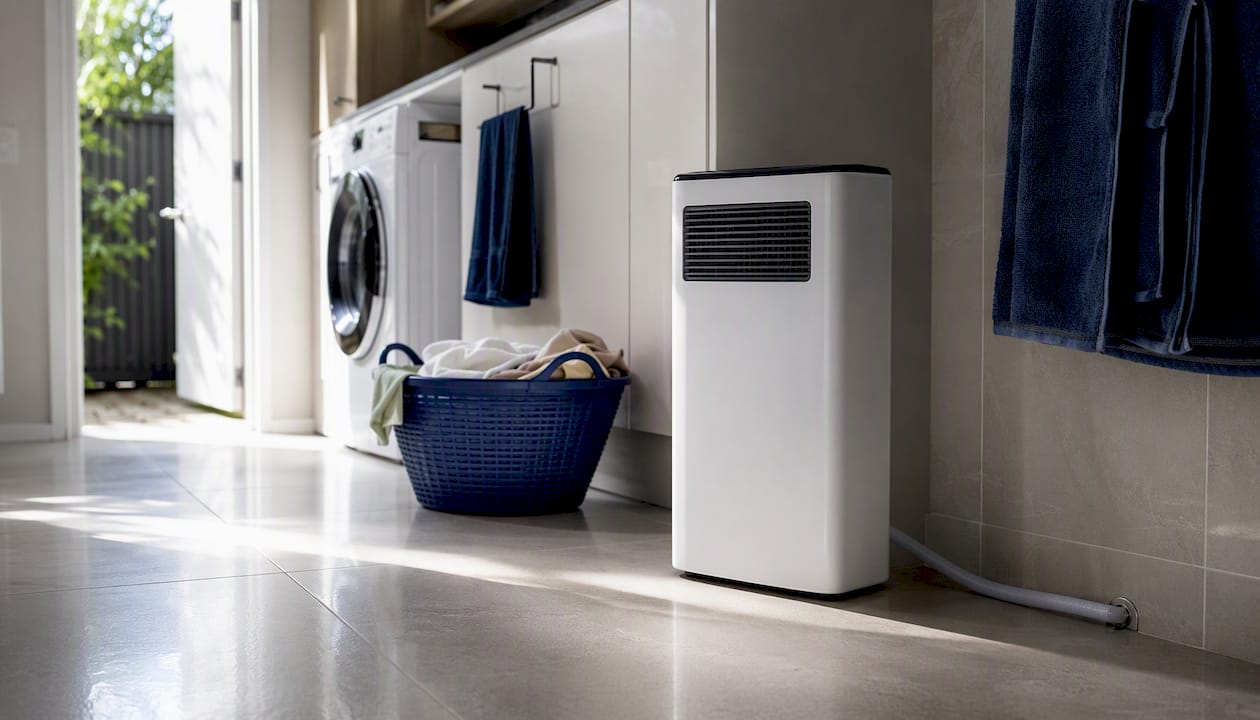
For most humid Australian homes, a refrigerant (compressor) dehumidifier sized to your room is the right starting point. If you’re in a cooler, mould-prone space, a desiccant or LGR unit will outperform a standard compressor model at lower temperatures. Before you buy anything, grab a hygrometer, check your current relative humidity, and run the Pureair-au Smart Finder to match room size, climate zone, and moisture concern to a shortlisted unit.
Three things to confirm before you shortlist:
- AHAM verification on the spec sheet confirms the rated extraction figure is independently tested, not a marketing claim.
- A built-in humidistat lets the unit cycle on and off automatically, so you’re not running it 24 hours a day.
- Australian electrical compliance: look for RCM marking and 220–240V / 50Hz compatibility before purchase.
Key takeaways
Sizing your dehumidifier correctly to your room and climate zone is the single most important decision, and a humidistat set to 45–55% RH does the rest automatically.
| Point | Details |
|---|---|
| Match capacity to room size | Use 20–30 L/day for small rooms, 50–70 L/day for medium, 70–90+ L/day for large or severe damp. |
| Choose the right technology | Refrigerant suits warm coastal climates; LGR or desiccant outperforms in cool or mould-prone spaces. |
| Set humidistat to 45–55% RH | Target under 50% in any area with prior mould; monitor with a hygrometer. |
| Use split AC first in summer | In hot weather, reverse-cycle AC in dry mode is often more efficient than a standalone dehumidifier. |
| Pureair-au Smart Finder | Run the Smart Finder at pureair-au.com to match your room, climate, and concern to an AHAM-verified unit. |
Table of Contents
- How do you choose a dehumidifier for a humid Australian home?
- What do dehumidifiers cost in Australia, and where can you buy one?
- What an air quality specialist actually does differently
- Pureair-au makes it straightforward to find the right unit
- Sources
How do you choose a dehumidifier for a humid Australian home?
Sizing: how many litres per day do you actually need?
Litres-per-day ratings are measured at 30°C and 80% RH, so real-world extraction in a cooler room will be lower. Use the table below as a starting point, then adjust up one tier if the space has visible mould, poor ventilation, or sits in a tropical or subtropical climate zone.
| Room size | Moisture severity | Recommended capacity |
|---|---|---|
| Small (up to ~25 m²) | Mild dampness | 20–30 L/day |
| Medium (25–60 m²) | Moderate, typical home | 50–70 L/day |
| Large or whole home | Severe, post-flood, restoration | 70 L/day or more |
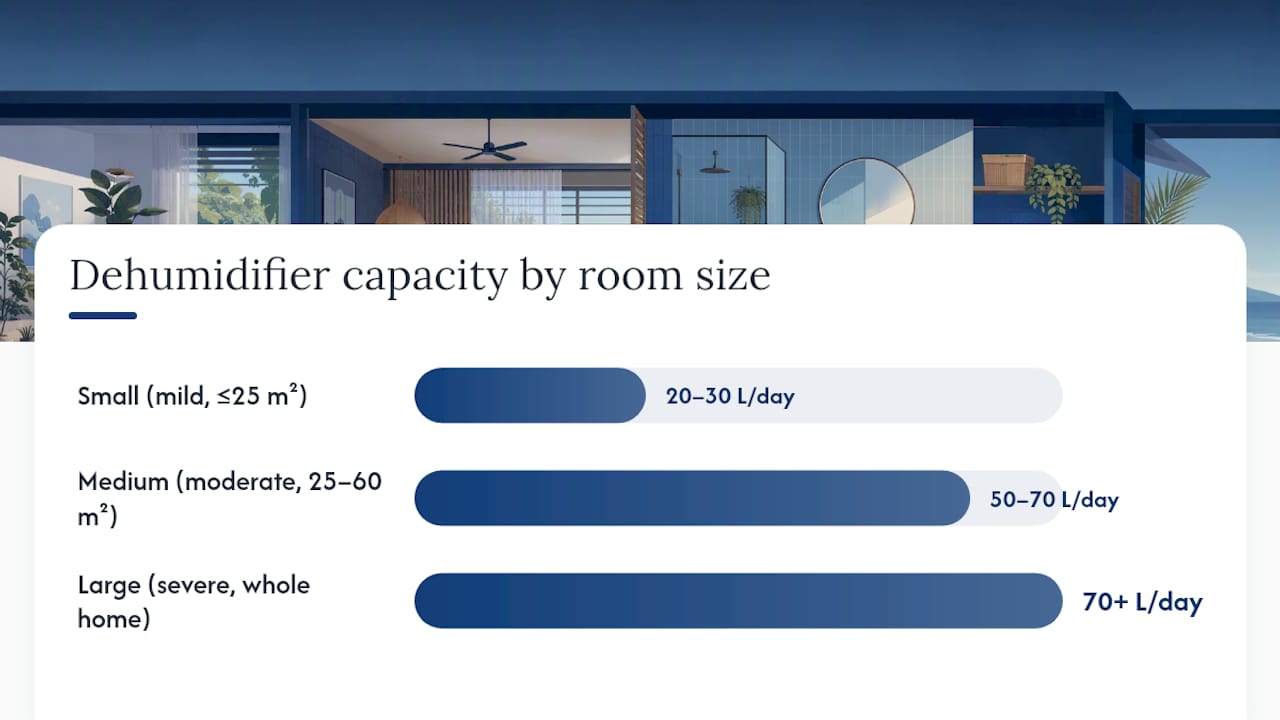
Understanding what dehumidifier capacity means in practice helps you avoid buying a unit that’s undersized for your actual conditions.
Which type suits Australian climates?
Refrigerant/compressor units are the workhorse for warm, coastal, and tropical homes. They’re energy-efficient above about 15°C and cover most of Queensland, NSW, and WA coastal areas year-round.
LGR (low-grain refrigerant) and desiccant models hold their extraction rate in cooler conditions where a standard compressor loses efficiency. Choice lab testing confirms that refrigerant and desiccant models behave differently in hot versus cold conditions, so if you’re dealing with a cool laundry, subfloor, or a southern-states winter, LGR or desiccant is the smarter pick.
Thermoelectric units are quiet but low-powered. They suit a small wardrobe or bathroom, not a living room with a real moisture problem.
Key features checklist
- Humidistat: set to 45–55% RH and the unit does the rest
- Continuous drain (gravity or pump): gravity-feed to a floor drain is the most reliable long-term setup; choose a pump model if gravity isn’t feasible
- Operating temperature range: check the lower limit if you’re running it through winter
- Energy use (kW): compare wattage, not just capacity, to estimate running costs
- Noise (dB): anything above ~50 dB will be noticeable in a bedroom
- Timer / app control: useful for scheduling around sleep or peak tariff hours
- Filter type: HEPA filtration captures fine particles alongside moisture
- RCM marking and local warranty: Australian buying guides stress that RCM marking and a responsible local supplier are non-negotiable before purchase
Running costs: multiply the unit’s wattage (kW) by your daily run hours, then by your electricity rate (c/kWh).
Placement: close all doors and windows, keep the unit away from walls (at least 30 cm clearance), and position it centrally. Consumer reports show a unit can pull around 1 litre from a bedroom-sized space in a few hours and up to 16 litres in 24 hours depending on model and conditions.
Pro Tip: If your home has a laundry or bathroom with a floor drain, set up gravity-fed continuous drainage from day one. You’ll never empty a tank again, and the unit can run unattended through a wet week.
What do dehumidifiers cost in Australia, and where can you buy one?
Entry-level units (20–30 L/day) typically start around $200–$350. Mid-range models with humidistats, continuous drain, and app control sit in the $350–$600 range. Larger capacity or feature-rich units, such as a 25 L/day model with HEPA filtration and app control, generally land between $500 and $800.
Canstar Blue’s survey of 308 Australian consumers found brands including Ausclimate, Breville, and De’Longhi rated across performance, value, and quietness, giving a useful benchmark for what Australians actually experience after purchase.
You can buy dehumidifiers from major appliance retailers (Harvey Norman, The Good Guys, JB Hi-Fi), online marketplaces, and specialist air quality stores. Buying from a local supplier with Australian after-sales support matters more than saving $30 on a grey-market import with no local warranty.
What an air quality specialist actually does differently
Most people buy a dehumidifier and run it constantly. That’s not the right approach, and it’s not the most cost-effective one either.
A split-system reverse-cycle air conditioner in ‘dry’ mode often dries and cools simultaneously in warm weather, draining moisture externally. In Queensland or coastal NSW summers, your split system is doing dehumidification work already. Reserve the standalone dehumidifier for cooler months, enclosed rooms the AC doesn’t reach, laundries, and crawlspaces.
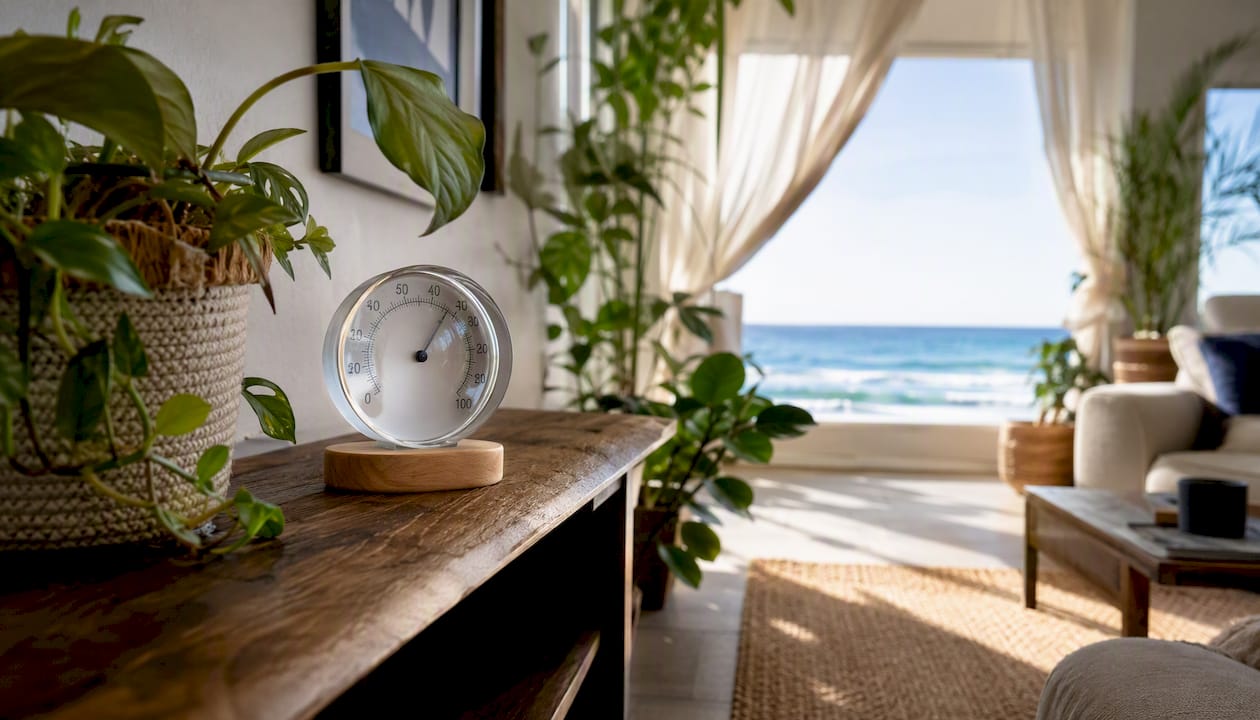
Mould accelerates above 60% RH; the professional target is 45–55%, and under 50% in any area that’s had mould before. Set your humidistat there and monitor with a hygrometer. Understanding how humidity affects indoor air quality explains why that 50% threshold matters beyond just comfort.
Maintenance is where most units fail. Empty the tank before it hits capacity, clean or replace the filter every 3–6 months, and check the continuous drain hose for blockages each season. Verify your unit carries a local warranty contact before you need it.
Pureair-au makes it straightforward to find the right unit
Choosing between compressor, LGR, and desiccant while cross-referencing L/day ratings, operating temperatures, and energy figures takes time most homeowners don’t have. Pureair-au’s Smart Finder tool cuts that process to minutes: enter your room size, climate zone, and primary concern (mould, damp clothes, post-flood restoration), and it returns a shortlist of AHAM-verified units matched to your conditions.
Every unit in the Pureair-au range carries Australian electrical compliance (RCM, 220–240V/50Hz), local warranty support, and where relevant, medical-grade HEPA filtration. Browse the full dehumidifier catalogue, run the Smart Finder, and add a continuous drain or pump option at checkout if your placement allows it.
Sources
- Best dehumidifiers
- Best‑rated dehumidifier brand – Canstar Blue
- Best dehumidifier Australia (Home Beautiful)
- Dehumidifier buying guide Australia 2026 (NordicDesignBlog)