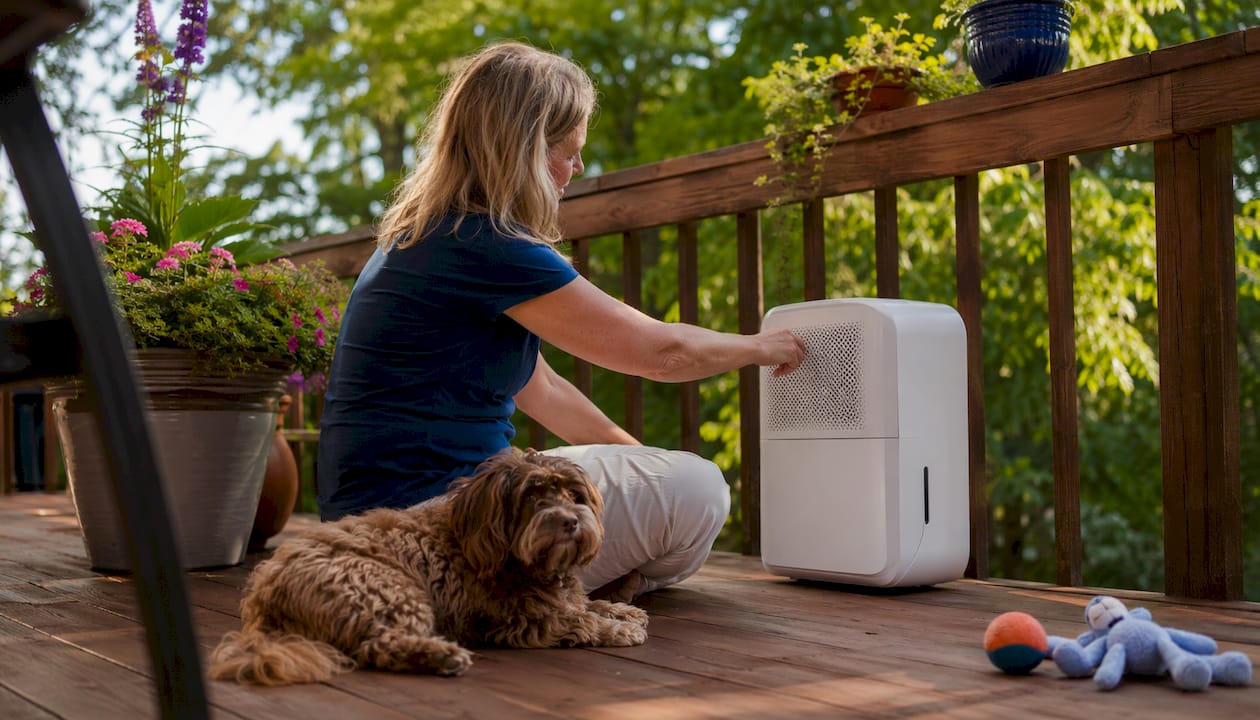
A dehumidifier reduces the conditions that make pet odour worse, but it cannot chemically break down urine or protein residues on its own. To actually eliminate pet smell, you need three things working together: enzyme-based source cleaning, mechanical moisture control set to a target relative humidity (RH), and active air purification with activated carbon plus HEPA filtration. Miss any one of them, and the smell comes back.
Here’s what to expect on timing:
- Over a few days: Noticeable reduction in ambient odour once a properly sized dehumidifier is running at the recommended relative humidity range
- Within a few weeks: Fuller benefit when enzyme cleaning and purification run alongside dehumidification
- Ongoing: Consistent maintenance prevents reactivation of uric acid crystals in carpet padding, which re-emit odour every time humidity spikes
Table of Contents
- Does a dehumidifier help with pet odour, or is it just part of the fix?
- How to remove pet smells: treat the source first, then control moisture and air
- What to look for in a dehumidifier for pet homes in Australia
- How to co-ordinate your dehumidifier, HEPA purifier and cleaning routine
- Maintenance tasks, filter schedules and what to expect over time
- When cleaning and a dehumidifier aren’t enough
- Key takeaways
- The case for treating air quality as a system, not a single device
- Pure Air’s approach to pet odour control for Australian families
- Useful sources
Does a dehumidifier help with pet odour, or is it just part of the fix?
A dehumidifier lowers odour volatility and slows the bacterial activity that turns pet waste into pungent airborne compounds. Damp air carries odour molecules more readily, so when you pull moisture out of a room, you reduce how strongly those molecules reach your nose. You also slow the microbial breakdown of organic material in soft furnishings, which is what produces the sharpest, most persistent smells.
What a dehumidifier cannot do is break down uric acid or protein residues sitting in carpet fibres or padding. Those compounds are essentially insoluble in water. Scrubbing with soapy water moves them around; it does not destroy them. Only enzyme cleaners with urease and protease actually digest the molecular bonds. A dehumidifier running over an untreated stain will reduce how much you smell it on a dry day, but the residue is still there, waiting for the next humidity spike to reactivate.
Pro Tip: Never run a steam cleaner over a pet stain before enzyme treatment. Heat sets protein stains permanently into fibres, making them far harder to remove later.
How to remove pet smells: treat the source first, then control moisture and air
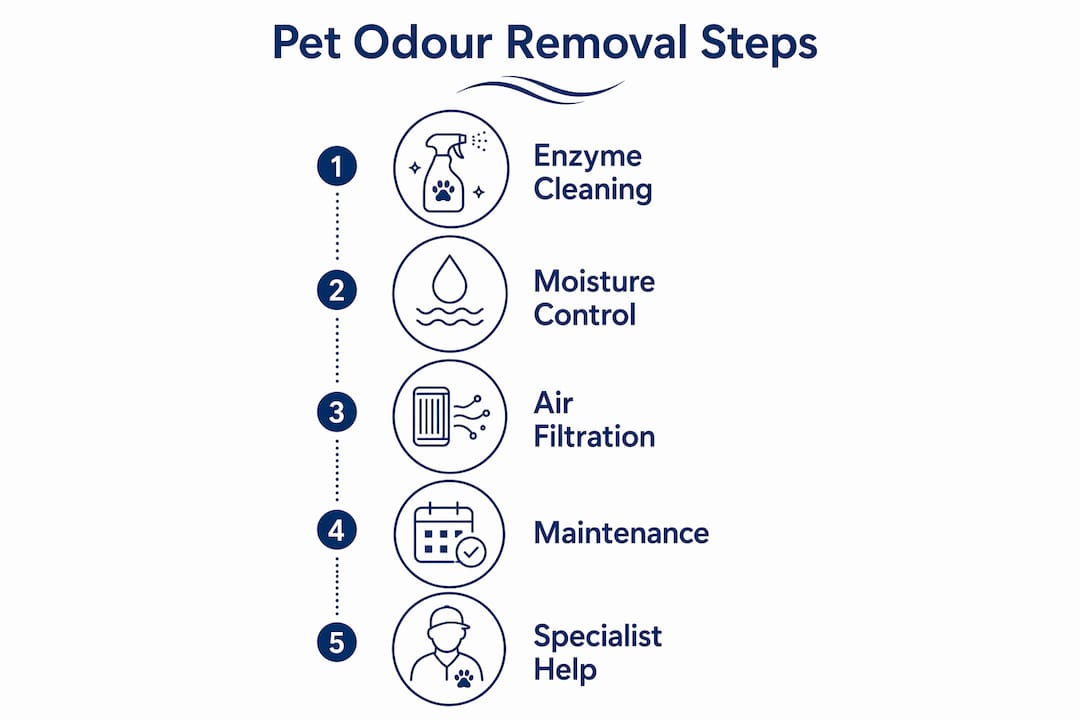
Follow this sequence. Skipping steps or reversing the order reduces effectiveness significantly.
- Apply enzyme cleaner generously to the affected area. For fresh stains, allow a dwell time of 4–8 hours. For set-in stains, allow 8–24 hours to give the enzymes time to break down uric acid and protein bonds fully. Keep the surface moist during dwell time; a dry enzyme cleaner stops working.
- Blot, do not rub, then allow the area to air dry. Once dry, check for residual odour. Repeat enzyme treatment if the smell persists before moving to any heat-based cleaning.
- Run your dehumidifier set to 50–55% RH. This range reduces odour volatility and slows bacterial activity without drying the air to a level that irritates pets or people. Use the humidistat to hold that target rather than running the unit at full capacity continuously.
- Run an air purifier with activated carbon and HEPA filtration simultaneously. The carbon stage captures VOC compounds and odour molecules already airborne; the HEPA stage removes dander and fine particles that carry allergens. Both stages together address what the dehumidifier cannot.
- Schedule a follow-up enzyme treatment at 3–4 weeks if the odour returns after a humidity event. Uric acid crystals in padding can reactivate with humidity spikes even after a thorough initial clean.
Most households notice meaningful improvement within 3–7 days of running this combined routine consistently. Full benefit typically takes 2–4 weeks.
What to look for in a dehumidifier for pet homes in Australia
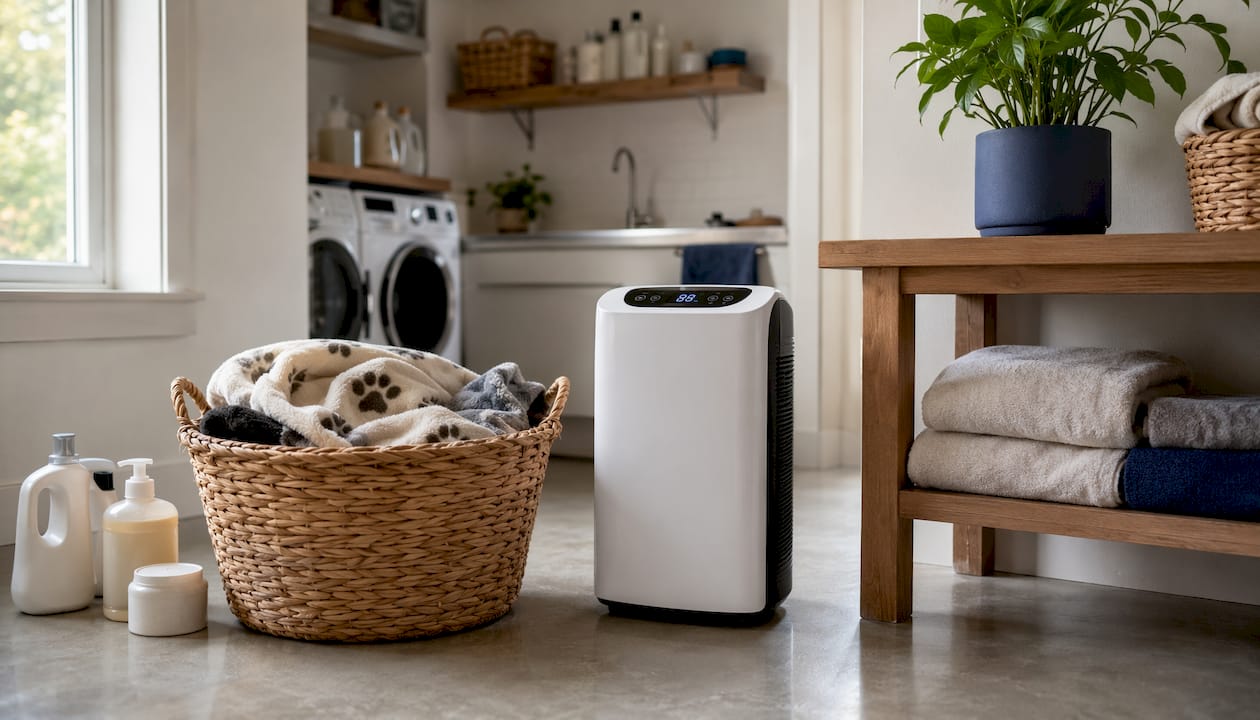
Capacity is the first decision. Smaller single-pet bedrooms require moderate extraction capacity, while multiple pets or larger living areas need higher capacity. Persistent problems in large or poorly ventilated spaces, including basements and open-plan areas, typically require even greater extraction capacity or a whole-home solution integrated with your HVAC.
| Feature | Why it matters for pet homes |
|---|---|
| Accurate humidistat | Holds RH at 50–55% automatically; prevents over-drying |
| Continuous drain option | Eliminates daily tank emptying; supports unattended overnight runs |
| Activated carbon filter or compatibility | Captures VOCs and pet odour molecules the dehumidifier draws through |
| AHAM verification | Confirms rated extraction capacity is independently tested |
| Low noise (quiet operation on low) | Avoids stressing pets; suitable for bedrooms |
| Energy star or high energy rating | Reduces running costs for continuous operation |
| Local warranty and filter supply | Ensures timely filter replacement and aftercare in Australia |
Australian climates vary sharply. Coastal Queensland and northern NSW run high ambient humidity year-round, where a 20+ L/day unit earns its keep every month. In Melbourne or Adelaide, seasonal humidity swings mean a mid-range unit with a reliable humidistat handles most situations. For very humid climates or whole-home coverage, integrated dehumidification paired with central HVAC gives more consistent control than standalone room units.
Pro Tip: AHAM verification is the only independent confirmation that a dehumidifier’s rated capacity reflects real-world performance. Check for it before purchase, especially for units marketed specifically for odour control.
How to co-ordinate your dehumidifier, HEPA purifier and cleaning routine
Placement and scheduling matter as much as the devices themselves. Getting this right means faster, measurable results.
- Dehumidifier placement: Position in the room where pets spend the most time, away from walls and furniture to allow free airflow. In open-plan homes, a higher-capacity unit centrally placed outperforms two smaller units in corners.
- Air purifier placement: Place the purifier in the same room, on the opposite side from the dehumidifier where possible. This creates a cross-room air movement pattern that draws air through both devices. For bedrooms, run the purifier overnight on a low, quiet setting. Understanding air circulation and pet dander helps you position devices for maximum coverage.
- Dehumidifier run schedule: Continuous low-level operation at the humidistat setpoint is more effective than intermittent high-capacity runs. After a cleaning session or an accident, run at higher capacity for 2–3 hours to accelerate drying, then return to the maintenance setpoint.
- Air purifier run schedule: Run continuously in pet rest areas. Overnight runtime in bedrooms addresses the dander accumulation that happens while pets sleep nearby.
- Filter pairing: HEPA captures particles, dander and fine dust. Activated carbon adsorbs odour molecules and VOCs. Neither stage replaces the other. A dedicated activated carbon filter paired with medical-grade HEPA addresses both the particle and odour dimensions that a dehumidifier alone cannot reach.
Maintenance tasks, filter schedules and what to expect over time
| Task | Frequency | Notes |
|---|---|---|
| Empty water tank | Daily (if no continuous drain) | Stagnant water grows bacteria; continuous drain eliminates this task |
| Vacuum pet zones | Twice weekly | Reduces dander load before it circulates |
| Wash pet bedding | Weekly with warm water cleaning | Enzyme-active detergent removes residue standard washing misses |
| Clean dehumidifier coils and tank | Monthly | Prevents mould and bacterial buildup inside the unit |
| Replace activated carbon filter | Every 3 months | Saturated carbon re-releases captured odour compounds |
| Replace HEPA filter | Every 6 months | Depends on pet activity and air quality; check manufacturer guidance |
| Deep enzyme clean of carpets and upholstery | Every 4 weeks | Shorter interval for multi-pet or long-haired breeds |
Expect noticeable odour reduction within 3–7 days of consistent operation. The full benefit of combined enzyme treatment, dehumidification and purification typically appears over 2–4 weeks. After that, the maintenance schedule above preserves performance. Local filter supply and aftercare in Australia reduces downtime between replacements, which matters for continuous-operation households.
When cleaning and a dehumidifier aren’t enough
Some situations call for professional remediation. Recognise these signs early.
- Odour persists after two full enzyme treatment cycles and consistent dehumidification at 50–55% RH. The residue has likely penetrated carpet backing or subfloor material beyond surface-level treatment.
- Smell returns sharply with every humidity spike, even after thorough cleaning. Uric acid crystals in padding are reactivating; the padding itself may need replacement.
- Visible staining in carpet backing or subfloor, or mould growth on walls or skirting boards. These require structural assessment, not just cleaning.
- Structural damp from plumbing leaks or rising damp. A dehumidifier manages symptoms; it cannot fix the moisture source.
When you call a remediation specialist, expect hot-water extraction, padding replacement, and potentially subfloor checks. Before the technician arrives, prepare: photographs of affected areas, a log of treatments applied and dates, and recent RH readings from a hygrometer. That information helps the specialist assess severity and quote accurately. For persistent cases, air quality testing before and after remediation confirms whether the intervention worked.
Key takeaways
A dehumidifier reduces pet odour by controlling moisture, but enzyme cleaning must come first and activated carbon plus HEPA filtration must run alongside it for lasting results.
| Point | Details |
|---|---|
| Enzymes before everything | Apply enzyme cleaner with an 8–24 hour dwell time for set-in stains before any other treatment. |
| Target RH of 50–55% | Set your humidistat to this range to reduce odour volatility and slow bacterial activity. |
| Pair carbon and HEPA | Activated carbon captures VOCs and odour molecules; HEPA removes dander. Neither replaces the other. |
| Expect results in 3–7 days | Noticeable improvement typically arrives within 3–7 days; full benefit takes 2–4 weeks of consistent operation. |
| Pureair-au for Australian families | AHAM-verified dehumidifiers and medical-grade HEPA plus carbon purifiers, available with local aftercare in Australia. |
The case for treating air quality as a system, not a single device
Most pet owners buy a dehumidifier or an air purifier and expect one device to solve the problem. It rarely does, and the reason is straightforward: pet odour has three distinct components. There’s the residue in the fabric, the airborne VOCs those residues emit, and the particles (dander, hair, dust) that carry allergens. No single device addresses all three.
The multi-layer approach, enzyme cleaning plus moisture control plus HEPA and carbon filtration, is not a marketing construct. It maps directly to the chemistry of what pet odour actually is. What I find underestimated is the humidity piece specifically. Australian families in coastal climates deal with ambient RH that regularly exceeds 70% in summer. At that level, even a well-cleaned carpet will re-emit odour from residues you thought were gone. A dehumidifier holding 50–55% RH is not a luxury in those conditions; it’s what makes the enzyme treatment stick.
Medical-grade HEPA at 99.97% capture matters here too, not just for odour but for the allergic responses that pet dander triggers. Families managing asthma or rhinitis alongside pet ownership need both the particle and the odour dimension addressed simultaneously. That’s the standard worth holding devices to.
Pure Air’s approach to pet odour control for Australian families
Persistent pet odour calls for a specific combination of devices, not a single purchase. Pureair-au stocks AHAM-verified dehumidifiers and medical-grade HEPA purifiers with activated carbon stages, selected for Australian climate conditions and available with local warranty and filter support.
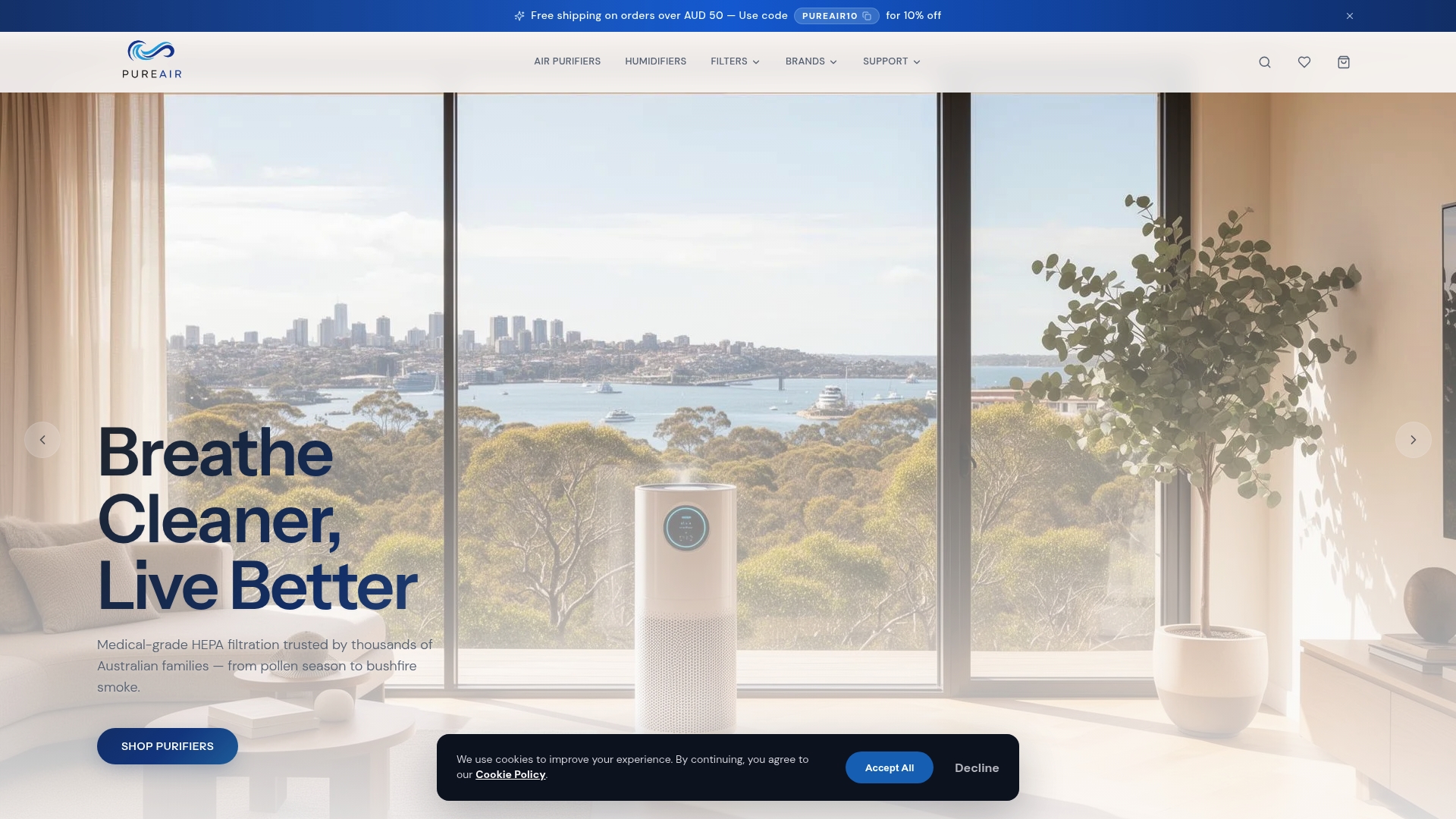
The Smart Finder tool on the Pureair-au website matches your room size, pet situation and climate zone to the right unit, taking the guesswork out of capacity and filter selection. Replacement filters, including HEPA and activated carbon stages, are stocked locally so you’re not waiting weeks for consumables that keep your system running. For families managing allergies alongside pet ownership, the full product catalogue covers HEPA plus carbon pairings suited to everything from a single-pet bedroom to a whole-home setup. Browse the range or use the Smart Finder at pureair-au.com to find the right combination for your home.
Useful sources
- Enzyme cleaner dwell times and pet stain removal guidance — detailed protocol for fresh and set-in stains, including uric acid breakdown
- Does a dehumidifier help with pet odour? — RH targets, timelines and capacity guidance
- Does a dehumidifier help with smell? — limits of dehumidification for urine and organic residues
- How to get rid of pet smell in your home — cleaning sequence and the steam-before-enzymes warning
- Dehumidifiers for pet odour basements — capacity guidance for small, medium and large spaces
- Dehumidifiers and allergen control: a home guide — AHAM verification, filter supply and Australian aftercare
- Reduce indoor humidity in humid climates — climate-tailored dehumidification for Australian homes
- Before purchasing any dehumidifier or purifier, verify AHAM certification and confirm HEPA filtration is rated at 99.97% capture efficiency.