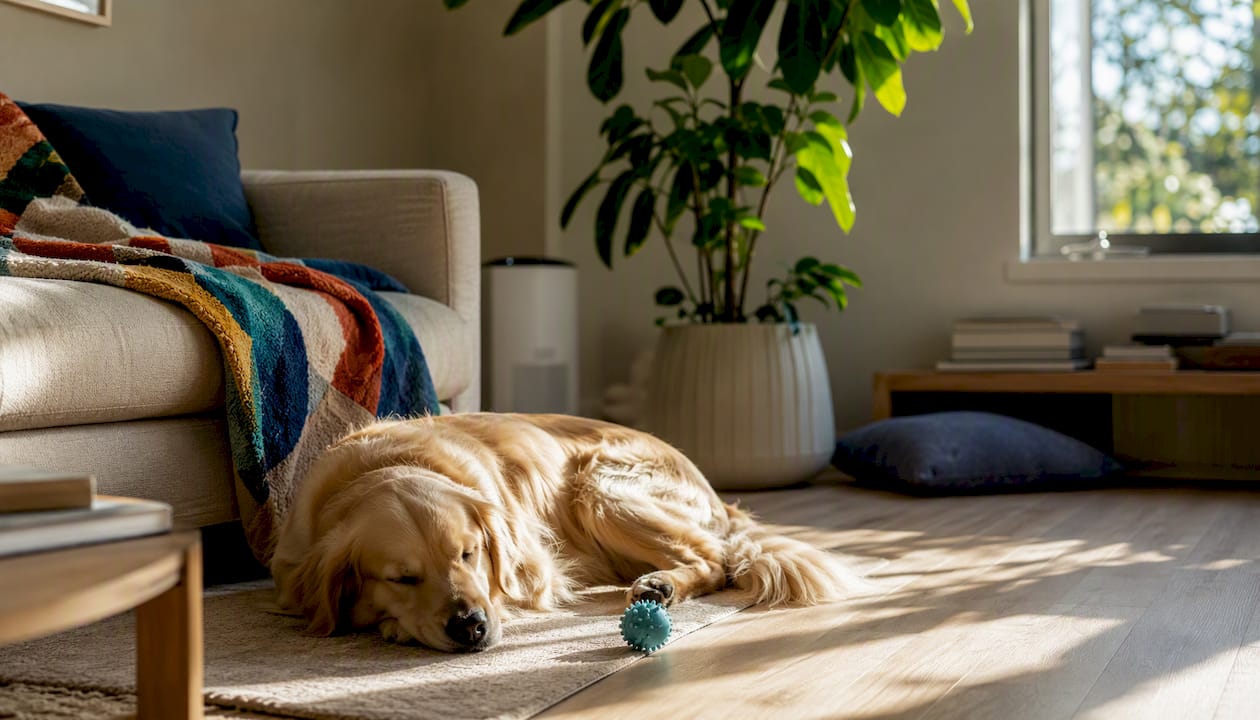
To stop a room smelling like a pet now and long-term, neutralise the organic source with an enzyme cleaner, extract trapped odour from fabrics and padding, then run active filtration with True HEPA plus activated carbon. That three-step sequence is what cleaning professionals recommend over any single product or spray. The single most effective investment for lasting results is an AHAM-verified HEPA + activated carbon purifier sized to your main living area. Pureair-au’s range meets that standard for Australian homes.
What you’re actually fighting isn’t a general “pet smell.” It’s a mix of:
- Uric acid crystals from urine, which reactivate with humidity and keep releasing odour long after the spot looks dry
- Sebum (skin lipids) shed constantly through fur and dander, which penetrate deep into carpet fibres and upholstery foam
- Saliva proteins deposited on surfaces during grooming and play
- Airborne dander, which carries odour molecules and recirculates through your HVAC system
Masking these with synthetic air fresheners or plug-ins doesn’t work. You get a suffocating mix of perfume and pet odour, and the molecular source remains untouched.
Table of Contents
- What can you do right now to freshen a room fast?
- Room-by-room deep-clean plan for entrenched odours
- What actually neutralises pet odour — and what to avoid
- A simple weekly and monthly routine to stay ahead of odour
- When does persistent odour signal a bigger problem?
- Key takeaways
- The thing most pet owners get wrong about nose-blindness
- Pureair-au’s HEPA + carbon purifiers for Australian pet homes
What can you do right now to freshen a room fast?
When guests are arriving in 30 minutes, you need speed, not a deep clean. These steps are ranked by impact and time required, based on expert practitioner advice:
- Open windows and create a cross-breeze (10–15 minutes). Two open windows on opposite sides of the room move stale air out faster than a single window. This alone shifts the baseline noticeably.
- Throw pet blankets and throws in the dryer on high heat for a suitable short period. Even without washing, heat kills odour-causing bacteria and refreshes fabric quickly.
- Sprinkle baking soda on carpets and soft furniture, wait a short time, then vacuum. Baking soda absorbs odour molecules rather than covering them.
- Spot-treat any visible accident areas with an enzyme spray (15 minutes dwell time). Don’t wipe immediately — let the enzymes work.
- Run your air purifier on its highest setting (10–30 minutes). A unit with activated carbon starts pulling gaseous odour molecules from the air within minutes.
Skip the heavy synthetic sprays for this list. They layer fragrance over odour and make the problem worse once the scent fades.
Pro Tip: You’ve almost certainly gone nose-blind to your own home’s smell. Before guests arrive, step outside for five minutes, then walk back in through the front door. That first breath tells you what your guests will notice. Better still, ask a neighbour or friend for an honest read.
Room-by-room deep-clean plan for entrenched odours
Quick fixes won’t touch odour that has soaked into padding or subfloor. Here’s where to go deeper.
Living room carpets and rugs
The uric acid in pet urine bonds to carpet fibres and padding, then reactivates every time humidity rises. Light spraying doesn’t reach it.
- Identify the affected zone using a UV torch in a darkened room — dried urine fluoresces yellow-green.
- Saturate the area with enzyme cleaner. You need enough product to reach the same depth the urine did, which often means soaking through to the backing.
- Cover with a damp cloth and allow 20–30 minutes dwell time. Don’t steam clean yet — heat sets proteins and deactivates enzymes before they finish working.
- Blot (don’t rub) with clean towels, then extract with a wet-dry vacuum or carpet extractor.
- For severe or repeated incidents, lift the rug or carpet and treat the subfloor directly with enzyme cleaner, then allow it to dry fully before relaying.
Pro Tip: A light mist is almost always ineffective on established urine odour. If you wouldn’t wet the fabric with water, you haven’t used enough enzyme cleaner.
Upholstery and removable covers
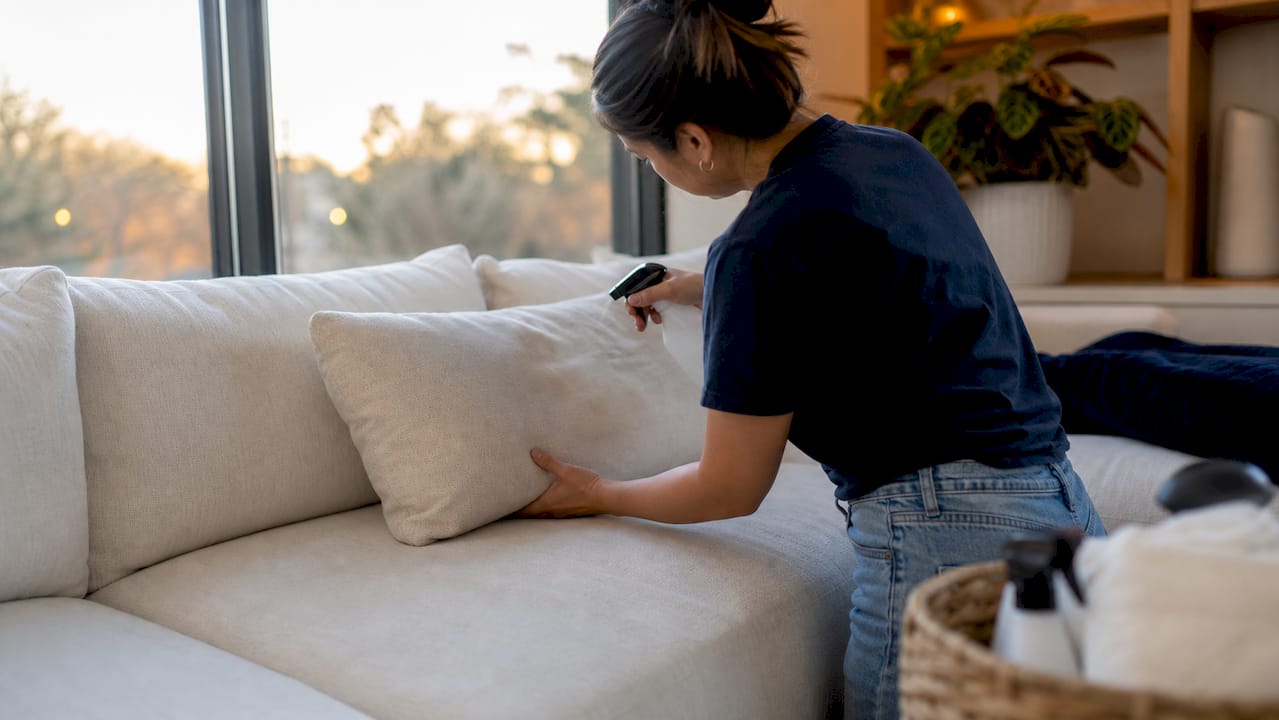
Wash removable covers at the hottest temperature the care label allows. Add half a cup of white vinegar to the rinse cycle — it neutralises alkaline urine compounds that detergent alone misses. For non-removable upholstery, apply enzyme cleaner, allow it to dwell, then follow with a fabric steamer once the enzymatic action is complete.
Hard floors, skirting boards and baseboards
Urine seeps into grout lines, timber grain and expansion gaps. On tiles, use an enzyme cleaner diluted per the label and work it into grout with a stiff brush. On timber floors, avoid soaking — apply enzyme cleaner sparingly, wipe clean, then follow with a timber-safe neutral cleaner. Pay attention to the gap between the skirting board and floor; that’s where urine pools and dries invisibly.
Pet bedding, crates and litter boxes
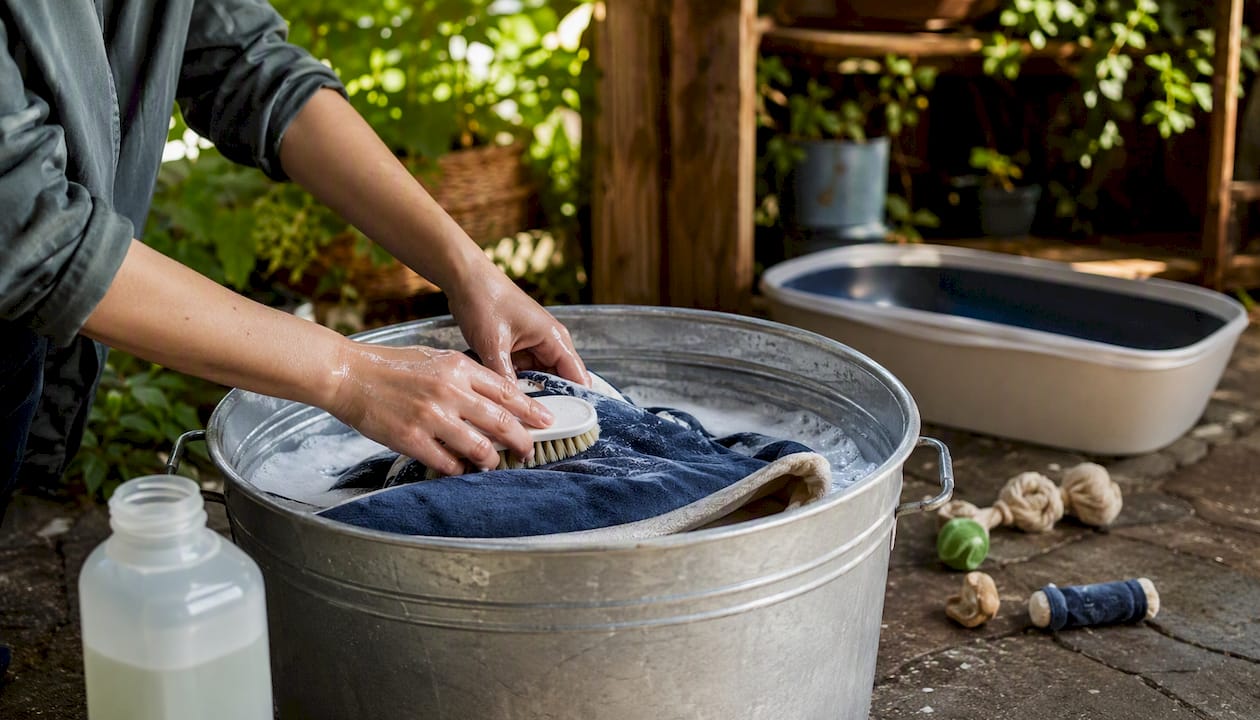
Wash bedding weekly in hot water with a pet-safe detergent and white vinegar. Foam inserts that can’t be machine-washed should be sun-dried monthly — UV light breaks down odour-causing bacteria. Litter boxes need a full scrub with warm water and a small amount of white vinegar (not bleach) weekly, and litter should be completely replaced every 1–2 weeks depending on the number of cats.
What actually neutralises pet odour — and what to avoid
Products that work
- Enzyme cleaners containing protease, lipase and urease digest the proteins, lipids and uric acid that cause odour. They need dwell time to work — follow the application instructions and don’t rush the process.
Products to avoid
Phenol-based cleaners and straight bleach on fabrics are both problematic. Bleach can set protein stains and produces fumes harmful to pets. Phenols are toxic to cats in particular. Heavy synthetic fragranced plug-ins mask rather than neutralise and leave the molecular source intact.
On essential oils: some are genuinely harmful to pets. Tea tree, eucalyptus, pennyroyal and cinnamon oils can cause toxicity in cats and dogs even at low concentrations. If you use a diffuser, keep pets out of the room during use and ventilate well before letting them back in.
A simple weekly and monthly routine to stay ahead of odour
Odour becomes entrenched when small amounts of sebum and dander accumulate unchecked. A short, consistent routine prevents that.
Weekly:
- Vacuum high-pet zones (sofa, pet beds, favourite floor spots) with a HEPA-filtered vacuum
- Wash pet bedding on a hot cycle with white vinegar in the rinse
- Wipe paws at the door after outdoor time to reduce tracked-in bacteria
- Run your air purifier on high for 2–3 hours, especially after your pet has been active indoors
Monthly:
- Deep-extract carpets in high-traffic pet zones, or spot-extract problem areas
- Clean or replace HVAC filters and your purifier’s pre-filter
- Sun and air foam inserts from pet beds
- Shampoo rugs if needed
Pro Tip: High-humidity homes and multi-pet households need shorter cycles — not longer. Humidity reactivates uric acid crystals and accelerates bacterial growth. If you live in a coastal or tropical part of Australia, treat the weekly list as your baseline and add a mid-week vacuum.
When does persistent odour signal a bigger problem?
If a room still smells after a full enzyme treatment and extraction, the odour has almost certainly penetrated the padding, foam or subfloor. Professional extraction uses commercial-grade machinery and controlled drying that home equipment can’t replicate. In severe cases, carpet padding needs replacing entirely.
A change in your pet’s odour is a different matter. New or worsening breath odour often signals dental disease. A musty or yeasty skin smell can indicate a skin infection or ear infection. Neither improves with cleaning — they need a vet visit.
Red flags that mean escalate:
- Odour returns within days of a full deep clean
- Smell intensifies after rain or high humidity
- Visible damp patches in carpet or at the base of walls
- New or worsening bad breath, skin odour or ear smell in your pet
Key takeaways
A multi-layer strategy — enzyme treatment, physical extraction, and active HEPA + activated carbon filtration — is the only reliable way to eliminate pet odour from rooms long-term.
| Point | Details |
|---|---|
| Neutralise, don’t mask | Enzyme cleaners break down uric acid and proteins; synthetic fragrances leave the source intact. |
| Saturation matters | Light spraying won’t reach padding or subfloor — use enough product to match the depth of the original incident. |
| Two-stage filtration | True HEPA captures dander; activated carbon adsorbs gaseous VOCs. You need both stages. |
| Consistent routine | Weekly vacuuming, hot-wash bedding, and regular purifier use prevent odour from becoming entrenched. |
| Pureair-au for lasting results | AHAM-verified HEPA + activated carbon purifiers sized for Australian living areas are the recommended long-term investment. |
The thing most pet owners get wrong about nose-blindness
Living with a pet means your nose adjusts. You stop noticing the smell that your guests notice the moment they walk in. That’s not a character flaw — it’s just how olfactory adaptation works. The problem is that nose-blindness makes it easy to underestimate how much odour has built up, and to stop the cleaning routine before it’s actually finished.
The good news is that the fix isn’t complicated. Small, regular actions — weekly washing, consistent vacuuming, running a purifier — prevent the kind of deep saturation that requires professional intervention. Most pet households that end up needing a professional extraction got there through months of light cleaning that felt adequate but wasn’t reaching the padding.
Serious problems are resolvable. Padding can be replaced, subfloors can be treated, and professional extraction services operate across Australia. But the better path is the boring one: stay consistent, use the right products, and invest in filtration that works while you sleep.
Pureair-au’s HEPA + carbon purifiers for Australian pet homes
Pet households need filtration that works continuously, not just when you remember to spray something. Pureair-au’s AHAM-verified air purifiers pair True HEPA with a dedicated activated carbon stage, sized for Australian living areas and tested to perform in local conditions — including the humidity swings that reactivate uric acid crystals in coastal homes.
The Smart Finder tool matches you to the right unit based on your room size, pet type, and specific concerns like dander or odour. Every unit in the range comes with guidance on filter replacement cadence for pet homes so you’re not guessing when to swap filters. For households ready to act, the full purifier and filter catalogue is available online with Australian pricing and direct support for product questions.