
An air purifier is a device that removes airborne pollutants by drawing indoor air through a series of filters, capturing particles and gases before returning cleaner air to the room. Understanding how air purifiers work helps you choose the right unit, place it correctly, and maintain it so it actually delivers results. For Australian families dealing with bushfire smoke, pollen seasons, and high humidity, that knowledge is not optional. It is the difference between a purifier that performs and one that collects dust on a shelf.
What mechanisms do air purifiers use to clean indoor air?
Air purifiers function by pulling room air through one or more filter layers using an internal fan, then releasing the filtered air back into the space. The most trusted technology is the HEPA filter. HEPA filters capture 99.97% of airborne particles 0.3 microns and larger, including dust mite debris, pollen, mould spores, and fine smoke particles. That 0.3 micron threshold matters because it covers the particle sizes most likely to penetrate deep into human lungs.
HEPA filters achieve this through three physical processes working together:
- Inertial impaction: Larger particles travelling with the airstream cannot follow the airflow around filter fibres and collide directly with them.
- Interception: Mid-sized particles follow the airflow but graze a fibre closely enough to stick.
- Diffusion: The smallest particles move erratically due to gas molecule collisions and contact fibres by chance.
Think of it like a layered net where different mesh sizes catch different-sized debris. No single mechanism does all the work. The combination is what makes HEPA so reliable.
Activated carbon filters handle what HEPA cannot: gases, volatile organic compounds (VOCs), and odours. Carbon is highly porous, and gaseous molecules bond to its surface through a process called adsorption. Activated carbon removes gases and odours effectively but requires replacement every 3–6 months, compared to 6–12 months for HEPA filters. This shorter lifespan reflects how quickly carbon becomes saturated with captured molecules.
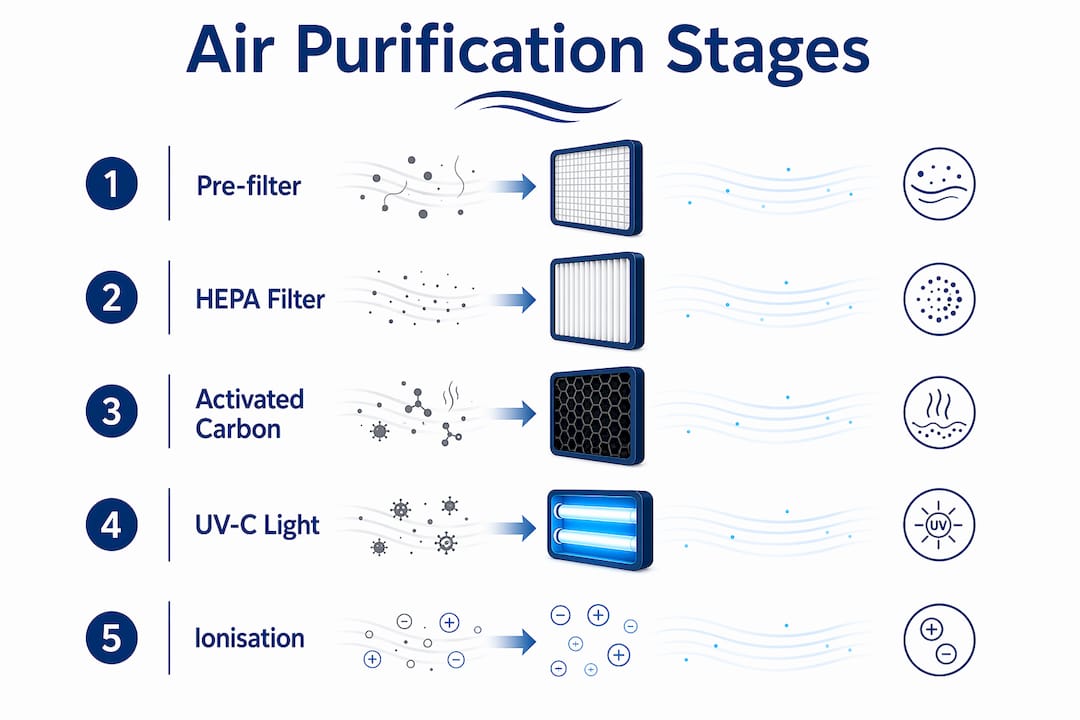
Some units also include UV-C light or ionisation stages. UV-C light targets bacteria and viruses by disrupting their DNA. Ionisers release charged particles that cause airborne pollutants to clump together and fall out of the air. Both technologies have a role, but neither replaces HEPA filtration as the primary workhorse. Most quality purifiers combine HEPA and activated carbon as a baseline, then add UV or ionisation as supplementary stages.
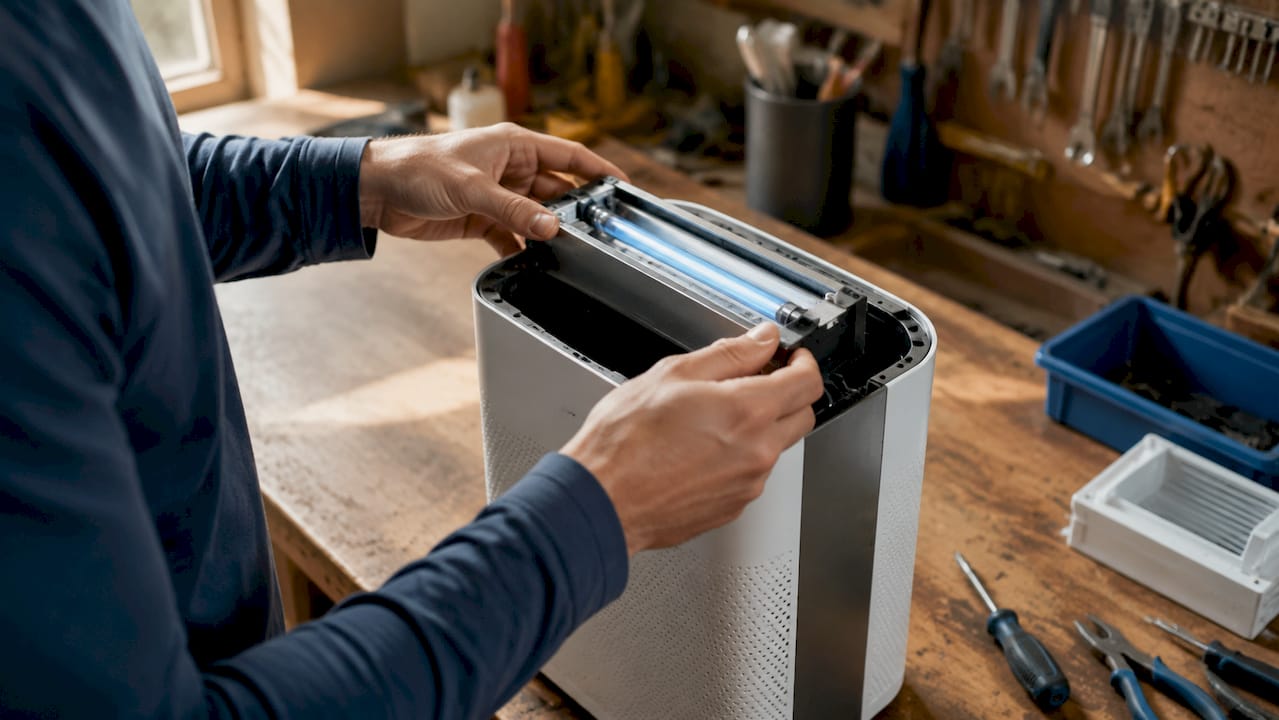
Pro Tip: When comparing purifiers, check whether the activated carbon layer is a thin mesh coating or a thick granular bed. A granular bed holds far more carbon and lasts significantly longer before saturation.
How effective are air purifiers at reducing smoke, allergens, and dust?
The effectiveness of any air purifier depends heavily on consistent use and correct setup. Research from the EPA shows that HEPA purifiers reduce PM2.5 by 29–56% during wildfire events when run continuously on high fan speed. That range reflects real-world variation in room size, building tightness, and how often doors and windows are opened.
“Air purifiers should be regarded as part of a broader air quality approach including source control and ventilation, not as a standalone solution.” — Air Filtration Explained
This is the most important thing to understand about air purifier technology explained plainly: filtration reduces airborne pollutants, but it does not eliminate the source. A purifier running in a room where someone is smoking will reduce smoke particles in the air, but it will not remove the smell from furniture or walls.
There are also two common misconceptions worth addressing directly. First, purifiers do not supply fresh oxygen or reduce CO2 levels. If your home feels stuffy, that is a ventilation problem, not a filtration problem. Opening a window or running a mechanical ventilation system addresses CO2 buildup. A purifier cannot. Second, air purifiers only capture airborne particles. Dust already settled on your bookshelf, blinds, or carpet stays there until you physically remove it. Running a purifier does not clean surfaces.
The practical implication is straightforward. Pair your purifier with regular vacuuming using a HEPA-equipped vacuum, and keep windows closed during high-pollen or smoke events. For Australian homes near bushfire-prone areas, this combination is far more effective than either approach alone. You can find more detail on combining these strategies in this guide to improving indoor air quality.
What factors influence an air purifier’s performance at home?
Getting the right purifier is only half the job. How you use it determines whether it actually cleans your air. Four factors consistently separate high-performing setups from disappointing ones.
1. Match CADR to your room size.
The Clean Air Delivery Rate (CADR) measures how quickly a purifier cleans a specific volume of air, expressed in cubic metres per hour. Undersized units fail to cycle enough air regardless of filter quality. Experts recommend oversizing CADR by 20–30% if you are unsure about your room volume, or if the room has high ceilings. A unit rated for 25 square metres will underperform in a 35 square metre open-plan living area.
2. Position the unit for maximum airflow.
Blocked airflow reduces purification efficiency significantly. Placing a purifier behind a sofa, inside a cabinet, or pressed into a corner restricts the intake and exhaust, cutting the effective coverage area. Position the unit in an open area, ideally near the room’s primary pollution source, such as a kitchen doorway or a window that lets in outdoor air. For detailed placement advice, Pureair-au has a practical guide on setting up your purifier for maximum coverage.
3. Run it continuously, not intermittently.
Turning a purifier on only when you notice bad air is like mopping a floor while it is still raining. Airborne particles are constantly being generated by cooking, movement, and outdoor infiltration. Continuous operation on a medium fan speed maintains a consistently lower particle load. Running on high speed only when pollution spikes, such as during a bushfire smoke event, is a reasonable compromise for noise-sensitive households.
4. Replace filters on schedule.
A clogged HEPA filter does not just stop working. It restricts airflow, strains the motor, and can actually release trapped particles back into the room. HEPA filters typically need replacement every 6–12 months. Activated carbon filters need changing every 3–6 months. Check the manufacturer’s indicator light if your unit has one, but also mark the replacement date on a calendar as a backup.
Pro Tip: Buy replacement filters at the same time you buy the purifier. Filter availability varies, and having a spare on hand means you will not run a clogged filter for weeks while waiting for a delivery.
How do different air purifier technologies compare?
Not every purifier suits every problem. The table below maps each technology to the pollutants it targets and its key limitations.
| Technology | Best For | Limitations |
|---|---|---|
| HEPA filtration | Dust, pollen, mould spores, smoke particles, pet dander | Does not remove gases or odours |
| Activated carbon | VOCs, cooking odours, smoke gases, chemical fumes | Does not capture particles; saturates quickly |
| UV-C light | Bacteria, viruses, some mould | Requires adequate exposure time; limited standalone effect |
| Ionisation | Fine particles, some allergens | May generate ozone, which irritates airways |
The EPA and medical researchers have flagged that some ionisation and ozone-generating devices can irritate lungs and produce inconsistent results. This does not mean ionisation is useless, but it should not be your primary filtration method, particularly in homes with asthma sufferers or young children.
For most Australian households, a combination HEPA and activated carbon unit covers the widest range of pollutants. If your primary concern is bushfire smoke, you need both: HEPA for the fine PM2.5 particles and activated carbon for the smoke gases and odour compounds. If allergies are the main issue, a strong HEPA filter alone may be sufficient. For a deeper look at how to match technology to your specific needs, the types of air purifiers guide from airpurifiers.com is worth reading alongside the HEPA filter buyer’s guide on the Pureair-au website.
When should you consider running multiple units? A single purifier cannot effectively clean an open-plan home of 80 square metres or more. Two smaller units placed strategically, one in the living area and one in the main bedroom, will outperform one large unit positioned centrally. Bedrooms are particularly worth prioritising because you spend 7–9 hours there breathing while asleep.
Key takeaways
Air purifiers work best when the right technology is matched to the right room size, positioned correctly, and maintained with regular filter changes.
| Point | Details |
|---|---|
| HEPA is the core technology | HEPA filters capture 99.97% of particles 0.3 microns and larger via three physical mechanisms. |
| Carbon handles gases and odours | Activated carbon adsorbs VOCs and smoke gases that HEPA cannot trap; replace every 3–6 months. |
| CADR must match room size | Oversize your CADR by 20–30% to account for high ceilings or uncertainty about room volume. |
| Placement and continuous use matter | Keep the unit in open space and run it continuously for consistent particle reduction. |
| Purifiers have real limits | They do not remove settled dust, supply fresh oxygen, or reduce CO2; ventilation and cleaning are still required. |
What i have learned from watching people use air purifiers wrong
I have spent years looking at how Australian families actually use air purifiers versus how they should. The gap is wider than most manufacturers want to admit.
The single most common mistake is buying a unit that is too small for the room, then concluding that air purifiers do not work. A purifier rated for 20 square metres placed in a 45 square metre open-plan kitchen and living area is not failing. It is simply outmatched. The physics are not in its favour. Getting the CADR right before you buy is more important than any feature on the box.
The second mistake is treating filter replacement as optional. I have seen purifiers running with filters so clogged they were pushing air around the filter rather than through it. At that point, you have an expensive fan. Set a calendar reminder. Buy the filter before you need it.
What genuinely surprises people is how much difference placement makes. Moving a purifier from a corner to the centre of a room, or near the main doorway, can visibly change how quickly the air quality indicator drops after cooking. Airflow is the most critical determinant of purifier efficiency, and most people never think about it after unboxing.
My honest view is that a mid-range HEPA and carbon unit, correctly sized, well-placed, and maintained properly, will outperform an expensive unit used carelessly. The technology is mature. The difference is in how you use it. Pair your purifier with good ventilation habits and a regular cleaning routine, and you will notice the difference within days. For a broader strategy, the room air quality guide on Pureair-au covers the full picture well.
— Lucas
Find the right air purifier for your australian home
Pureair-au stocks a curated range of HEPA and activated carbon air purifiers, humidifiers, and dehumidifiers selected specifically for Australian conditions, from coastal humidity to inland bushfire smoke. Every product in the catalogue is AHAM verified, meaning the performance claims on the box reflect real-world results. The Pureair-au Smart Finder tool helps you match a unit to your room size, primary concern (allergies, smoke, mould), and budget without needing to decode technical specifications yourself.
Whether you need a compact unit for a bedroom or a high-CADR purifier for an open-plan living area, the full product catalogue includes options at multiple price points with filter replacement support. Pureair-au also provides ongoing guidance on filter schedules and setup, so you get the performance you paid for from day one.
FAQ
What do air purifiers actually remove from indoor air?
Air purifiers with HEPA filters remove dust, pollen, mould spores, pet dander, and fine smoke particles. Units with activated carbon filters also capture gases, VOCs, and odours.
How do air purifiers filter smoke particles from bushfires?
HEPA filters capture fine PM2.5 smoke particles through impaction, interception, and diffusion. Activated carbon layers then adsorb the gaseous compounds and odour molecules that HEPA cannot trap.
Do air purifiers reduce co2 or freshen stale air?
No. Air purifiers filter particles and gases already in the room but do not supply fresh oxygen or reduce CO2 levels. Stale or stuffy air requires ventilation, not filtration.
How often should i replace my air purifier filters?
HEPA filters typically need replacement every 6–12 months. Activated carbon filters saturate faster and should be replaced every 3–6 months, depending on usage and pollution levels.
What size air purifier do i need for my room?
Match the unit’s CADR rating to your room size and oversize by 20–30% if you have high ceilings or an open-plan layout. A unit rated for 20 square metres will underperform in a larger space regardless of filter quality.