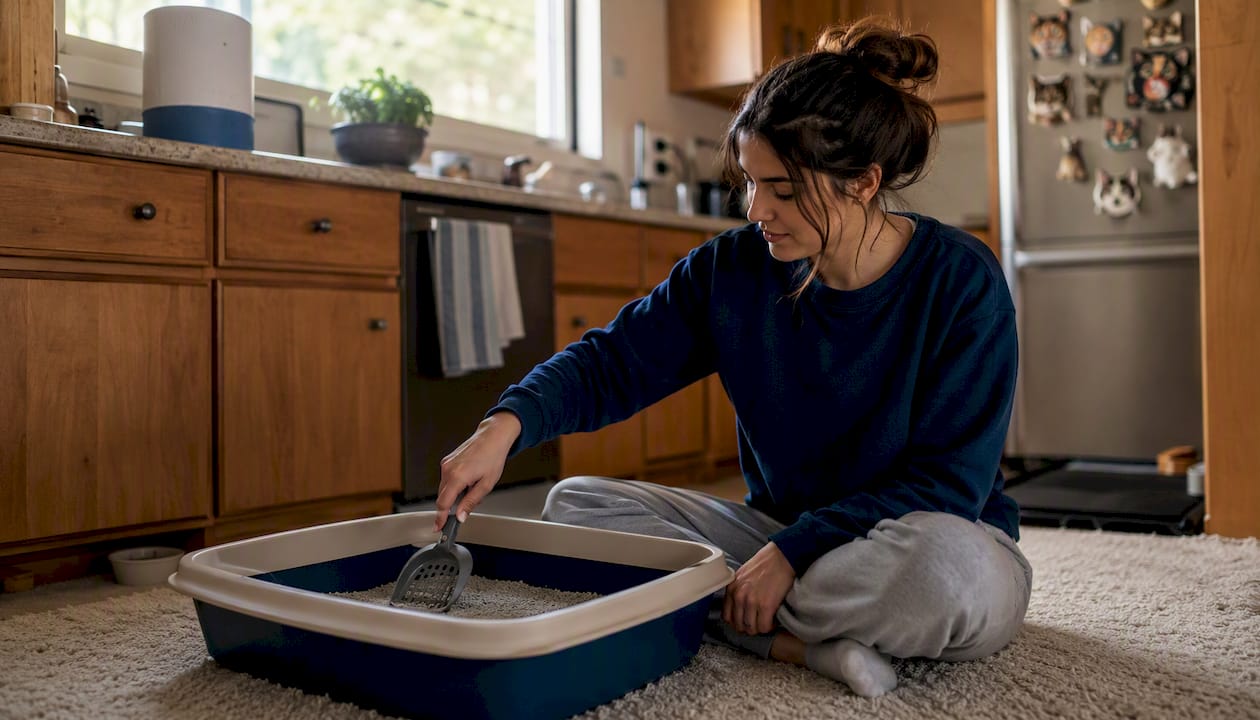
Yes, litter boxes affect indoor air quality. The two main culprits are ammonia gas released from cat urine and fine particulate dust from the litter itself. Both are measurable, both persist in indoor air longer than most cat owners realise, and both are manageable. The highest-impact first step is source control: switch to a low-dust, unscented litter and scoop daily. Pair that with a HEPA and activated carbon air purifier positioned near the litter station, and you address the problem from both ends. A 2024 emissions study and apartment-scale filtration testing both confirm this layered approach works.
Priority actions at a glance:
- Swap to a low-dust, unscented litter (natural wood or plant-based where possible)
- Scoop at least once daily; twice if you have two or more cats
- Place the box in a well-ventilated room, away from bedrooms
- Add a HEPA and carbon air purifier within 1–2 metres of the litter station
Pro Tip: If you can smell the box from another room, ammonia levels are already above the threshold where they irritate mucous membranes. That smell is your cue to act, not to add a deodoriser.
Table of Contents
- What does a litter box actually release into your air?
- What are the health risks for people and cats?
- How litter type changes what you breathe
- Where you place the box changes your exposure significantly
- A practical cleaning routine that actually controls emissions
- Do air purifiers actually help with litter box air quality?
- Why many vets advise against covered litter boxes
- Your immediate action checklist for a cleaner litter station
- Key takeaways
- The trade-off most cat owners miss
- Pureair-au’s HEPA and carbon units for pet homes
- Useful sources and further reading
What does a litter box actually release into your air?
Every time your cat digs, covers, or exits the box, it launches a small cloud of material into the room. Understanding what is in that cloud is the first step to controlling it.
The main emissions fall into five categories:
- Ammonia (NH₃): Produced when bacteria break down urea in cat urine. Concentrations build quickly in enclosed or poorly ventilated spaces and are the primary odour compound.
- Volatile organic compounds (VOCs): Released by scented litters, chemical deodorisers, and some plastic box materials. Fragrance additives are a common but overlooked source of indoor VOC pollution.
- Particulate matter (PM10 and PM2.5): Visible dust is PM10; the finer PM2.5 fraction is invisible and stays airborne far longer. Clay litters are a particularly high source of silica dust, which is a documented respiratory irritant.
- Bio-aerosols: Bacteria, fungal spores, and protozoa (including Toxoplasma gondii oocysts) can become airborne during disturbance of soiled litter.
- Tracked residue and dander: Litter particles carried on paws become a secondary airborne source as your cat moves through the house.
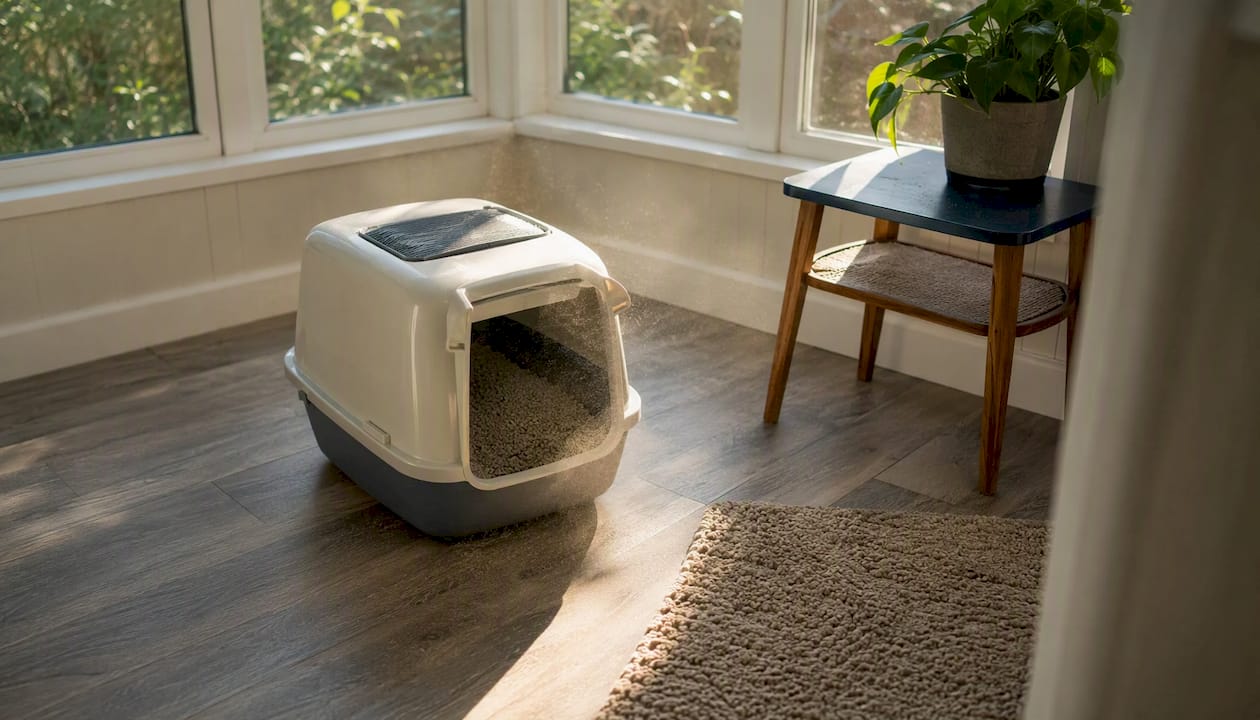
Micro-dust behaviour matters. PM2.5 particles stay suspended in indoor air for hours and travel via HVAC airflow and human movement. A litter box in the laundry can contribute to particle counts in the living room.
Normal handling, including pouring fresh litter, scooping, and your cat’s digging, all create airborne release events. The box’s impact is not limited to the room it sits in.
What are the health risks for people and cats?
The risks are real but proportionate to exposure. Most healthy adults tolerate low-level litter box emissions without acute symptoms. The concern is chronic, cumulative exposure, particularly for vulnerable groups.
Human health risks:
- Respiratory irritation: Ammonia and silica dust both irritate the upper airways; regular exposure can worsen existing conditions.
- Asthma triggers: Fine particulates and VOCs from scented litters are recognised asthma triggers; people with asthma should treat litter box emissions as a managed risk.
- Silica-related lung irritation: Clay litter silica dust is a documented irritant; long-term heavy exposure is a concern, particularly in poorly ventilated homes.
- Headaches and eye irritation: Elevated ammonia and VOC levels cause these symptoms at concentrations that are common in small, poorly ventilated rooms.
- Toxoplasmosis risk: Toxoplasma gondii oocysts in cat faeces become infectious 1–5 days after shedding. The CDC notes that pregnant people and the immunocompromised face the greatest risk; daily scooping removes oocysts before they reach the infectious stage.
Cat health risks:
- Ammonia concentrated inside a covered box irritates a cat’s respiratory tract and eyes.
- Stress from a poorly placed or dirty box can suppress immunity and increase susceptibility to upper respiratory infections.
- Dusty litters cause sneezing, watery eyes, and chronic nasal discharge in sensitive cats.
Vulnerable groups: Children, pregnant people, people with asthma or chronic obstructive pulmonary disease, the immunocompromised, and senior cats all face elevated risk from the same exposures.
Pro Tip: Persistent sneezing, watery eyes, or nasal discharge in your cat after a litter change is a signal the new litter is too dusty. In people, recurring headaches that ease when you leave the house warrant a look at where the litter box sits. Both warrant a vet or GP conversation if they persist.
How litter type changes what you breathe
The litter you choose is the single biggest variable in your home’s litter box air pollution load. Lab data makes the difference stark.
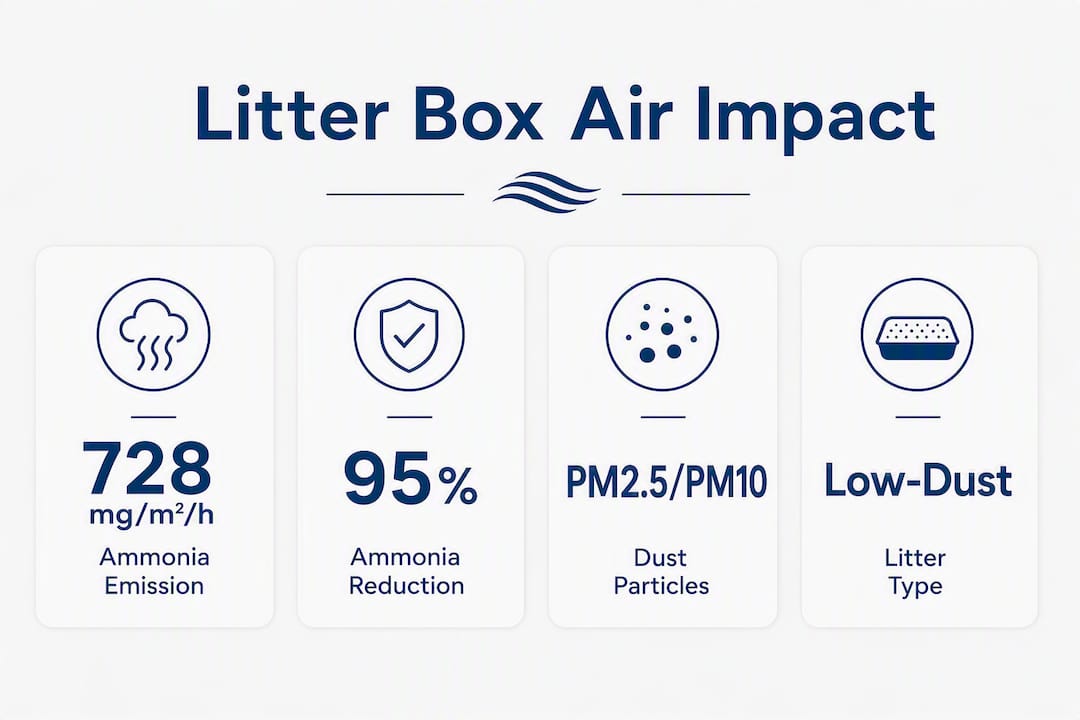
A controlled emissions study found that traditional clay litter produced ammonia at 728 mg/m² h⁻¹, while a probiotic-supplemented vegetable litter produced just 21–32 mg/m² h⁻¹. That is a reduction of over 95%.
| Litter type | Ammonia emissions | Silica/dust risk | VOC risk |
|---|---|---|---|
| Traditional clay (clumping) | Very high (728 mg/m² h⁻¹) | High (crystalline silica) | Low (unscented) |
| Scented clay | Very high | High | High (fragrance VOCs) |
| Silica gel crystal | Moderate | Moderate (amorphous silica) | Low |
| Natural wood/pine | Low | Low | Low |
| Plant-based/vegetable | Low | Low | Low |
| Probiotic vegetable | Very low (21–32 mg/m² h⁻¹) | Low | Low |
Scented litters deserve a specific warning. The fragrance compounds that mask ammonia odour are themselves VOCs. Swapping a clay litter for a scented version trades one problem for another. For most Australian homes, an unscented, low-dust natural or plant-based formula is the best starting point.
The 95% ammonia reduction between clay and probiotic vegetable litter is not a marginal improvement. It is the difference between a box that drives measurable indoor air quality degradation and one that contributes minimally.
Where you place the box changes your exposure significantly
Placement is the second most controllable variable after litter choice. Poor placement concentrates exposure where people spend the most time.
Placement rules:
- Never place a box in a bedroom. Prolonged proximity during sleep increases cumulative inhalation of ammonia and dust more than any other placement mistake.
- Avoid small, damp, poorly ventilated rooms. Bathrooms without exhaust fans trap ammonia and humidity, accelerating bacterial growth and odour.
- Choose well-ventilated, low-traffic areas. A laundry with an exhaust vent, a utility room, or a covered outdoor area (weather permitting) all reduce household exposure.
- Keep boxes away from HVAC return vents. A return vent positioned directly above a litter box will distribute fine particles and odour throughout the entire duct system.
- Avoid corners with no airflow. Stagnant air allows ammonia to accumulate; some cross-ventilation is better than none.
- Consider air circulation patterns when choosing a spot. Airflow that moves away from living areas, rather than through them, reduces whole-home particle counts.
Multiple cats multiply the problem. The standard veterinary recommendation is one box per cat plus one extra. In a two-cat household, that means three boxes. Each additional box adds to the cumulative ammonia load, making placement and ventilation even more critical.
Pro Tip: In humid Australian climates, a small dehumidifier near the litter area reduces the moisture that accelerates bacterial breakdown of urine and ammonia production. Lower humidity means slower odour build-up between cleans.
A practical cleaning routine that actually controls emissions
Cleaning frequency has a direct, measurable effect on ammonia levels. Soiled litter is the ammonia source; removing it promptly is the most reliable way to keep concentrations low.
Daily tasks:
- Scoop all clumps and solid waste once per day minimum; twice daily in multi-cat homes.
- Dispose of waste in a sealed bag directly into an outdoor bin where possible.
- Wipe the box rim and surrounding floor with a damp cloth to remove tracked residue.
Weekly tasks:
- Top up litter to the recommended depth (typically 5–8 cm) to maintain clumping performance.
- Check the box for cracks or scratches that harbour bacteria.
- Wash the scoop with hot water and unscented soap.
Monthly tasks:
- Empty the box completely and wash with hot water and a mild, unscented, non-toxic cleaner (diluted white vinegar works well and leaves no chemical residue).
- Allow the box to dry fully before refilling; moisture trapped under fresh litter accelerates bacterial growth.
- Replace the box entirely every 6–12 months if scratches are visible, as bacteria colonise those surfaces permanently.
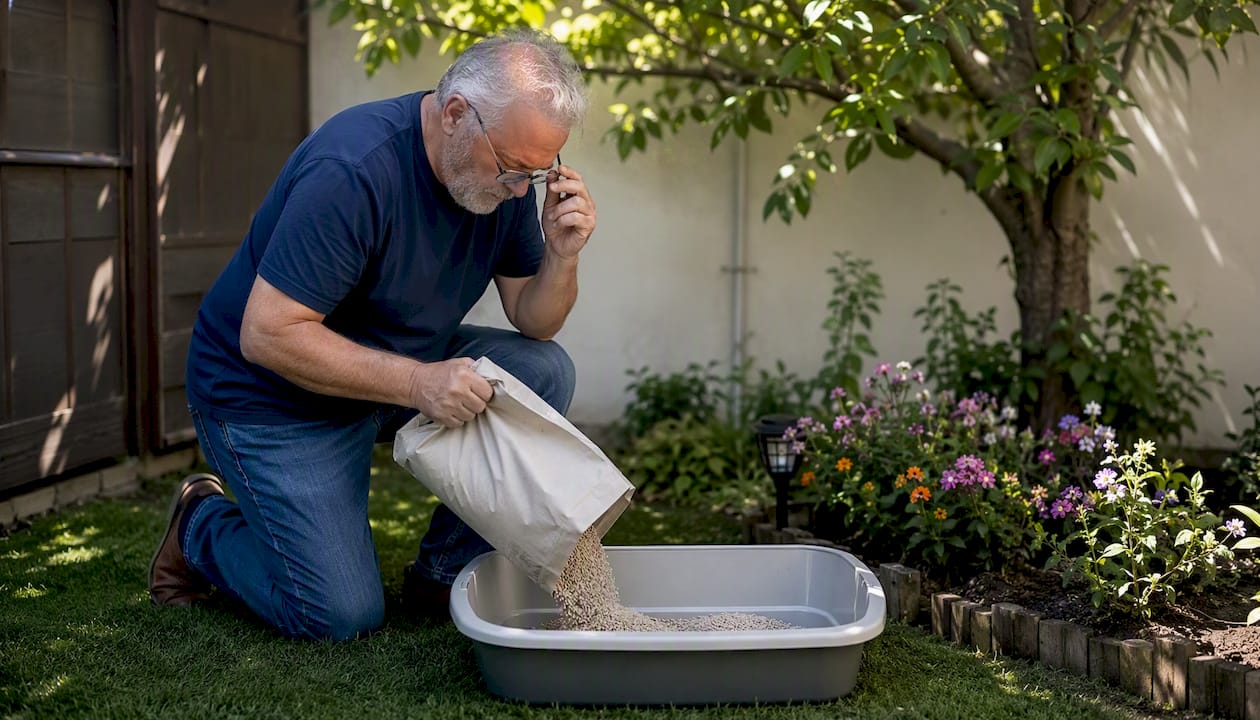
When pouring fresh litter: pour low and slow, directly into the box rather than from height, to minimise the dust cloud. A higher-sided box or a top-entry design also reduces scatter and re-suspension of tracked particles.
Avoid aerosol deodorisers and baking-soda-based masking products near the box. They add VOCs or fine particles without addressing the source.
Do air purifiers actually help with litter box air quality?
Yes, with important caveats. Air purifiers reduce airborne dust, dander and lingering odour near the litter area, but they work on what escapes the box, not on the source itself. Source control (litter choice and cleaning) comes first; filtration handles the residual.
How each filter stage works:
- HEPA (High Efficiency Particulate Air): Captures PM2.5 and PM10 particles, including silica dust and bio-aerosols. Medical-grade HEPA captures 99.97% of particles at 0.3 microns. This is the stage that addresses the dust and dander problem.
- Activated carbon: Adsorbs ammonia and VOC molecules. Without a carbon stage, a purifier will clean particles but leave odour compounds untouched.
Active vs. passive litter-box ventilation: Apartment-scale testing shows that active ventilation systems (fan plus carbon filter built into the box or cabinet) reduce inside-box ammonia substantially and can bring room-level ammonia below the human odour threshold. Passive ventilation, relying on natural airflow through a hooded box, often fails in apartments and multi-cat homes.
| Approach | Particle removal | Ammonia/VOC removal | Room-level odour |
|---|---|---|---|
| No filtration | None | None | Perceptible |
| Passive hooded box | Partial containment | Minimal | Reduced slightly |
| Active box ventilation (fan + carbon) | Good inside-box | Good inside-box | Below perceptible threshold |
| HEPA + carbon room purifier | Excellent | Good | Significantly reduced |
| Active box + HEPA + carbon purifier | Best combined | Best combined | Lowest achievable |
Buying checklist for Australian shoppers:
- Match CADR (Clean Air Delivery Rate) to your room size; a unit rated for 20 m² will not adequately serve a 40 m² open-plan space.
- Confirm true HEPA rating (99.97% at 0.3 microns), not “HEPA-type” or “HEPA-style.”
- Verify a dedicated activated carbon stage, not just a thin carbon pre-filter layer.
- Check filter replacement availability in Australia before buying; some imported units have filters that are difficult or expensive to source locally.
- Choose a unit with a low noise setting suitable for continuous operation near a pet.
Pro Tip: Position the purifier 1–2 metres from the litter station, not directly on top of it. You want it drawing air from the litter area, not sitting in the dust cloud itself. Pureair-au’s HEPA and carbon units are sized for Australian room dimensions and come with local filter support.
Why many vets advise against covered litter boxes
The instinct to use a hooded box is understandable: it contains odour at room level. The problem is that it concentrates ammonia, moisture, and bio-aerosols inside the box, where your cat spends time breathing.
The two core veterinary concerns:
- Trapped ammonia and moisture: A closed box with no active ventilation accumulates ammonia at concentrations that irritate a cat’s eyes and respiratory tract with every visit. Cats have a far more sensitive sense of smell than humans; a box that smells acceptable to you may be genuinely unpleasant and irritating to your cat.
- Stress and avoidance: Cats that find a box aversive, whether from odour, confinement, or discomfort, will avoid it. Avoidance leads to house soiling, which creates a larger air quality problem than the box itself.
The trade-off is real: an open box gives your cat better air but spreads more odour and dust into the room. A covered box contains odour but concentrates gases internally. The best resolution is an actively ventilated hooded box (fan plus carbon filter) cleaned very frequently, paired with a room-level HEPA and carbon purifier. That combination addresses both the cat’s welfare and the household’s air quality without forcing a compromise between the two.
Your immediate action checklist for a cleaner litter station
Work through these in order. The first three have the biggest impact and cost nothing.
Next 24 hours:
- Scoop the box completely and dispose of waste in a sealed bag.
- Move the box out of any bedroom or poorly ventilated room.
- Open a window or run an exhaust fan near the litter area for 15 minutes.
- Check your current litter: if it is scented clay, plan to switch at the next bag.
This week:
- Buy an unscented, low-dust litter (natural wood, plant-based, or probiotic vegetable formula).
- Do a full litter change using the new formula; wash the box before refilling.
- Identify the best purifier placement: 1–2 metres from the box, in the same room.
- Run a simple dust test: shine a torch beam across the room after scooping. Visible particles in the beam indicate a litter that is too dusty.
This month:
- Add a HEPA and carbon air purifier to the litter room. Use the room air quality improvement guide to size it correctly.
- If you have multiple cats, confirm you have one box per cat plus one extra.
- Set a monthly reminder to deep-clean and inspect boxes for cracks.
Pro Tip: If you cannot replace your litter or add filtration immediately, increase ventilation by cracking a window and placing a box fan to draw air away from living areas. It is a temporary fix, not a solution, but it meaningfully reduces ammonia build-up while you sort the longer-term steps.
Key takeaways
Litter boxes are a measurable source of indoor air pollution, but switching to a low-dust unscented litter, scooping daily, and adding a HEPA and carbon purifier near the station reduces exposure to manageable levels for most Australian households.
| Point | Details |
|---|---|
| Main pollutants | Ammonia, silica dust (PM2.5/PM10), VOCs from scented litters, and bio-aerosols are the primary emissions. |
| Litter choice matters most | Probiotic vegetable litter emits much lower ammonia than clay litter, representing a dramatic reduction. |
| Cleaning frequency is non-negotiable | Daily scooping removes the ammonia source before concentrations build; twice daily in multi-cat homes. |
| Filtration works best in layers | Active box ventilation plus a HEPA and carbon room purifier achieves the lowest measurable ammonia and particle levels. |
| Pureair-au for Australian homes | Pureair-au’s medical-grade HEPA and carbon units are sized for Australian rooms and backed by local filter availability. |
The trade-off most cat owners miss
The conversation about litter boxes and air quality tends to collapse into two camps: people who think the smell is just part of having a cat, and people who buy every deodorising product on the shelf. Both miss the actual problem.
The smell is a symptom, not the issue. Ammonia at detectable concentrations is already above the level where it causes low-grade irritation to airways and eyes. Masking it with fragrance sprays adds VOCs to a room that already has too many airborne compounds. The instinct to make the box smell like lavender is counterproductive.
What actually works is less glamorous: a better litter, a cleaner box, a well-placed purifier. The 95% ammonia reduction between clay and probiotic vegetable litter is not a marketing claim; it comes from controlled measurement. That single swap, combined with daily scooping, does more for your household’s air than any deodoriser ever will.
The cat welfare angle is also underweighted in most guides. A cat that avoids its box because the ammonia concentration inside a covered hood is too high creates a worse air quality problem than the box itself. Prioritise your cat’s willingness to use the box; the rest of the mitigation strategy builds from there.
Incremental changes work. You do not need to overhaul everything at once. Start with the litter, add the cleaning routine, then add filtration when the budget allows. Each step compounds.
Pureair-au’s HEPA and carbon units for pet homes
If you have sorted the litter and the cleaning routine and still notice dust or odour lingering, a dedicated air purifier near the litter station is the most reliable next step. Pureair-au stocks medical-grade HEPA and activated carbon units sized for Australian rooms, with replacement filters available locally so you are not waiting on international shipping when it is time to swap them out.
The Honeywell Air Touch P2 is a compact option well suited to a laundry or utility room litter station. For larger open-plan spaces, the full Pureair-au catalogue includes units with higher CADR ratings and multi-stage filtration covering PM2.5, silica, ammonia, and pet dander in a single pass. All units are AHAM verified and come with Pureair-au’s Smart Finder tool to match the right unit to your room size and specific concern, whether that is pet dander, dust, or odour control.
Useful sources and further reading
The following sources underpin the key evidence points in this article:
- Litter box preference in domestic cats: covered versus uncovered (emissions data) — source for the 2024 clay vs. probiotic vegetable litter ammonia emissions figures (728 mg/m² h⁻¹ vs. 21–32 mg/m² h⁻¹)
- Passive vs. active litter box ventilation: VOC tested — apartment-scale testing showing active filtration reduces room-level ammonia below perceptible thresholds
- Cat litter dust guide: causes, airflow, tests and health — PM2.5 and PM10 behaviour, suspension times, and HVAC transport
- Indoor air quality and cat litter: clay vs. natural wood — practical comparison of litter materials and handling technique guidance
- Dangers of cat litter to humans and safer alternatives — silica dust risks and low-dust litter recommendations
- Can litter boxes cause respiratory problems? — open vs. covered box trade-offs and respiratory symptom links
- Do air purifiers help with cat litter smell? — realistic expectations for purifier performance near litter stations
- CDC: Toxoplasmosis — infectivity timeline and risk groups for Toxoplasma gondii
- OSHA: Crystalline silica — occupational and environmental silica dust guidance
- Why air quality testing matters in pet homes (Pureair-au) — Australian-specific guidance on HEPA filtration and local filter support for pet households