

Whole home filtration is defined as a point-of-entry water treatment system that filters 100% of water entering your home at the main supply line before it reaches any tap, shower, or appliance. Unlike a jug filter or a single under-sink unit, a whole house water filtration system treats every drop your household uses. The system targets sediment, chlorine, volatile organic compounds (VOCs), heavy metals, and in certified configurations, even PFAS chemicals. Understanding how whole home filtration works is the first step toward making a genuinely informed decision about your home’s water quality.
How does a whole home water filtration system work?
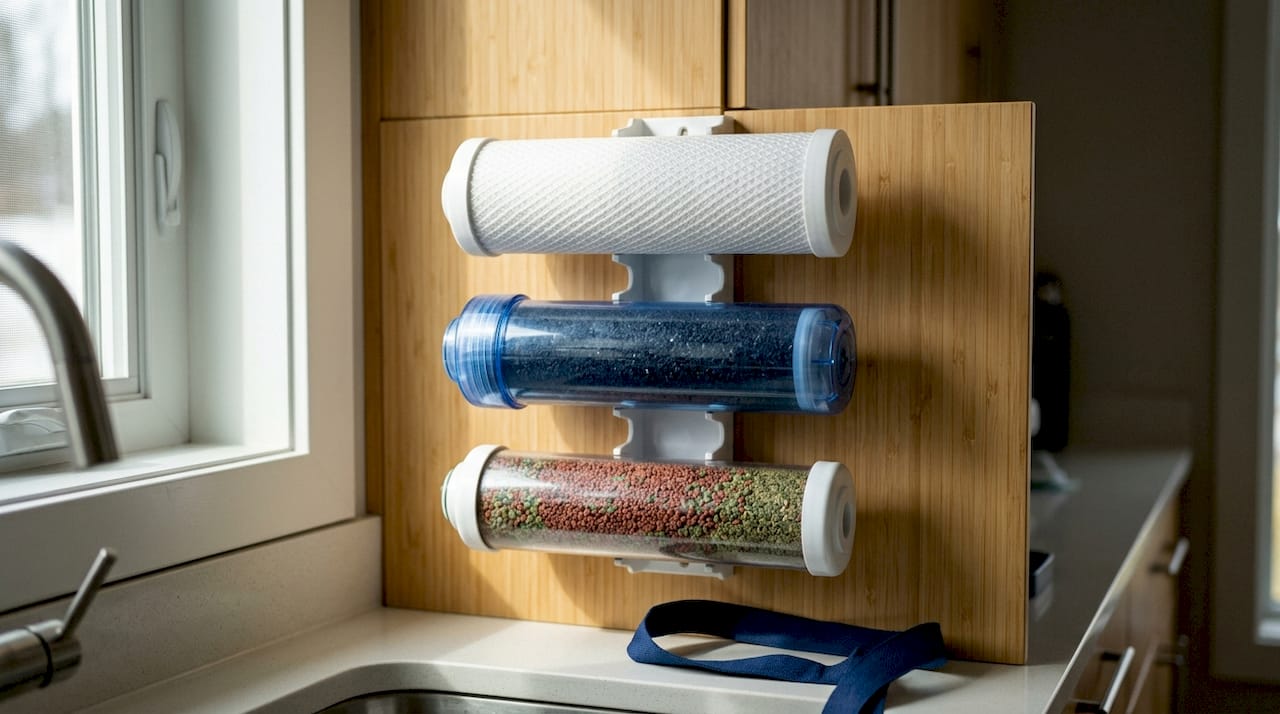
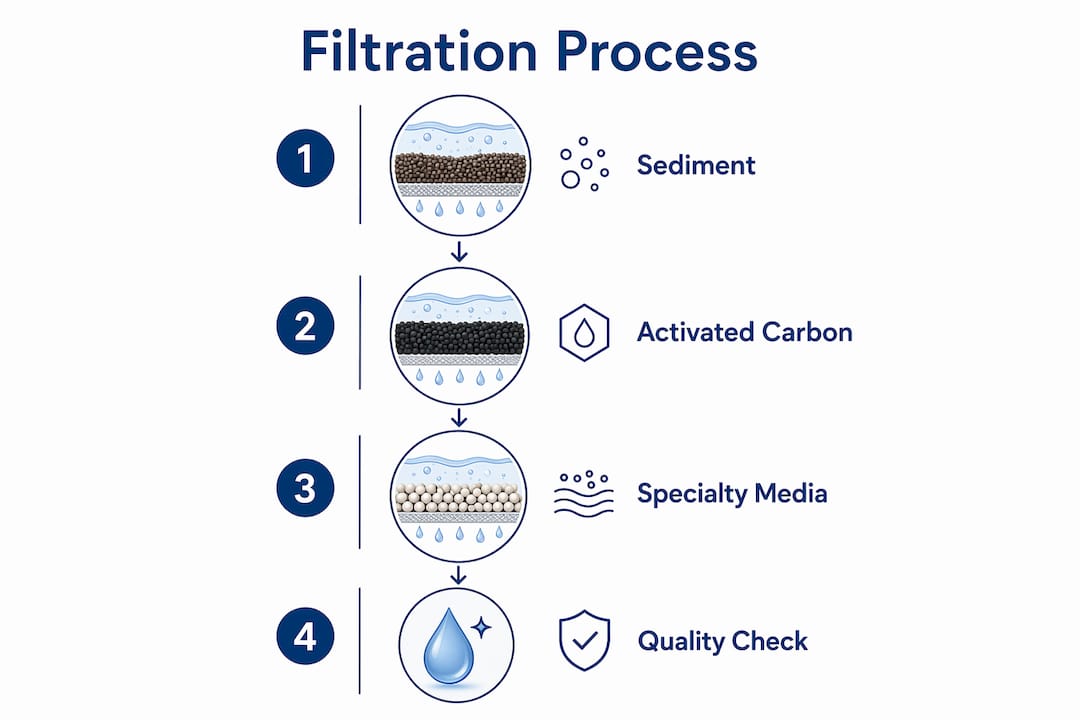
Multi-stage filtration combines mechanical sieving, chemical adsorption, and sometimes ion exchange to remove contaminants while maintaining adequate water flow throughout your home. Each stage handles a different category of pollutant, which is why skipping a stage weakens the entire system. The stages work in sequence, with each one protecting the next from overload.
Stage 1: Sediment pre-filter
The sediment pre-filter is the system’s first line of defence. It physically traps particles like sand, rust, silt, and fine grit before they reach the more sensitive media downstream. Sediment filters are typically rated by micron size, with a 5-micron filter catching particles invisible to the naked eye. Skipping sediment filter replacement clogs downstream filters, causes pressure drops, and shortens media lifespan significantly. This stage is cheap to replace and expensive to ignore.
Stage 2: Activated carbon filter
Activated carbon works through adsorption, a process where contaminants bond to the surface of the carbon material rather than being physically strained out. This stage removes chlorine, chloramines, VOCs, pesticides, and the compounds responsible for bad taste and odour. Carbon block filters offer denser contact time than granular activated carbon (GAC), making them more effective for chemical removal. For Australian households on municipal supply, this stage does most of the heavy lifting.
Stage 3: Specialty media
The third stage varies based on your water source and test results. Common media types include KDF (Kinetic Degradation Fluxion), which targets heavy metals like lead and mercury through a redox reaction, and iron reduction media for homes on bore or tank water. Some systems add a polishing filter here to improve clarity and remove any remaining fine particles. Certified systems meeting NSF/ANSI Standard 53 can reduce total PFAS contaminants by up to 99.9% at the point of entry. That standard is the benchmark worth looking for when comparing systems.
Pro Tip: Ask your supplier to confirm which NSF/ANSI standards their system is certified to before purchasing. Certification to Standard 42 covers aesthetics like taste and odour, while Standard 53 covers health-related contaminants. You may need both.
How does whole home filtration affect your water quality and appliances?
Whole home systems treat water once at the main supply, protecting every tap, shower, toilet, and appliance from scale and sediment damage. This is the key advantage over point-of-use filters, which only treat water at one outlet. The benefits extend well beyond drinking water.
- Appliance protection. Scale buildup from hard water and sediment from unfiltered supply shortens the life of dishwashers, washing machines, hot water systems, and coffee makers. Filtered water reduces mineral deposits and keeps heating elements running efficiently.
- Safer bathing and drinking water. Chlorine and chloramines absorbed through skin during showers are a genuine concern, not just a taste issue. A whole home system removes these chemicals before water reaches your showerhead, not just your kitchen tap.
- Improved taste and odour. Activated carbon removes the compounds that make tap water smell like a swimming pool. The difference is noticeable immediately after installation.
- Cost savings over time. Whole home filters often pay for themselves within 3–5 years by reducing appliance repairs, extending plumbing life, and cutting the need for bottled water.
- Limitations to understand. Most systems improve taste, smell, and particulate purity but do not remove dissolved solids unless advanced membrane technology like reverse osmosis is employed. If you need to remove dissolved salts or minerals, a standard whole home system is not sufficient on its own.
What maintenance does a whole home filtration system need?
Maintenance is the most underestimated part of whole home filtration ownership. A neglected system does not just stop working well. It can actively make your water quality worse by releasing trapped contaminants back into the supply.
Typical service intervals run around 12 months or 100,000 gallons, though this varies with your water quality and household usage. Homes with high sediment loads or bore water may need pre-filter changes every 3–6 months. The key maintenance tasks are:
- Sediment pre-filter replacement. This is the most frequent task and the most critical. A clogged pre-filter starves downstream stages and drops water pressure across the whole house.
- Carbon filter replacement. Activated carbon has a finite adsorption capacity. Once saturated, it stops removing chemicals and can leach them back. Follow the manufacturer’s schedule, not just your own judgement.
- Specialty media inspection. KDF and iron reduction media last longer than carbon but still need periodic replacement. Check the manufacturer’s rated lifespan for your specific media type.
- System pressure monitoring. A noticeable drop in water pressure across multiple outlets is the clearest sign that a filter stage needs attention.
- Smart monitoring. Some systems include app-based or inline monitors that track filter life based on actual water volume processed, not just elapsed time. These are worth the added cost for households with variable usage.
Physical installation requires adequate space, main water line access, and an electrical supply for systems with UV or electronic monitoring components. Older Australian homes with compact utility areas can find this a genuine constraint. Plan the installation location before purchasing the system.
Pro Tip: Set a calendar reminder for filter changes rather than waiting until you notice a problem. By the time pressure drops or taste changes, the downstream media has already been compromised for weeks.
For guidance on filter replacement timing and what happens when maintenance is delayed, the principles apply across filtration technologies, whether for water or air.
How do you choose the right whole home filtration system?
The single most important step before buying any whole home system is testing your water. Without a baseline water test, you risk purchasing filtration media that does not target your actual contaminants, wasting money and leaving real problems unaddressed.
The right system depends on your water source, household size, and installation constraints. Here are the key factors to assess:
- Water source. Municipal water typically needs chlorine and chemical removal as the priority. Well, bore, or tank water often requires pre-treatment for sediment, iron, manganese, or acidity before standard filtration media can function effectively.
- Household size and flow rate. A system rated for a two-person flat will not keep up with a five-bedroom house. Match the system’s rated flow rate (measured in litres per minute) to your peak demand, not your average usage.
- Certified standards. Look for NSF/ANSI certification relevant to your contaminants. Standard 42 covers taste and odour. Standard 53 covers health-related reduction. Standard 58 applies to reverse osmosis systems.
- Installation space. Systems vary considerably in footprint. Installation constraints including space, pipe access, and power availability can complicate fitting in older or compact homes.
- Municipal versus well water needs. Municipal water users typically need chlorine and chemical removal, whereas well-water users often require pre-treatment for sediment, iron, or acidity to protect system longevity.
The table below summarises the key differences between the two main water source scenarios:
| Factor | Municipal water | Well or bore water |
|---|---|---|
| Primary contaminants | Chlorine, chloramines, VOCs, PFAS | Sediment, iron, manganese, bacteria |
| Recommended Stage 1 | Fine sediment pre-filter | Heavy-duty sediment pre-filter |
| Recommended Stage 2 | Activated carbon block | Activated carbon or iron reduction media |
| Specialty media need | Optional (PFAS, heavy metals) | Often required (KDF, iron filter) |
| Testing priority | Chemical and PFAS panel | Full mineral and bacteria panel |
Understanding the types of air filtration systems used in residential settings also helps homeowners see how mechanical and chemical filtration principles apply across both water and air quality systems.
Key takeaways
Whole home filtration works through sequential stages of mechanical, chemical, and specialty media filtration at the point of entry, protecting every outlet and appliance in your home.
| Point | Details |
|---|---|
| Point-of-entry treatment | The system filters all water at the main supply line before it reaches any tap or appliance. |
| Multi-stage filtration | Sediment, carbon, and specialty media stages each target different contaminant categories. |
| Maintenance is non-negotiable | Skipping filter changes causes pressure drops and can worsen water quality over time. |
| Test before you buy | A water test identifies your actual contaminants and prevents purchasing the wrong system. |
| Know the limits | Standard systems do not remove dissolved solids; reverse osmosis is required for that level of purification. |
What I have learned from watching homeowners get this wrong
The most common mistake I see is buying a system based on marketing claims rather than a water test. A homeowner installs a premium carbon-heavy system, then wonders why their water still smells metallic. The answer is almost always iron, and carbon does nothing for iron. A $40 water test would have redirected that purchase entirely.
The second mistake is treating installation as an afterthought. I have seen systems purchased and then left in boxes for months because the utility cupboard was too small or the water main was in an awkward location. Measure your space and check your pipe configuration before you order anything.
The third thing most articles do not tell you: whole home filtration does not remove dissolved solids. People assume “filtered” means “purified to the highest level possible.” It does not. If your water has high total dissolved solids (TDS), you need a reverse osmosis stage, and that is rarely practical for whole-home application due to flow rate and pressure demands. A point-of-use reverse osmosis unit under the kitchen sink, combined with a whole home system for everything else, is usually the more sensible approach.
Finally, get a professional to commission the system after installation. Incorrect bypass valve settings or loose fittings are the most common causes of early system failure, and they are entirely avoidable with a 30-minute check.
— Lucas
Pureair-au’s range for Australian homes
Australian homes face specific water and air quality challenges, from bore water with high iron content to municipal supplies treated with chloramines. Pureair-au carries a range of home filtration and air quality products selected for Australian conditions, including AHAM-verified air purifiers, humidifiers, and dehumidifiers suited to local climates.
If you are managing indoor air quality alongside water quality, Pureair-au’s product range covers both. The team can guide you toward the right unit for your household size, specific concerns like mould or bushfire smoke, and your budget. Browse the full catalogue at pureair-au.com or use the Smart Finder tool to match a product to your needs without the guesswork of reading through every specification yourself.
FAQ
What does a whole home filtration system actually filter out?
A whole home system removes sediment, chlorine, chloramines, VOCs, heavy metals, and in NSF/ANSI Standard 53 certified configurations, PFAS chemicals. It does not remove dissolved solids unless a reverse osmosis membrane stage is included.
How often do whole home water filters need replacing?
Most systems require maintenance every 12 months or after treating approximately 100,000 gallons, though homes with high sediment or bore water may need pre-filter changes every 3–6 months.
What is the difference between whole house filtration versus point of use?
Whole house filtration treats all water at the main supply line, protecting every outlet and appliance. Point-of-use filters treat water at a single tap and offer no protection to plumbing, appliances, or shower water.
Do I need to test my water before buying a system?
Yes. Without a water test, you risk buying filtration media that does not target your actual contaminants. A basic test costs very little and prevents a costly mismatch between your system and your water quality.
Can a whole home system remove all contaminants?
No. Standard mechanical and carbon-based systems cannot remove dissolved solids or all bacteria. Advanced membrane technologies like reverse osmosis are required for that level of purification, and these are rarely practical for whole-home application due to flow rate demands.