
When outdoor air is polluted, stop natural ventilation and switch to sealed, filtered indoor air. That’s the short answer. SA Health guidance is clear: opening windows during bushfire smoke or high-pollen events lets pollutants bypass any filtration you have running. The fix is medical-grade HEPA filtration and positive pressure, not fresh air through a cracked window.
Medical-grade HEPA filters capture nearly all airborne particles down to 0.3 microns, including fine bushfire smoke particles that standard filters miss entirely.
Three things to do right now:
- Close all windows and external doors immediately
- Set your HVAC system to recirculate mode (not fresh air intake)
- Run a medical-grade HEPA purifier in your main living area and each bedroom
Table of Contents
- What to do right now during smoke, pollen or heavy pollution
- How to set up a pressurised safe room at home
- How to choose the right medical-grade HEPA purifier for your home
- When is it actually safe to open your windows?
- How quickly does filtration actually reduce indoor particles?
- Common mistakes that leave your family exposed
- Key takeaways
- Why medical-grade HEPA is the only standard worth trusting
- Pureair-au: matched solutions for Australian homes
- Authoritative sources and further reading
What to do right now during smoke, pollen or heavy pollution
Follow these steps in order. Speed matters more than perfection.
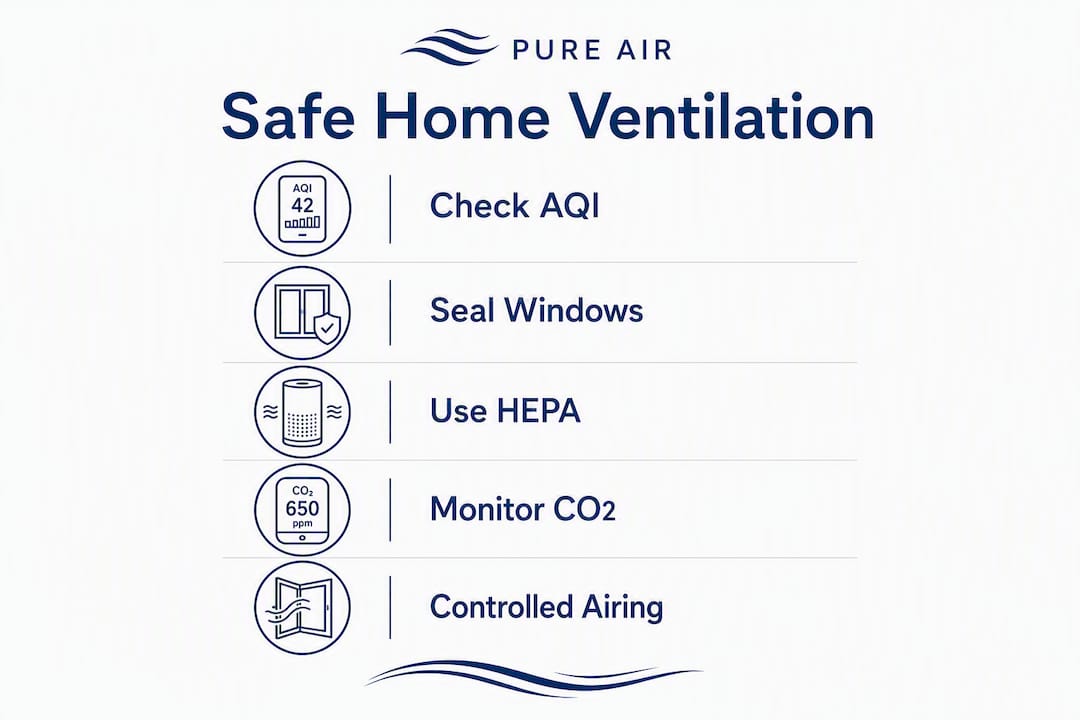
- Close everything. Windows, doors, pet flaps, and any vents you can manually seal. Every gap is a pollution entry point.
- Check your AC setting. Many residential split systems only recirculate indoor air, but some have a fresh-air damper. Verify the setting and close any outdoor intake damper before running the system.
- Switch off exhaust fans. Bathroom and kitchen exhaust fans create negative pressure that actively pulls untreated outdoor air through gaps in your walls and ceiling. Turn them off.
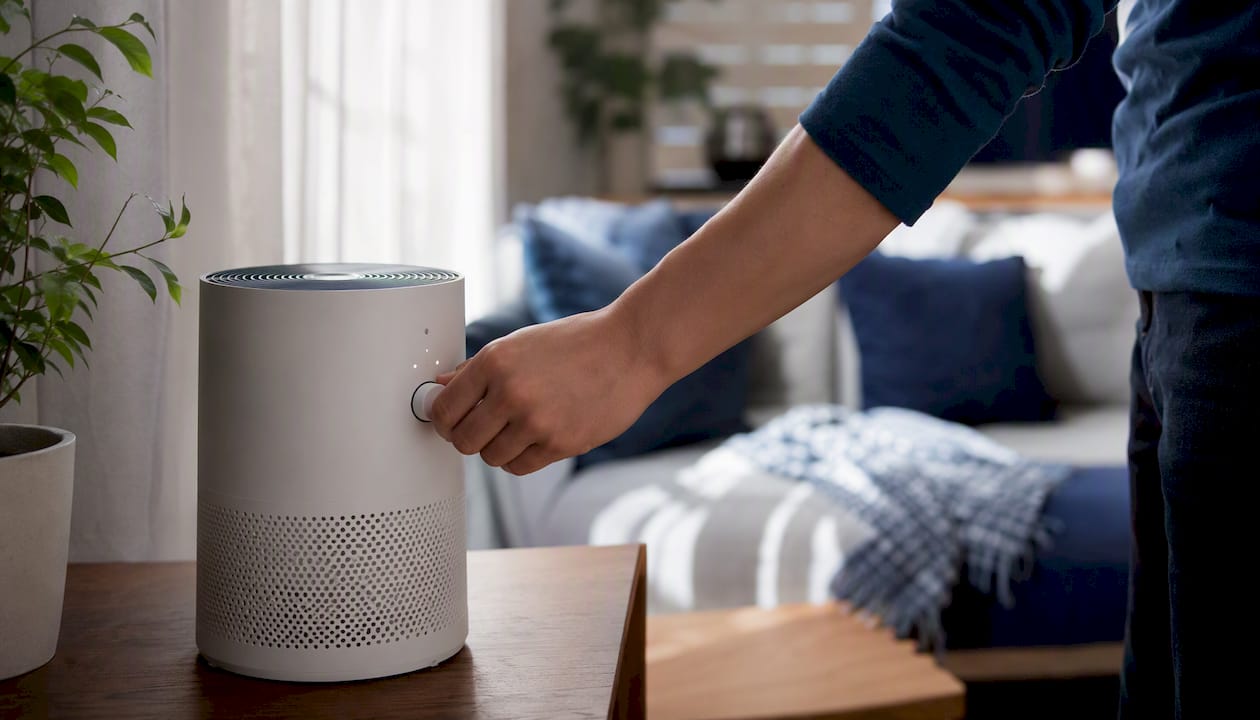
- Place your HEPA purifier in the room where people spend the most time. Bedroom first if you have children, then the main living area.
- If you only have one purifier, concentrate it in a single sealed room and keep that door closed. One high-CADR unit in a small, sealed space outperforms the same unit trying to cover an entire house.
- Stay inside until the outdoor AQI drops or public health authorities give the all-clear.
Pro Tip: Prioritise children’s bedrooms above all else. Kids breathe more air relative to their body weight than adults, so their exposure risk during a smoke event is proportionally higher. One strong HEPA unit in a sealed bedroom is your most effective single action.
How to set up a pressurised safe room at home
A pressurised safe room works by pushing filtered air in faster than air leaks out, so the net airflow is always outward. Outdoor pollutants cannot enter against that pressure. Respiratory experts cite this approach as one of the most reliable ways to protect vulnerable household members during prolonged events.
Step-by-step setup:
- Choose an interior bedroom. Interior rooms pressurise faster and have fewer external wall gaps. Avoid kitchens and bathrooms — moisture and odour complicate the seal.
- Seal the gaps. Apply weather-stripping to the door frame, use a door-bottom draught stopper, and cover power outlets with foam outlet seals. Even small leaks defeat positive pressure.
- Choose your filtration method. A portable HEPA H13 or H14 purifier is the simplest option. For ducted systems, upgrade to MERV 13 filters and ensure the supply register feeds the safe room.
- Calculate required airflow. Target 6–12 air changes per hour (ACH) for a safe room. Multiply room volume (length × width × height in metres) by your target ACH to get the cubic metres per hour your purifier needs to deliver.
- Run it continuously for the duration of the pollution event, 24 hours a day.
- Test the seal. Hold a tissue near the door gap with the purifier running. If the tissue blows outward, you have positive pressure. If it’s drawn inward, find and seal the leak.
Equipment you need:
- HEPA H13 or H14 portable purifier (or medical-grade equivalent)
- Weather-stripping and door draught stopper
- Foam outlet covers
- Low-cost PM2.5 sensor to confirm particle levels are falling
- CO2 monitor if the room will be occupied for extended periods (CO2 rise signals you need brief, controlled ventilation)
| Equipment | Purpose | Notes |
|---|---|---|
| HEPA H13/H14 purifier | Primary particle removal | Must not produce ozone |
| MERV 13 HVAC filter | Ducted system upgrade | Pair with supply to safe room |
| DIY box fan + MERV 13 | Short-term backup option | Seal edges tightly; no gaps |
| PM2.5 sensor | Confirm particle reduction | Inexpensive; essential for monitoring |
| CO2 monitor | Track air freshness in sealed room | Alerts you before CO2 builds to unsafe levels |
Pro Tip: A CO2 reading above 1,000 ppm in a sealed room means it’s time for a brief, controlled air exchange — open a window for five minutes when outdoor AQI allows, then reseal. Don’t wait until the room feels stuffy.
How to choose the right medical-grade HEPA purifier for your home
Start with the filter standard: H13 or H14 HEPA only. Anything labelled “HEPA-type” or “HEPA-style” is not the same thing and will not capture fine smoke particles reliably. The CDC recommends HEPA filtration as the substitute for natural ventilation during high outdoor pollution, with MERV 13 or higher for any HVAC-integrated filters.
What to check before you buy:
- Filter standard: HEPA H13 or H14, confirmed in the product specification, not just the marketing copy
- CADR vs room size: AHAM-verified CADR (Clean Air Delivery Rate) should match or exceed your room’s requirements. A complete buyer’s guide can walk you through the calculation
- AHAM verification: Third-party confirmation that the stated CADR is real, not self-reported
- Noise level: Bedrooms need units that run quietly at effective speeds; check the decibel rating at medium and high fan settings
- No ozone output: Ionisers and some UV-C units produce ozone. Ozone is a lung irritant — the opposite of what you need
- Local filter availability: Check that genuine replacement filters are stocked in Australia before you buy the unit
- Running costs: Factor in filter replacement intervals (typically every 6–12 months depending on use) and power consumption
Sizing guidance: For a standard Australian bedroom of around 15–20 m², target a CADR of at least 150–200 m³/h for 6 ACH. Living areas of 30–40 m² need proportionally higher CADR. When in doubt, size up.
| Filter type | Particle capture | Typical use case |
|---|---|---|
| Standard fibreglass (MERV 1–13) | Large dust, pollen only | Basic HVAC maintenance |
| MERV 13 | Fine particles, smoke, some bacteria | HVAC upgrade during events |
| HEPA H13 | Nearly all at 0.3 microns | Portable purifiers, safe rooms |
| HEPA H14 | Nearly all at 0.3 microns | Medical-grade, highest protection |
When is it actually safe to open your windows?
The core rule from NSW Health is straightforward: ventilate naturally only when local outdoor air quality is good. When it’s not, keep the home sealed and run filtration. The US EPA frames this as a hybrid approach — increase natural airflow when outdoor air is clean, pivot to mechanical filtration when it’s not.
Decision rules:
- Check your state environment authority’s AQI feed before opening anything. In Australia, the relevant feeds are run by state EPAs (NSW EPA, EPA Victoria, SA EPA, and equivalents)
- A PM2.5 reading below 12 µg/m³ is generally considered low risk; above 25 µg/m³, keep the home sealed
- Avoid opening windows during nearby fires, high pollen counts (check the AusPollen network), or morning and evening traffic peaks in urban areas
- Public health warnings override any consumer app reading — if SA Health or your state health authority advises staying indoors, follow that advice
How to ventilate safely when conditions allow:
- Check the AQI feed for your area and confirm PM2.5 is in the low range
- Choose the best time: often early morning or after rain, when particle counts are lowest
- Open windows on opposite sides of the house for cross-ventilation; 10–15 minutes is usually enough to refresh the air
- Close up again and run your HEPA purifier immediately after to capture any particles that entered
How quickly does filtration actually reduce indoor particles?
With the right CADR running in a sealed room, indoor particle counts drop substantially within 1–3 hours and reach much lower steady-state levels within 6–12 hours of continuous operation. The American Lung Association notes that residential baseline ventilation sits around 0.35 ACH; safe room designs target 6–12 ACH for rapid particle reduction.
Variables that affect how fast levels fall:
- How well the room is sealed (gaps slow everything down)
- The purifier’s CADR relative to room volume
- How often doors are opened during the event
- Whether there are indoor pollution sources (cooking, candles, pets)
| ACH target | Approx. time to significant reduction | Typical application |
|---|---|---|
| 2 ACH | 3–4 hours | Whole-house general filtration |
| 6 ACH | 1–2 hours | Pressurised safe room, bedroom |
| 12 ACH | Under 1 hour | High-risk household members, medical need |
Use a PM2.5 sensor inside the room to watch particle counts fall in real time. It’s the only way to confirm the setup is actually working rather than assuming it is.
Common mistakes that leave your family exposed
The most common error is keeping windows open during a smoke or high-pollen event because the air “doesn’t smell that bad.” Fine particles — the ones that reach deep into the lungs — are odourless. You cannot smell PM2.5.
Red flags and devices to avoid:
- Ionisers and ozone generators: These produce ozone, a lung irritant, and do not filter particles out of the air
- “HEPA-type” filters: No standardised rating, no guaranteed capture efficiency for fine smoke particles
- Undersized purifiers: A unit rated for 20 m² cannot protect a 50 m² open-plan living area, regardless of what the packaging implies
- Skipping filter replacements: A clogged HEPA filter loses efficiency fast. Check the maintenance schedule for your specific unit
- Leaving HVAC fresh-air dampers open: During a smoke event, this pipes outdoor pollution directly into your ducted system
- Running exhaust fans: As noted earlier, they create negative pressure and draw untreated air in through every gap
The DIY box-fan-plus-MERV-13 option is legitimate in a pinch — the EPA has evaluated these builds and found they can reduce airborne particles effectively. But the edges must be sealed with tape so air flows through the filter, not around it. An unsealed DIY unit is barely better than no filter at all.
Key takeaways
Sealing your home and running medical-grade HEPA filtration is the most reliable way to protect your family’s indoor air when outdoor pollution is high.
| Point | Details |
|---|---|
| Pause natural ventilation | Close windows and doors whenever outdoor AQI or PM2.5 is elevated; check your state EPA feed first. |
| Use HEPA H13/H14 only | AHAM-verified CADR matched to your room size; never use ionisers or ozone-producing devices. |
| Build a pressurised safe room | Seal an interior bedroom, target 6–12 ACH, and run a HEPA purifier continuously during events. |
| Monitor with a PM2.5 sensor | Real-time readings confirm your setup is working; don’t rely on smell or assumption. |
| Pureair-au Smart Finder | Use the Pureair-au Smart Finder tool to match an AHAM-verified unit to your room size and specific concern. |
Why medical-grade HEPA is the only standard worth trusting
Most of the advice circulating about indoor air during bushfire season focuses on “ventilating well” without distinguishing between clean outdoor air and smoke-laden outdoor air. That conflation costs families real protection. The engineering evidence is not ambiguous: natural ventilation introduces outdoor pollutants directly into living spaces when outdoor air is poor, and staying indoors only helps when the building is sealed and filtered.
What I find underappreciated is how much the filter standard matters in practice. A unit labelled “HEPA” without an H13 or H14 designation may capture large particles but miss the fine smoke particles that cause the most respiratory harm. AHAM verification closes that gap by independently confirming the stated CADR is real. For Australian families dealing with bushfire smoke, seasonal pollen, and urban smog, that verification is not a nice marketing detail — it’s the difference between a purifier that works and one that just looks like it does.
Pureair-au’s approach — AHAM-verified units, genuine H13/H14 filtration, local replacement filter stock, and the Smart Finder tool — addresses the exact failure points that leave families under-protected. The room-by-room improvement steps on the Pureair-au site are worth bookmarking before the next smoke season, not during it.
Pureair-au: matched solutions for Australian homes
Choosing the right purifier for your home doesn’t need to be complicated. Pureair-au offers AHAM-verified, medical-grade HEPA purifiers sized for Australian bedrooms and living areas, with genuine replacement filters available locally and delivered to your door.
The Smart Finder tool at Pureair-au lets you select by room size, specific concern (bushfire smoke, pollen, mould, pet dander), and budget — so you’re not guessing at CADR numbers. All units are verified to the standards covered in this guide. For families setting up a pressurised safe room or preparing for bushfire season air quality, Pureair-au’s support team can advise on placement and sizing before you buy.
Browse the full range of AHAM-verified air purifiers and filters and get the right unit in place before the next smoke event hits.
Authoritative sources and further reading
Key public health and technical sources used to build the recommendations in this guide:
- SA Health — ventilation and smoke guidance
- CDC — ventilation and filtration recommendations
- NSW Health — dynamic ventilation strategy
- US EPA — improving indoor air quality
- US EPA — DIY air cleaner guidance
- Better Health Victoria — HVAC and AC guidance
- Asthma Australia — ventilation and indoor air advice
- American Lung Association — ventilation and ACH guidance
- Annual Reviews — personal interventions to reduce exposure
- ttHVACpro — pressurised safe room guidance
- Pureair-au — how to filter indoor air pollution particles
For live AQI data, check your state environment authority: NSW EPA, EPA Victoria, SA EPA, or the equivalent for your state or territory. For product help, setup guides, and replacement filter orders, visit Pureair-au.