
True HEPA is defined as a high-efficiency particulate air filter certified to capture at least 99.97% of airborne particles at 0.3 microns in size, the standard set by the U.S. Department of Energy and referenced by the U.S. Environmental Protection Agency. That single number separates genuine filtration from the flood of marketing terms that crowd the air purifier market. For Australian families dealing with bushfire smoke, pollen seasons, and damp conditions that breed mould, knowing what does true HEPA mean is not a technical curiosity. It is the difference between buying real protection and buying a label.
What does true HEPA mean, and why does 0.3 microns matter?
True HEPA filtration is built around one deliberately chosen test condition. The 0.3 micron particle size is the most penetrating particle size (MPPS), meaning it is the hardest size for a filter to catch. Particles larger or smaller than 0.3 microns are actually trapped with even higher efficiency. So when a filter passes the 99.97% test at 0.3 microns, it performs better than that across the full range of particle sizes you encounter at home.
This matters because common household threats sit right in this range. Fine dust, tobacco smoke particles, some bacteria, and the smallest pollen fragments all fall near or below 1 micron. A filter that genuinely meets the true HEPA standard handles these with authority. One that merely claims to be “HEPA-style” may let a significant fraction of those particles pass straight through.
The U.S. DOE standard has been adopted as a global benchmark, and Australian consumers can use it as a reliable reference point when evaluating any air purifier. If a product does not explicitly state 99.97% efficiency at 0.3 microns, the true HEPA filter meaning does not apply to it. That is the line in the sand.
How does true HEPA differ from HEPA-like and HEPA-style filters?
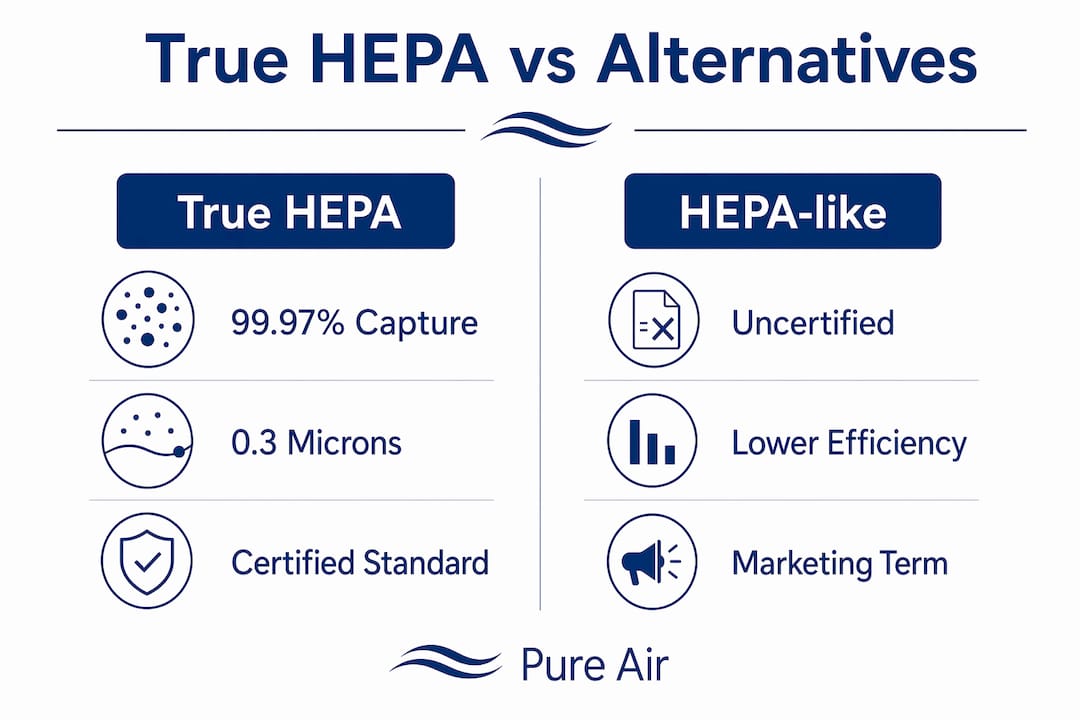
The gap between certified true HEPA and uncertified alternatives is wide, even though the packaging can look almost identical. The Washington State Department of Health advises consumers to treat terms like “HEPA-like,” “HEPA-style,” and “99% HEPA” as red flags unless the manufacturer provides documented test certification. That advice holds just as firmly for Australian buyers.
Here is what the terminology actually signals:
- True HEPA: Certified to 99.97% efficiency at 0.3 microns. Test documentation exists and can be verified.
- HEPA-type or HEPA-style: No defined performance standard. Efficiency may be significantly lower, sometimes as poor as 85–90%.
- 99% HEPA: Sounds close, but 99% versus 99.97% means the filter lets through roughly three times more particles at the critical size.
- HEPA-grade: Another unregulated marketing phrase. Without a certification number, it means nothing.
- Washable HEPA: Reusable filters rarely maintain true HEPA efficiency after washing. Treat these with scepticism.
The absence of explicit HEPA certification in a product’s technical specifications should be treated as a warning, not an oversight. Reputable manufacturers publish their test data. If you cannot find it, the filter has probably not been tested to the standard.
Pro Tip: Before purchasing, search for the product’s technical specification sheet rather than relying on the box. Look for the phrase “99.97% at 0.3 microns” in the specs, not just the word “HEPA” in the product name.
You can also read through Pureair-au’s guide on HEPA filter stages to understand exactly what a certified filter assembly looks like and how to confirm genuine construction.
Does CADR matter as much as the HEPA certification?
A true HEPA filter is only as useful as the air purifier moving air through it. Clean air delivery rate (CADR) measures how much filtered air a unit delivers per minute, expressed in cubic metres or cubic feet. The EPA recommends matching a unit’s CADR to the size of the room where it will operate, because a small unit with a certified HEPA filter will underperform in a large open-plan living area.
Choosing the right CADR involves a few practical steps:
- Measure your room. Calculate the floor area in square metres and note the ceiling height. A standard Australian living room might be 25–40 square metres with a 2.7 metre ceiling.
- Check the CADR rating. The unit’s CADR should be sufficient to cycle the room’s air volume at least four to five times per hour for meaningful particle reduction.
- Match to particle type. CADR ratings are often listed separately for dust, pollen, and smoke. For bushfire smoke, prioritise the smoke CADR figure.
- Account for usage patterns. If you run the unit on a low setting overnight, the effective CADR drops. Check performance at the speed you will actually use.
The EPA confirms that high CADR paired with genuine HEPA filtration delivers measurable improvements in indoor air quality. A certified filter in an undersized unit is like a hospital-grade water filter connected to a garden hose. The filtration is real, but the throughput defeats the purpose.
Pro Tip: A quick rule of thumb: divide your room’s volume in cubic metres by 12 to get the minimum CADR in cubic metres per hour you need for four air changes. Use this number when comparing units.
What can’t true HEPA filters remove?
True HEPA filters are mechanical filters. They physically trap particles in a dense mat of fibres. That mechanism works brilliantly for solid and liquid particles, but it does nothing for gases or molecules.
Particles that true HEPA captures effectively include:
- Dust and dust mite debris
- Pollen from grasses, trees, and weeds
- Pet dander and hair fragments
- Mould spores and some fungal fragments
- Fine particulate matter from bushfire smoke (PM2.5 and PM10)
- Some bacteria and larger virus-carrying droplets
What true HEPA does not remove:
- Volatile organic compounds (VOCs) from paints, cleaning products, and new furniture
- Cooking odours and cigarette smoke gases
- Carbon monoxide or nitrogen dioxide
- Formaldehyde and other chemical off-gassing
Mechanical HEPA filters do not help with gases or odours. Activated carbon filters are needed for those pollutants. This is a critical distinction because many consumers buy a true HEPA unit expecting it to eliminate cooking smells or chemical odours, then conclude the technology does not work. The technology works exactly as designed. It simply was not designed for that task.
For comprehensive air cleaning that addresses both particles and gases, look for units that combine a certified true HEPA stage with an activated carbon or sorbent stage. The two technologies are complementary, not interchangeable.
How do you maintain a true HEPA filter for lasting performance?
A true HEPA filter does not stay effective indefinitely. As the filter captures particles, the fibres become loaded and airflow resistance increases. Eventually, the filter either restricts airflow so much that CADR drops significantly, or particles begin to break through degraded sections.
Signs that your filter needs replacing:
- The unit’s indicator light signals a filter change (if fitted)
- Airflow from the unit feels noticeably weaker at the same speed setting
- Allergy or asthma symptoms return despite the unit running
- A musty or dusty smell comes from the unit’s output
Filter replacement typically occurs every 6–12 months, though this varies with usage intensity, local air quality, and whether pets are in the home. Australian households near bushfire-prone areas or with multiple pets may need to replace filters closer to the six-month mark. Delaying replacement degrades performance and can directly affect health outcomes for people with allergies or asthma.
Pro Tip: Set a calendar reminder for six months after each filter installation. Check the filter at that point rather than waiting for the indicator light, which can lag behind actual filter condition in some units.
Pureair-au’s guide on filter replacement in pet homes covers replacement timing in detail, including how pet hair and dander load filters faster than most manufacturers’ standard estimates account for.
Key takeaways
True HEPA is defined by a single, verifiable standard: 99.97% particle capture at 0.3 microns, and no marketing term substitutes for documented certification.
| Point | Details |
|---|---|
| True HEPA definition | Certified to capture 99.97% of particles at 0.3 microns; any other claim requires documented proof. |
| Marketing terms to avoid | “HEPA-like,” “HEPA-style,” and “99% HEPA” are unregulated phrases that do not confirm performance. |
| CADR is equally critical | Match the unit’s CADR to your room size; a certified filter in an undersized unit will underperform. |
| Particle vs. gas limitation | True HEPA captures particles but not gases or VOCs; add activated carbon for odour and chemical removal. |
| Replace filters on schedule | Replace every 6–12 months; delays reduce efficiency and worsen outcomes for allergy and asthma sufferers. |
The thing most buyers get wrong about true HEPA
I have spoken with a lot of Australian families who bought an air purifier, ran it for a year, and then told me it stopped working. Almost every time, the filter had not been replaced. The unit was still running, the fan was still spinning, but the filter was so loaded it was barely moving air. They had paid for true HEPA performance and were getting almost none of it.
The second most common mistake is buying on the HEPA label alone without checking CADR. A compact unit with a certified filter is genuinely useful in a bedroom. Put it in a large open-plan kitchen and living area and it is overwhelmed before it can make a dent. The certification is real. The mismatch is the problem.
What I find most frustrating is the “HEPA-like” category. These products are not cheap. They sit at similar price points to certified units, and the packaging is designed to look nearly identical. The Washington State Department of Health’s guidance to treat any ambiguous HEPA claim as a red flag is the right call, and I would apply it without hesitation to anything sold in Australia too. Ask for the test data. If the seller cannot provide it, walk away.
Buying a certified HEPA air purifier is not complicated once you know what to look for. The standard is clear. The certification is verifiable. The only variable is whether you check before you buy.
— Lucas
Pureair-au’s range of certified true HEPA air purifiers
Australian families have specific air quality challenges that generic products do not always address. Bushfire smoke, coastal humidity, and long pollen seasons demand units that are matched to local conditions, not just imported specifications.
Pureair-au stocks a range of certified air purifiers with documented true HEPA filtration, covering room sizes from compact bedrooms to large open-plan living areas. Every unit in the catalogue is AHAM verified, which means the CADR figures are independently tested, not self-reported. The Pureair-au Smart Finder tool helps you identify the right unit based on your room size, specific concerns like allergies or mould, and your preferred maintenance schedule. If you want genuine true HEPA performance backed by verifiable standards, the catalogue is the right place to start.
FAQ
What is the true HEPA filter meaning in plain terms?
True HEPA means a filter certified to capture at least 99.97% of airborne particles at 0.3 microns, the hardest particle size to trap. This certification is based on standards set by the U.S. Department of Energy and referenced by the EPA.
What is the difference between HEPA and true HEPA?
“HEPA” on its own is sometimes used loosely to describe filters that have not been independently certified. True HEPA specifically refers to filters with documented 99.97% efficiency at 0.3 microns; the Washington State Department of Health advises consumers to avoid any HEPA claim that lacks this certification.
Are true HEPA filters worth it for Australian homes?
True HEPA filters are worth it for households dealing with bushfire smoke, pollen allergies, pet dander, or mould spores. The EPA confirms that high CADR paired with genuine HEPA filtration delivers measurable indoor air quality improvements.
Do true HEPA filters remove odours and gases?
No. Mechanical true HEPA filters capture particles but do not remove gases, VOCs, or odours. An activated carbon or sorbent filter stage is needed alongside HEPA filtration for comprehensive air cleaning.
How often should a true HEPA filter be replaced?
True HEPA filters typically need replacing every 6–12 months. Households with pets, high dust loads, or proximity to bushfire-prone areas should check filters at the six-month mark rather than waiting for an indicator light.