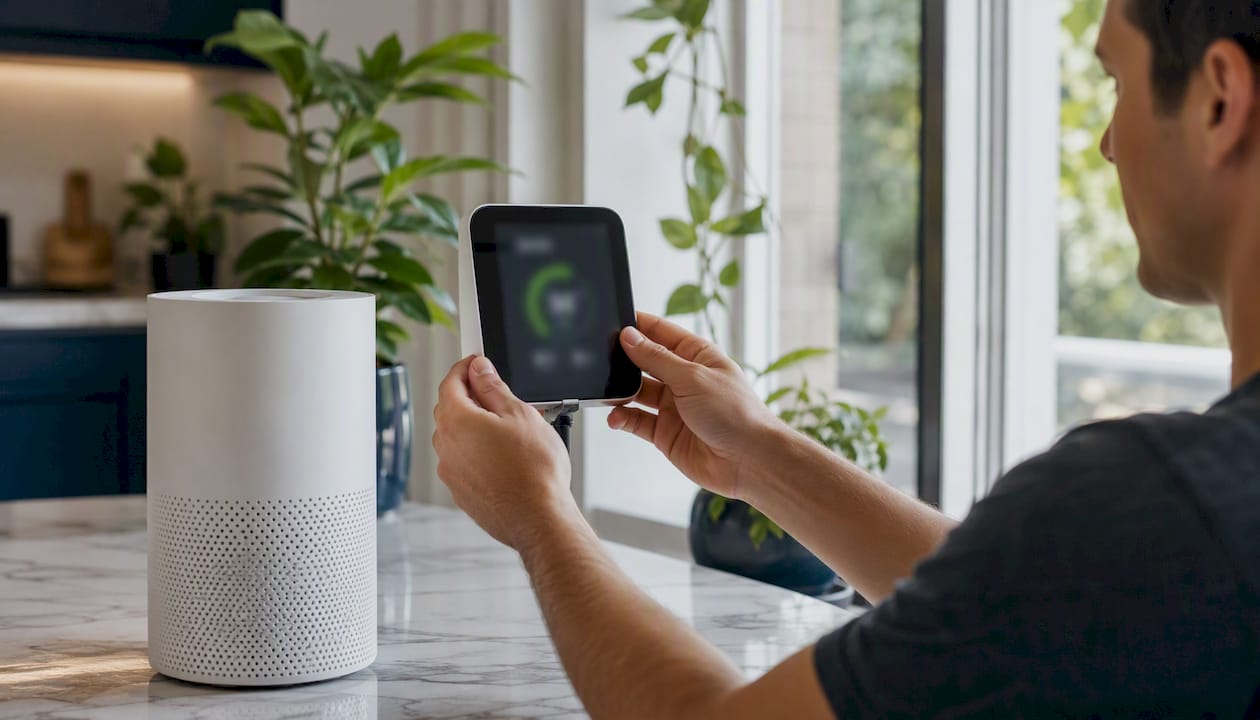
Air changes per hour (ACH) measures how many times the total air volume in a room is completely replaced within one hour, expressed as a rate in hr⁻¹. So if a room runs at 6 ACH, its entire air volume cycles through six times every hour — roughly once every ten minutes. That single number tells you whether a space is well-ventilated, dangerously stale, or somewhere in between.
Knowing your ACH matters most when you are trying to reduce allergens, dilute bushfire smoke, or lower the risk of airborne illness. The sections below give you the exact formulas, worked metric examples, recommended targets, and practical steps to raise ACH in any Australian home or workplace.
Table of Contents
- What does air changes per hour actually measure?
- How to calculate air changes per hour
- Worked examples for common Australian rooms
- What ACH targets should you aim for?
- How do you measure ACH in the real world?
- Practical steps to raise ACH in your Australian home
- When ACH misleads you: limits and quick checks
- Key takeaways
- Pureair-au has the right purifier for your room size
What does air changes per hour actually measure?
ACH is a ventilation rate metric: it tells you how fast air moves through a space relative to that space’s volume. It says nothing, on its own, about what is in that air or how well contaminants are removed — just how quickly the volume turns over.
Perfect mixing and why real rooms fall short
Every ACH calculation assumes “perfect mixing” — that fresh air distributes instantly and evenly throughout the room. In practice, supply vents positioned near exhaust vents can cause short-circuiting, where fresh air exits before it ever reaches the far corner of the room. Dead zones form behind furniture or in ceiling pockets. The result is that a room’s measured ACH can overestimate how much protection occupants actually receive.
eACH, CADR and ventilation rate: the vocabulary you need
eACH (equivalent ACH) accounts for filtration as well as ventilation. When you add a portable air purifier, it does not replace outdoor air, but it does clean the air already in the room. The EPA’s guidance on air cleaners uses eACH to describe the combined effect of mechanical ventilation plus filtration — a more useful number for infection-risk reduction than raw ACH alone.
CADR (Clean Air Delivery Rate) is the lab-measured volume of clean air a purifier produces per unit time, typically in m³/h or CFM. AHAM-verified CADR figures are the appropriate reference when sizing a portable purifier for a given room.
Ventilation rate is often expressed as litres per second per person (L/s/person) in Australian standards and engineering practice, rather than ACH. You can convert between the two once you know the room volume and occupancy — more on that in the targets section.
Common misconceptions
- ACH does not mean the air is instantly clean after one cycle — contaminant concentration falls exponentially, not all at once.
- Higher ACH does not automatically fix all indoor air problems; a high ACH with unfiltered outdoor air during a bushfire event can make things worse.
- A purifier’s CADR does not equal installed ACH without accounting for placement and mixing losses.
How to calculate air changes per hour
The metric and imperial formulas are straightforward. Australia uses metric, so start there.
Metric formula:
ACH = Airflow (m³/h) ÷ Room volume (m³)
Imperial formula (useful when reading US equipment specs):
ACH = (CFM × 60) ÷ Room volume (ft³)
The AIHA’s room ACH calculator expresses this as N = 60Q ÷ V, where Q is airflow in cubic feet per minute and V is room volume in cubic feet — the same relationship, different notation.
Unit conversions at a glance
| From | To | Multiply by |
|---|---|---|
| L/s | m³/h | — |
| m³/h | L/s | — |
| CFM | m³/h | 1.699 |
| m³/h | CFM | — |
| L/s | CFM | — |
Engineers in Australia and the US often work in different default units/13%3A_Flow_Control_and_Measurement/13.02%3A_Air_Flow_Rate_in_Pneumatic_Systems) — CFM dominates US equipment datasheets while m³/h appears on most Australian and European HVAC specifications. The conversion factor 1 CFM ≈ 1.699 m³/h is the one you will use most often.
What to measure before you calculate
To use either formula you need two numbers: room volume and airflow rate. Room volume is length × width × height in metres. Airflow comes from one of three places: your HVAC system’s design specification (usually in m³/h), a direct anemometer measurement at the supply grille, or a purifier’s AHAM-verified CADR rating. The Camfil step-by-step method recommends measuring each supply grille separately and summing them for the total room airflow before dividing by volume.
Worked examples for common Australian rooms
These examples use metric units throughout. Follow the arithmetic and you can replicate the method for any room in your home.
-
Small bedroom — 4 m × 3.5 m × 2.4 m
Volume = 4 × 3.5 × 2.4 = 33.6 m³
A typical split-system air conditioner recirculates about 200 m³/h on a medium fan setting (check your unit’s datasheet for the rated figure).
ACH = 200 ÷ 33.6 = 5.95 ACH
That sits comfortably in the 4–6 ACH range considered adequate for a residential bedroom. Bear in mind this is recirculated air unless the system draws outdoor air — filtration quality matters here. -
Open-plan lounge and kitchen — 7 m × 5 m × 2.7 m
Volume = 7 × 5 × 2.7 = 94.5 m³
A ducted system delivering 400 m³/h to this zone gives:
ACH = 400 ÷ 94.5 = 4.23 ACH
That is on the lower end for a high-occupancy living space. In an open-plan layout, mixing is also less predictable — cooking fumes and CO₂ from occupants can concentrate away from the supply grille. Positioning a portable purifier near the kitchen end improves effective clean-air delivery across the whole zone. -
Portable purifier — converting CADR to eACH
Say you place a purifier with an AHAM-verified CADR of 240 m³/h in the bedroom from Example 1 (volume 33.6 m³).
eACH = CADR ÷ Room volume = 240 ÷ 33.6 = 7.14 eACH
Combined with the existing 5.95 ACH from the air conditioner, the total effective clean-air rate rises substantially. The EPA’s guidance notes that portable air cleaners can meaningfully increase equivalent ACH when sized correctly for the room. Placement matters: a unit tucked in a corner loses a significant portion of its effective reach even if the CADR figure looks sufficient on paper.
Each example is drawn from the calculation methods described by Solver360 and the Camfil guide — the arithmetic is the same regardless of which source you follow.
What ACH targets should you aim for?
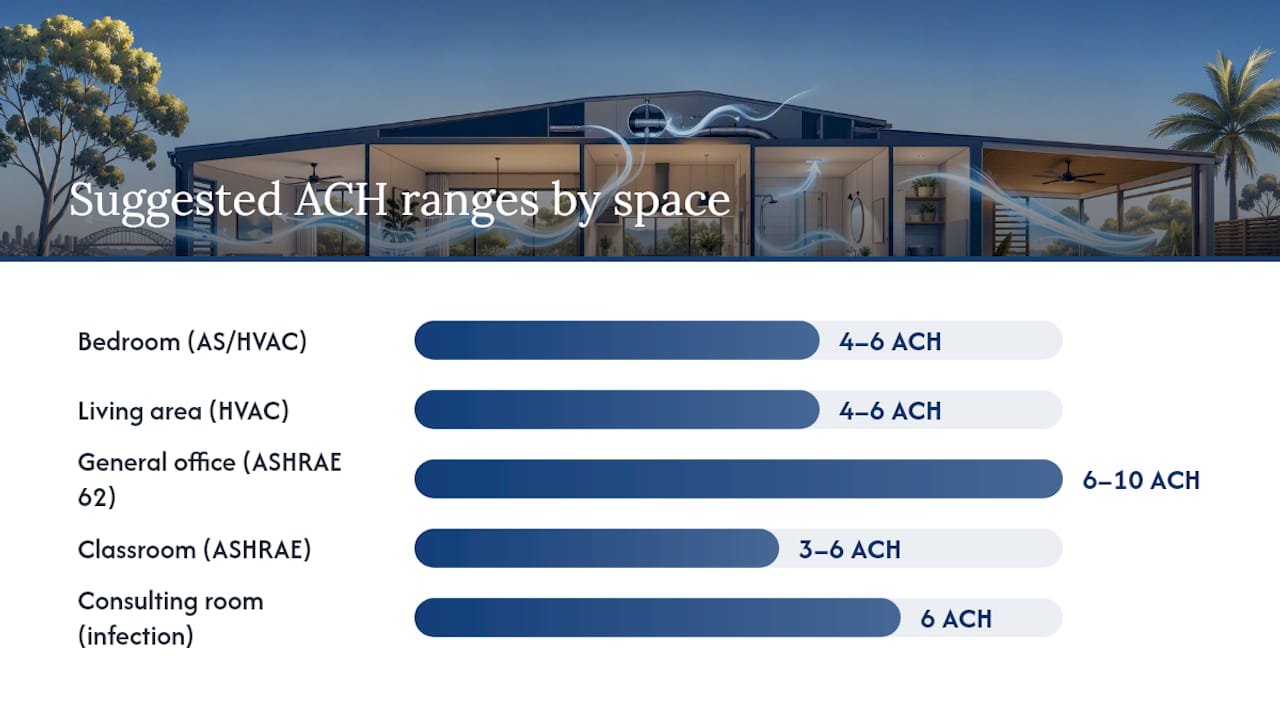
Recommended ranges vary by space type and the authority setting the standard. The table below summarises common guidance; note that clinical targets are set by infection-control requirements, not comfort alone.
| Space type | Suggested ACH range | Primary source |
|---|---|---|
| Residential bedroom | 4–6 | General HVAC practice / AS |
| Residential living area | 4–6 | General HVAC practice |
| General office | 6–10 | ASHRAE 62 |
| Classroom | 3–6 (minimum); higher recommended post-COVID | ASHRAE school reopening guidance |
| Consulting room / GP clinic | 6 | Infection-control guidelines |
| Hospital isolation room | a high ventilation target for infection control | CDC/NIOSH / Australian infection-control standards |
| Surgical suite | — | CDC/NIOSH |
The EPA’s ventilation and COVID-19 guidance reinforces that higher ventilation rates reduce airborne infection risk, particularly in spaces with multiple occupants. Australian Standard AS 1668.2 governs mechanical ventilation in buildings and sets minimum outdoor-air supply rates in L/s per person — a different framing from ACH, but convertible.
Converting L/s per person to ACH
If your standard specifies, say, 10 L/s per person for an office with 8 occupants, total airflow = 80 L/s = 288 m³/h. Divide by the room volume to get ACH. For a 72 m³ office: 288 ÷ 72 = 4 ACH — below the 6–10 range, which signals the need for supplementary filtration or increased supply.
How do you measure ACH in the real world?
Calculating ACH from design specs tells you what a system should deliver. Measuring it tells you what it actually delivers.
Tracer-gas decay
This is the gold standard. A known concentration of tracer gas (typically SF₆ or CO₂ at elevated levels) is released into the space, then monitored as it decays. The decay rate gives the true air change rate and reveals short-circuiting or dead zones that a simple airflow calculation misses. It requires specialist equipment and a controlled environment, so it is primarily used for building commissioning, clinical spaces, and compliance testing.
Direct airflow measurement
An anemometer placed at each supply and exhaust grille measures velocity; multiply by grille area to get volumetric flow in m³/h. Sum the supply grilles, divide by room volume. This is practical for HVAC technicians and building managers and gives a reasonable estimate without tracer gas. Accuracy depends on grille geometry and flow uniformity.
CO₂ as a practical proxy
Steady elevated CO₂ in an occupied space is a reliable indicator of insufficient fresh-air exchange per person. A CO₂ monitor is inexpensive, requires no specialist skill, and gives continuous feedback. Readings consistently above 1,000 ppm in a normally occupied room suggest ventilation is inadequate for the occupancy load. This method does not give you a precise ACH figure, but it tells you whether the ventilation is working well enough for the people in the room — which is often the more relevant question.
Pro Tip: Place your CO₂ monitor at breathing height (roughly 1–1.5 m from the floor) and away from supply vents. A reading taken directly under a supply grille will look artificially low and give a false sense of security.
Rated CADR for purifiers
For portable units, divide the AHAM-verified CADR (m³/h) by the room volume to estimate eACH, as shown in the worked examples above. This is the most accessible method for homeowners and does not require any measurement equipment beyond the purifier’s product datasheet.
When to call a professional: clinical spaces, newly commissioned buildings, any space where a regulatory compliance certificate is required, or when CO₂ readings remain high despite apparent ventilation improvements.
Practical steps to raise ACH in your Australian home
Getting ACH up is usually a combination of increasing outdoor-air ventilation and adding filtration. Here is where to start.
Increase outdoor-air ventilation first. Open windows on opposite sides of the room to create cross-ventilation. Even a 10-cm gap on each side moves air meaningfully. In mild weather, this is the cheapest and most effective intervention available.

Size your purifier by CADR, not by room area alone. The quick formula: eACH = CADR (m³/h) ÷ room volume (m³). For a 40 m³ bedroom, a purifier with a CADR of 240 m³/h delivers 6 eACH. Aim for at least 4–5 eACH from your purifier if mechanical ventilation is limited. AHAM-verified CADR figures are the only reliable basis for this calculation — marketing claims without AHAM verification are not comparable.
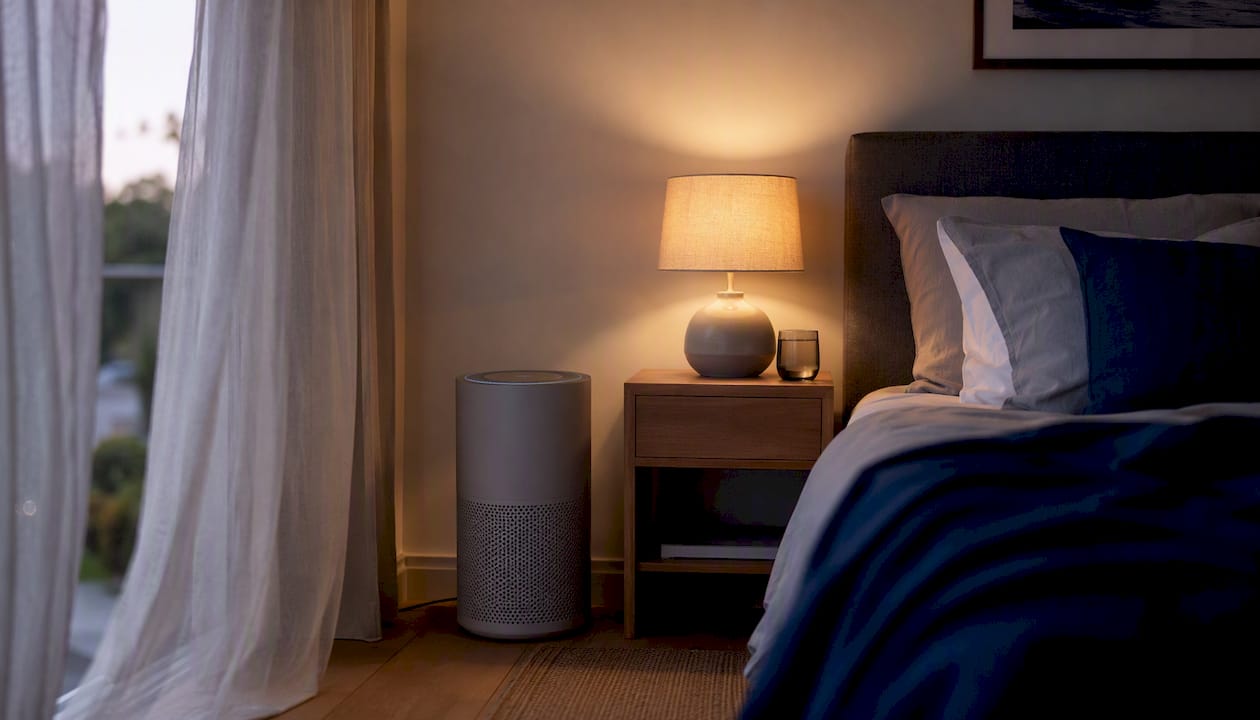
Placement changes everything. Keep the unit away from corners and walls; place it near the main pollution source (a bed, a desk, a cooking area) or where occupants spend the most time. An air purifier placement guide can walk you through the specifics for different room layouts. Unobstructed airflow on all sides of the unit is the single biggest factor in whether its rated CADR translates to real-world performance.
Upgrade HVAC filters. A ducted system running a MERV 13 filter removes a far higher proportion of fine particles than a standard MERV 8 filter, without requiring any change to the airflow rate. Check that your system’s fan can handle the increased static pressure before upgrading.
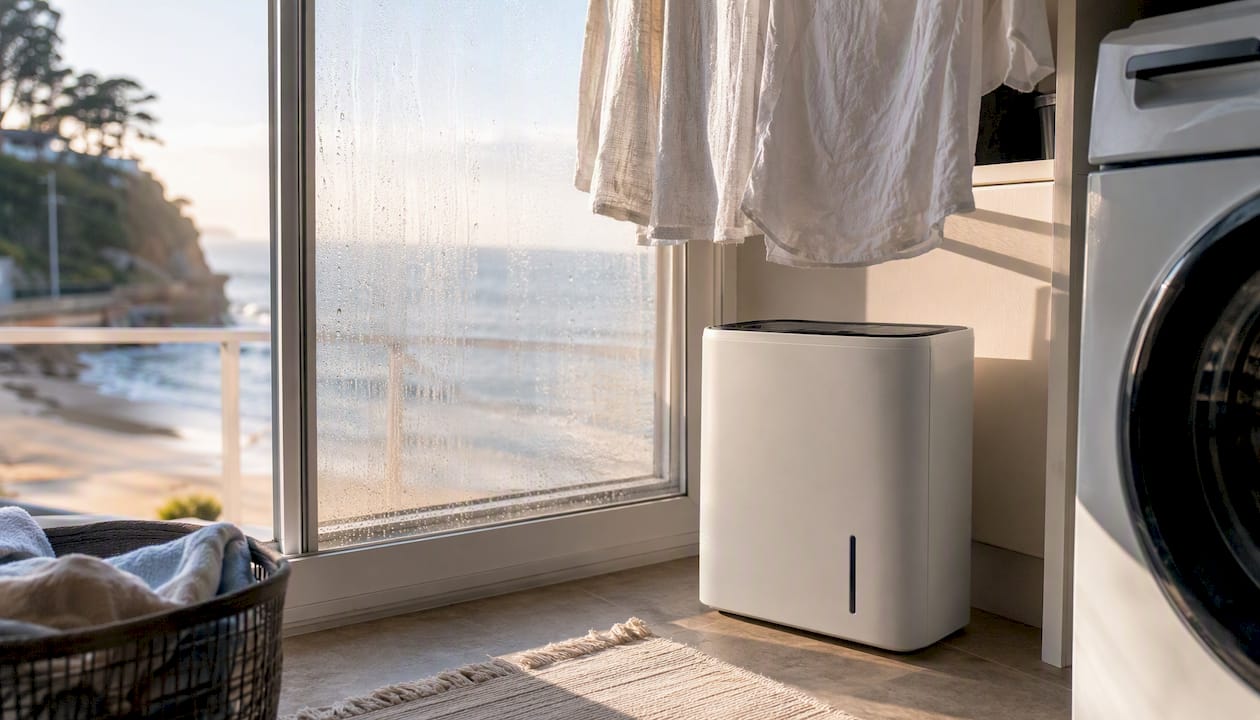
Australian-specific considerations. During bushfire smoke events, closing windows and running purifiers on a higher setting is the right call — outdoor ACH becomes a liability when the air outside is worse than inside. In humid coastal summers, balance ventilation against moisture ingress; a dehumidifier or a 2-in-1 purifier and humidifier can help manage both air quality and humidity simultaneously. For more on balancing these factors, the indoor humidity guide covers the seasonal trade-offs in detail.
Pro Tip: During a bushfire smoke period, seal gaps around doors and windows with draught excluders and run your purifier continuously on its highest effective setting. This keeps eACH high while keeping smoke-laden outdoor air out.
When ACH misleads you: limits and quick checks
ACH is a useful shorthand, but it has real limits worth knowing before you rely on it.
The perfect-mixing assumption is the biggest one. A room with 6 ACH on paper can have pockets where the effective air change rate is closer to 2 ACH because supply air short-circuits directly to the exhaust. Occupants sitting in those dead zones get far less protection than the headline number implies.
ACH also measures volume exchange, not filtration quality. A system delivering 8 ACH of unfiltered recirculated air does almost nothing for fine particle or pathogen removal. eACH, which accounts for filtration efficiency, is the more meaningful metric for health outcomes — and it is why HEPA-grade filtration matters alongside ventilation rate.
Quick checks to detect likely mixing problems:
- Walk the room with a CO₂ monitor and note whether readings vary significantly between locations; a large spread suggests dead zones.
- Check that supply and exhaust vents are on opposite sides of the room (or at least not adjacent), so air must travel across the occupied zone.
- Confirm purifier placement is central and unobstructed, not tucked behind a sofa or in a corner.
- Look for signs of stratification: warm air pooling near the ceiling in winter means the mixing fan speed may need increasing.
A tracer-gas test or professional HVAC assessment is warranted whenever a space must meet a regulatory standard (clinical, aged care, school) or when CO₂ readings remain persistently elevated despite apparent ventilation improvements. For home-level air quality improvement steps, the practical checks above are usually sufficient to identify the problem.
Key takeaways
ACH measures how many times a room’s air volume is replaced per hour, and combining it with eACH from a correctly sized and placed purifier gives the most complete picture of indoor air quality.
| Point | Details |
|---|---|
| ACH definition | ACH = airflow (m³/h) ÷ room volume (m³); a value of 6 means the full volume cycles six times per hour. |
| Metric formula in Australia | Use m³/h ÷ m³ for ACH; convert CFM to m³/h by multiplying by 1.699. |
| Recommended targets | Residential spaces typically need 4–6 ACH; classrooms and offices 6–10. |
| CO₂ as a proxy | Readings consistently above 1,000 ppm in an occupied room indicate insufficient ventilation for the occupancy load. |
| Pureair-au for sizing | Use AHAM-verified CADR figures from Pureair-au’s catalogue to calculate eACH before purchasing a purifier. |
Why ACH knowledge is more than a number
Most people encounter ACH only when something goes wrong — a persistent cough, a smoke event, or a post-COVID building audit. The metric tends to be treated as a compliance checkbox rather than a live tool for decision-making. That framing undersells it.
The more useful way to think about ACH is as a rate of dilution. Every contaminant in a room — allergens, smoke particles, CO₂, volatile organic compounds — decays at a rate tied directly to how fast clean air replaces the existing air. Knowing your ACH, even roughly, tells you whether opening a window will make a meaningful difference or whether you need a purifier running at full speed. It turns a vague sense that “the air feels stuffy” into something you can actually act on.
The eACH concept matters even more for Australian households, where bushfire seasons and high-pollen springs make outdoor ventilation unreliable for months at a time. A well-placed, correctly sized purifier with a verified CADR can deliver the equivalent of several additional air changes per hour without bringing outdoor air inside. That is not a workaround — for many Australian homes, it is the primary strategy.
Pureair-au has the right purifier for your room size
Calculating eACH is only useful if the purifier you buy actually delivers its rated CADR. Every unit in the Pureair-au catalogue carries AHAM verification, which means the CADR figure on the box is the figure you can use in your calculation — not a marketing estimate. The range covers medical-grade HEPA filtration for bushfire smoke and allergens, humidity controls for coastal summers, and smart air quality monitoring so you can see ACH-equivalent performance in real time.
Use the Smart Finder tool on the Pureair-au website to match a unit’s CADR to your room volume, or browse the full range of air purifiers, humidifiers and filters to find the right fit for your home.
Authoritative sources and further reading
- Air changes per hour – Wikipedia
- Air Changes per Hour Calculator
- How to Calculate Air Changes Per Hour – Camfil
- Guide to Air Cleaners in the Home, 2nd edition — EPA
- Room Air Changes Per Hour — AIHA
- Ventilation and Coronavirus (COVID-19) | US EPA
- Air flow rate in pneumatic systems — LibreTexts/13%3A_Flow_Control_and_Measurement/13.02%3A_Air_Flow_Rate_in_Pneumatic_Systems)
- Complete Guide to Air Changes per Hour (ACH): Calculation Methods and Applications | Solver360
- ASHRAE reopening guidance for schools and universities (COVID-19)