
HEPA filtration is defined as a mechanical air cleaning process that forces air through a fine mesh, capturing 99.97% of airborne particles including dust, pollen, pet dander, and bushfire smoke. Knowing how to maintain HEPA filters at home correctly separates a purifier that protects your family from one that quietly fails while still running. Most Australian homeowners replace filters too late, clean them incorrectly, or skip pre-filter care entirely. This guide covers the right replacement schedules, safe cleaning methods, and step-by-step replacement practices for units like the Philips NanoProtect and Honeywell Air Touch series, with specific adjustments for Australian conditions in 2026.
How often should you replace your HEPA filter at home?
True HEPA filters need replacing every 6–12 months under normal household conditions. That range shifts significantly based on what is happening inside and outside your home.
Households with pets or smokers should replace filters every 6–8 months. Low-traffic homes with minimal dust can stretch replacement to 14–16 months. Australian homes near bushfire-prone areas or high-pollen regions face heavier filter loads and should lean toward the shorter end of that range.
Environmental factors matter as much as household habits. Cooking with high heat, running ceiling fans that stir up settled dust, and leaving windows open during pollen season all accelerate filter clogging. A filter in a coastal home dealing with salt air and humidity ages differently from one in a dry inland suburb.
The table below gives a practical starting point for replacement timing based on household type.
| Household type | Recommended replacement interval | Key trigger signs |
|---|---|---|
| Standard (no pets, no smokers) | Every 10–12 months | Reduced airflow, visible darkening |
| Pets or smokers | Every 6–8 months | Increased fan noise, allergy symptoms return |
| Low-traffic, low-dust home | Up to 14–16 months | Airflow check every 3 months |
| Bushfire smoke or high pollen exposure | Every 6 months or sooner | Smell, reduced airflow, symptom flare |
Pro Tip: Set a recurring calendar reminder every 3 months to physically check your filter. You do not need to replace it at each check, but a quick look at airflow and filter colour keeps you ahead of failure.
Can you clean HEPA filters at home, and what methods are safe?
The single most important rule in HEPA filter care is this: check the manufacturer label before doing anything. Manufacturer labelling is the definitive guide on whether your filter is washable or non-washable. Ignoring that distinction can void your warranty and degrade your air quality.
Washable HEPA filters
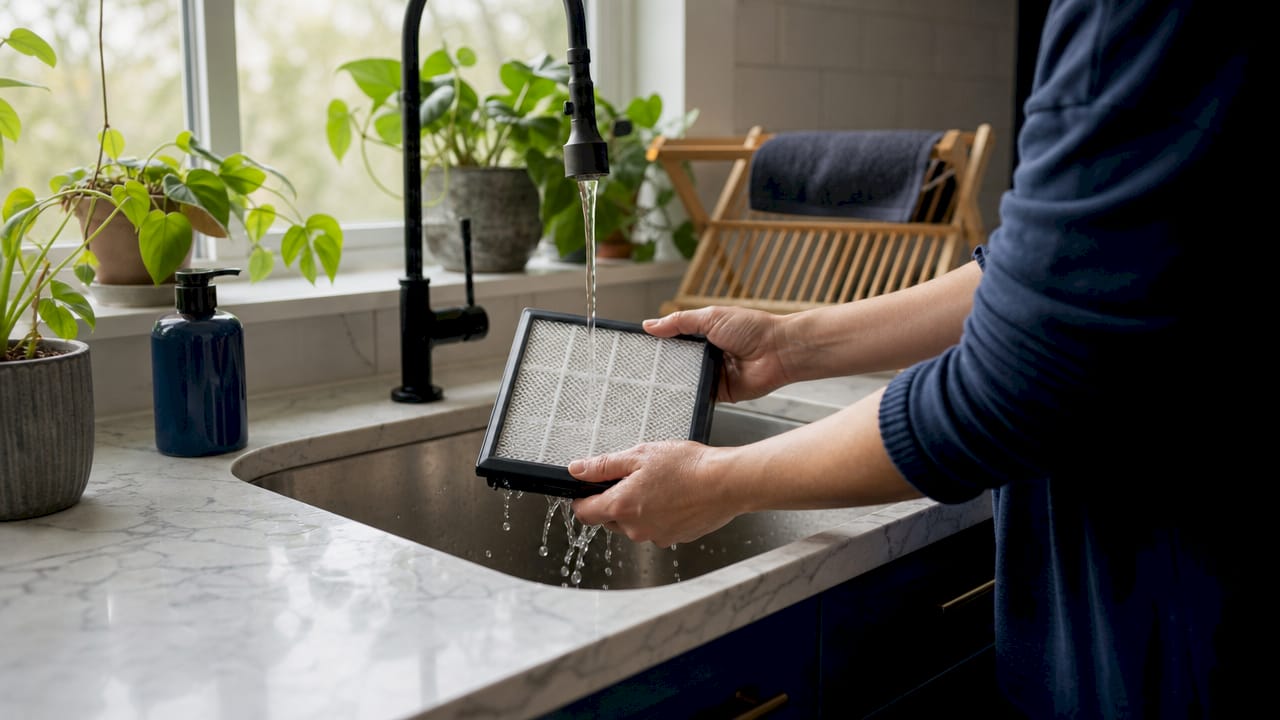
Washable filters are clearly labelled as such. Rinse them gently under cool running water, working from the clean side outward to push debris out rather than deeper into the media. Never use detergent, hot water, or scrubbing brushes. After rinsing, allow 24–48 hours of complete air drying before reinstalling. A damp filter reinstalled too early creates mould inside your purifier, which then blows spores directly into your living space.
Non-washable HEPA filters
Non-washable filters make up the majority of units sold in Australia, including most Philips NanoProtect and Levoit filter ranges. Washing or vacuuming these filters damages the electrostatic media that traps fine particles, creating gaps that allow pollutants to pass straight through. The only safe surface maintenance for non-washable filters is:
- Gentle tapping over a bin to dislodge loose surface dust
- A soft, dry brush run lightly across the outer surface
- A low-suction vacuum with a brush attachment, only if the manufacturer explicitly permits it
- Never use compressed air, which drives particles deeper into the media and can rupture fibres
Pro Tip: If you are unsure whether your filter is washable, treat it as non-washable. The cost of a replacement filter is far lower than the cost of degraded air quality or a voided warranty.
Step-by-step: how to replace a HEPA filter safely
Replacing a HEPA filter incorrectly can release a concentrated cloud of trapped particles back into your home. Follow these steps to do it cleanly and safely.
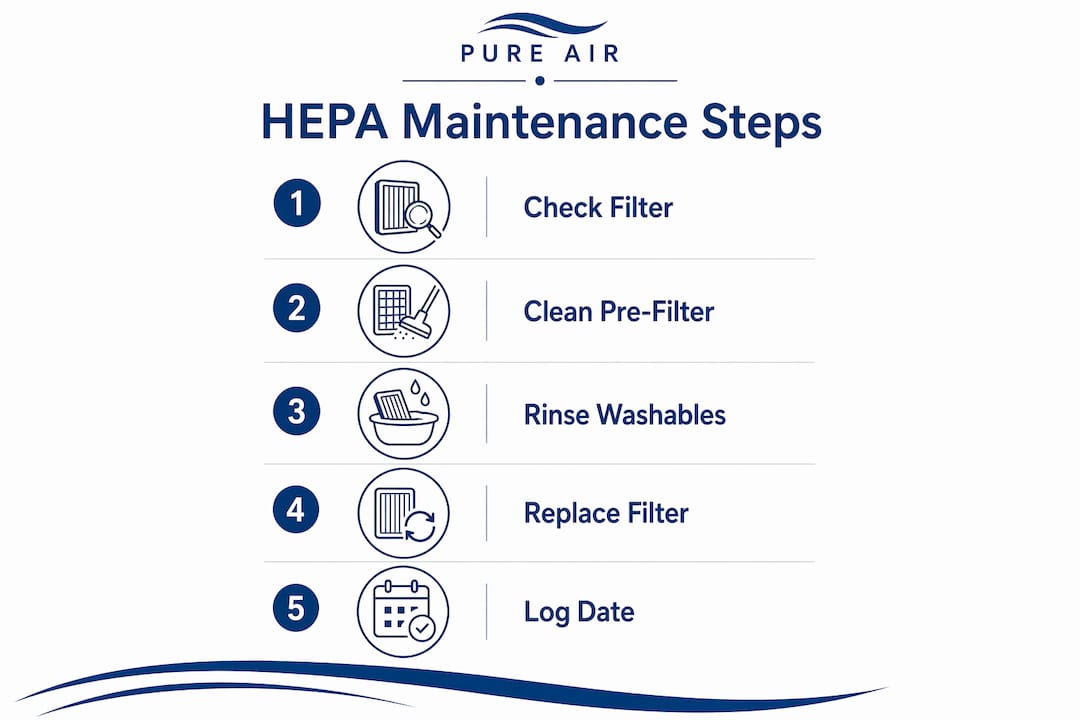
- Unplug the device. Never open a running purifier. Work in a well-ventilated area, ideally near an open window or outside.
- Remove the old filter carefully. Slide or lift it out slowly to avoid shaking loose particles. Place it directly into a sealed plastic bag before moving it anywhere else in the home.
- Clean the device casing. Use a dry or lightly damp cloth to wipe the interior housing. Do not use spray cleaners near the motor or electrical components.
- Remove all packaging from the new filter. Leaving plastic wrapping on a new filter is one of the most common installation mistakes. It blocks airflow completely and the purifier will appear to run while doing nothing.
- Install the new filter in the correct orientation. Most filters have an arrow indicating airflow direction. Align it with the arrow on the device housing.
- Check the seal. Press gently around the filter edges to confirm there are no gaps. Air bypassing the filter defeats the purpose entirely.
- Run the device on high for 20–30 minutes. This post-installation run clears any new-filter odours and confirms the unit is drawing air correctly.
Pro Tip: Keep a simple log, a sticky note on the device or a note in your phone, recording the date of each filter replacement. This is far more reliable than trusting the device indicator light alone.
For model-specific timing, the Levoit filter replacement guide on Pureair-au covers individual unit schedules in detail.
Troubleshooting common issues and extending filter life
Symptoms are a more reliable signal than indicator lights. Increased fan noise, reduced airflow, or the return of allergy symptoms often appear before the device indicator triggers and before the filter looks visibly dark. Trust your body and your ears over the light on the panel.
Indicator lights are time-based timers, not sensors measuring actual filter condition. A filter in a pet-heavy home during spring pollen season can clog in half the time the light assumes. Relying solely on the indicator in those conditions means running a failing filter for weeks.
The pre-filter is the most overlooked part of HEPA filter maintenance. Cleaning the pre-filter every 2–4 weeks prevents large particles like pet hair, lint, and dust clumps from reaching the HEPA layer. Neglecting pre-filter cleaning can halve HEPA filter lifespan, particularly in homes with dogs or cats. That is the difference between replacing your HEPA filter every 6 months versus every 12.
The comparison below shows the real-world impact of pre-filter maintenance on HEPA lifespan.
| Maintenance behaviour | Typical HEPA filter lifespan | Notes |
|---|---|---|
| Pre-filter cleaned every 2–4 weeks | 10–14 months | Recommended for all households |
| Pre-filter cleaned monthly | 7–10 months | Acceptable in low-dust homes |
| Pre-filter rarely or never cleaned | 4–6 months | Common in pet households |
| No pre-filter (single-stage unit) | 6–8 months standard | Replace on schedule, no extension possible |
Beyond pre-filter care, reducing the overall load on your purifier extends filter life. Keep windows closed during high-pollen days, groom pets outdoors when possible, and use rangehood fans while cooking. These habits reduce the volume of particles your HEPA filter must process each day.
For pet owners specifically, the common mistakes with air purifiers guide on Pureair-au covers the most frequent errors that shorten filter life in animal-friendly homes.
Key takeaways
Proper HEPA filter maintenance requires knowing your filter type, cleaning the pre-filter every 2–4 weeks, and replacing the HEPA layer based on household conditions rather than indicator lights alone.
| Point | Details |
|---|---|
| Replacement interval varies | Replace every 6–8 months with pets or smokers, up to 14–16 months in low-traffic homes. |
| Never wash non-washable filters | Washing damages electrostatic media and allows particles to bypass filtration entirely. |
| Pre-filter care doubles HEPA life | Cleaning the pre-filter every 2–4 weeks can double the effective lifespan of your HEPA filter. |
| Indicator lights are not sensors | Trust airflow, fan noise, and allergy symptoms over time-based device indicator lights. |
| Remove all packaging before installing | Leaving plastic wrap on a new filter blocks airflow completely and ruins purifier performance. |
What I have learned from years of watching people maintain HEPA filters
Most people treat their air purifier like a smoke alarm: they install it, forget it, and only notice it when something goes wrong. The single most common mistake I see is skipping pre-filter maintenance entirely. Homeowners replace expensive HEPA filters every few months while the pre-filter sits clogged with pet hair, doing none of the work it was designed to do.
The second most common mistake is washing a non-washable filter after reading a generic cleaning tip online. The filter looks cleaner afterwards. The air quality gets worse. The electrostatic charge that captures fine particles is gone, and the unit runs at full power while filtering almost nothing.
What actually works is building filter checks into your existing cleaning routine. Check the pre-filter when you vacuum. Check the HEPA filter when you change your air conditioning filter. Write the replacement date on a piece of tape stuck to the back of the unit. These are not complicated systems. They are just habits that most people never form because no one told them the stakes.
Australian homes face specific pressures that make this more urgent than generic advice suggests. Bushfire smoke seasons, high spring pollen counts, and the humidity swings between coastal and inland areas all accelerate filter degradation faster than the schedules written for Northern Hemisphere conditions. Adjust your intervals accordingly, and your purifier will actually protect you when you need it most.
— Lucas
HEPA filter replacements and purifiers for Australian homes
Pureair-au stocks a full range of replacement HEPA filters and air purifiers suited to Australian household conditions, from low-dust apartments to high-allergen family homes.
The Philips HEPA NanoProtect filter is one of the most popular replacement options for Australian homes, starting from $52.00 for compatible models. For homeowners ready to upgrade their unit, the Honeywell Air Touch P1 offers reliable HEPA performance at $246.00. Browse the full air purifiers and filters catalogue to find the right replacement or new unit for your home, with AHAM-verified products and Australian-focused support.
FAQ
How often should I replace my HEPA filter at home?
Replace true HEPA filters every 6–12 months under normal conditions. Homes with pets, smokers, or heavy bushfire smoke exposure should replace every 6–8 months.
Can I wash my HEPA filter to make it last longer?
Only wash filters explicitly labelled as washable by the manufacturer. Non-washable HEPA filters must never be rinsed, as this destroys the electrostatic media and allows particles to pass through unfiltered.
What are the signs my HEPA filter needs replacing?
Reduced airflow, increased fan noise, and the return of allergy symptoms are the most reliable signs. These often appear before the device indicator light triggers.
Does cleaning the pre-filter really extend HEPA filter life?
Yes. Cleaning the pre-filter every 2–4 weeks prevents large particles from clogging the HEPA layer prematurely. Neglecting it can halve the HEPA filter’s effective lifespan.
What is the most common mistake when installing a new HEPA filter?
Leaving the plastic packaging on the new filter is the most frequent error. It blocks all airflow and the purifier runs at full power while filtering nothing.