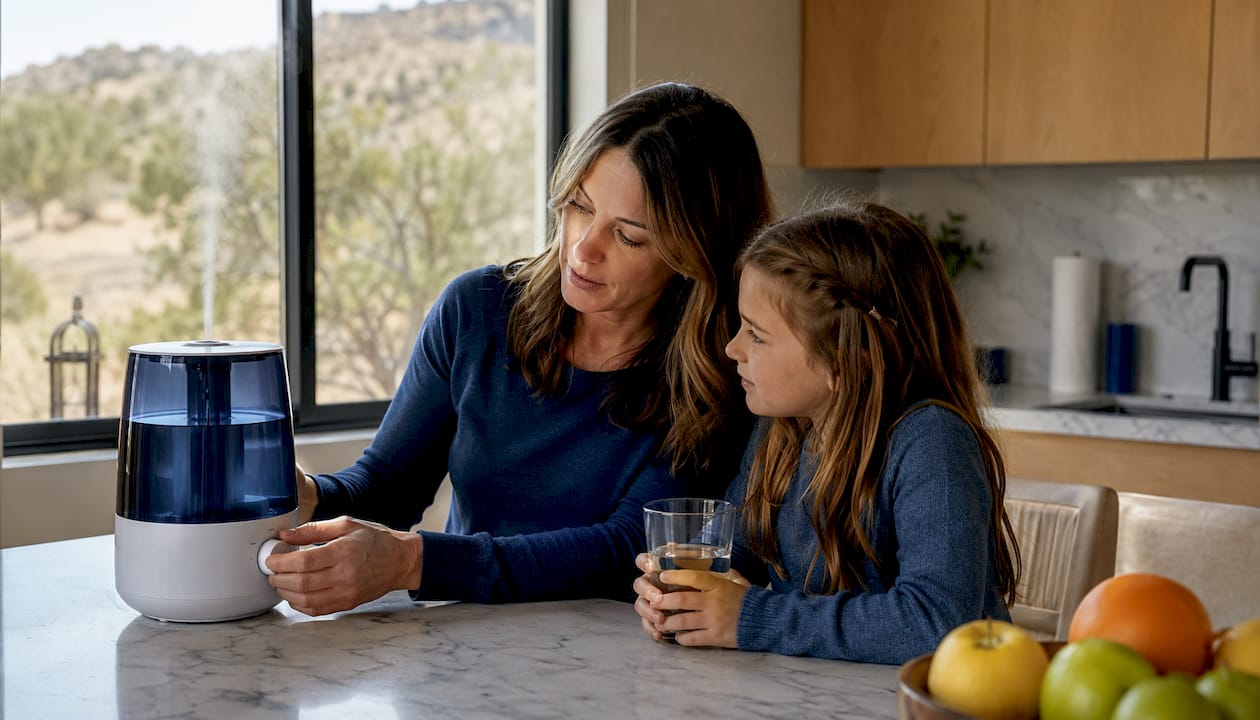
Humidifiers support your family’s respiratory health during smoky bushfire seasons, but they do not change outdoor fire behaviour or reduce bushfire risk. That distinction matters for how you use them.
- Use them for health, not fire prevention. During prolonged smoke events, humidification eases nasal and throat irritation, particularly for infants, older adults, and anyone with asthma or COPD.
- They do not remove smoke particles. Pair any humidifier with a medical-grade HEPA purifier and seal your home to limit smoke infiltration.
- Choose safe, verified units. AHAM-verified humidifiers tested to recognised electrical safety standards reduce appliance hazards; steam units carry specific overheating risks covered below.
- Evacuation always comes first. If there is a direct fire threat, no indoor air strategy replaces following emergency services instructions.
Table of Contents
- How does outdoor relative humidity drive bushfire behaviour?
- What health benefits do humidifiers actually provide during smoke events?
- Which humidifier type suits fire season use?
- How to use a humidifier safely during a smoke event
- Daily and weekly maintenance to keep your humidifier safe
- When should you prioritise humidification, filtration, sealing, or evacuation?
- Key takeaways
- A practical perspective on humidifiers in smoke-prone seasons
- Pureair-au’s AHAM-verified options for Australian homes
- Useful sources and further reading
How does outdoor relative humidity drive bushfire behaviour?
Relative humidity is the single most important weather variable for predicting wildland fire spread, ranking above temperature and wind in fire-management research. When RH drops, fine fuels — grasses, leaf litter, bark — lose moisture rapidly and ignite far more easily. The Bureau of Meteorology tracks RH as a core fire-weather metric for exactly this reason.
Fine fuels with a one-hour timelag respond to RH changes within roughly 60 minutes. That rapid exchange is what drives the dangerous afternoon fire conditions familiar to anyone who has lived through a hot, dry Australian summer: RH falls through the day, fuels dry out, and fire danger peaks in the late afternoon. The diurnal RH cycle is one reason fire agencies issue warnings that escalate through the day even when conditions looked manageable at dawn.
The critical point for families: indoor humidifiers raise moisture in the air inside your home. They cannot raise regional fuel moisture, alter RH across a landscape, or change the behaviour of a fire burning kilometres away. Extreme fire behaviour research confirms that once vegetation crosses critical moisture thresholds, no indoor intervention can counteract those regional forces.
| Fuel type | Timelag | Response to RH change |
|---|---|---|
| Fine fuels (grass, litter) | 1 hour | Rapid — dries within an hour of RH drop |
| Small woody fuels | 10 hours | Moderate — responds over several hours |
| Medium woody fuels | 100 hours | Slow — takes days of sustained low RH |
| Large logs | — | Very slow — reflects long-term drought conditions |
Indoor RH does affect the moisture content of timber framing and wood-panel surfaces inside your home. Modelling from MDPI Sensors shows that maintaining moderate indoor RH can slow the drying of interior wood surfaces, which has implications for structure fire risk — but that is a separate question from outdoor bushfire behaviour entirely.
What health benefits do humidifiers actually provide during smoke events?
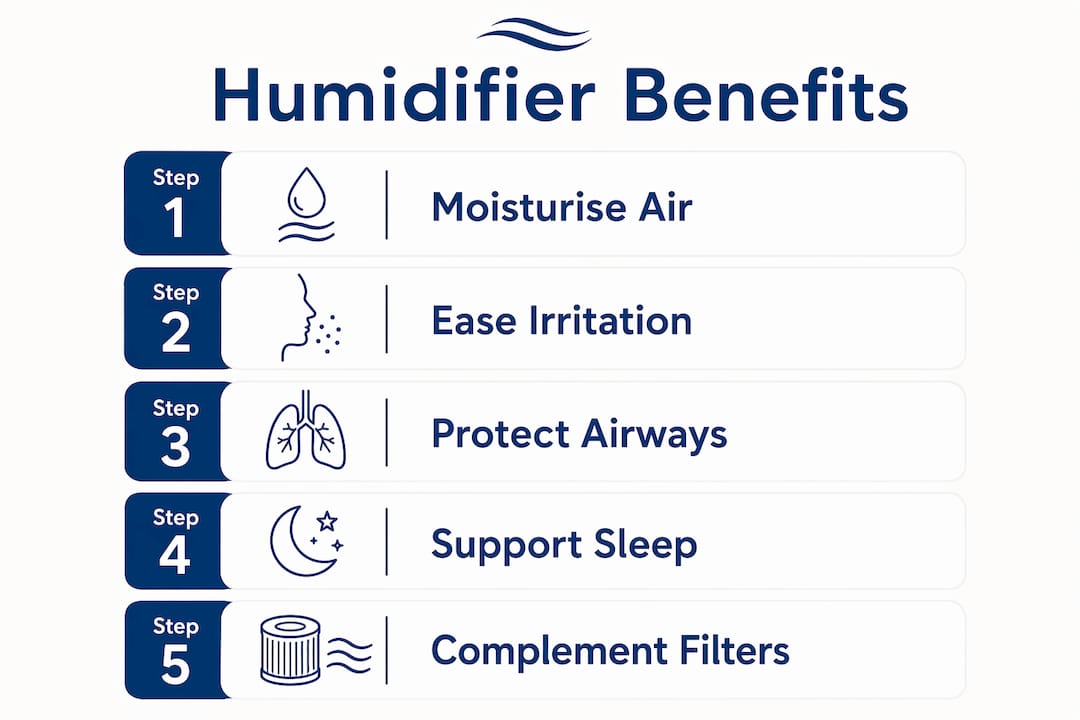
Humidification supports mucous membrane function. When smoke-laden air dries out nasal passages and airways, the body’s first line of defence against inhaled particles is compromised. Keeping indoor RH at a moderate level helps maintain the thin mucous layer that traps and clears irritants before they reach the lower airways.
Who benefits most:
- Infants and young children, whose airways are narrower and more sensitive to irritation
- Adults over 65, particularly those with reduced lung capacity
- People with asthma, COPD, or chronic bronchitis
- Anyone using a CPAP machine, where dry air worsens mask seal and throat irritation
Humidifiers do not capture or neutralise PM2.5 particles. That job belongs to a HEPA air purifier, which captures 99.97% of airborne particles at 0.3 microns. The two devices address different problems: filtration removes particles, humidification supports the airways that particles irritate. Running both together, with windows closed, gives you the most protective indoor environment during a smoke event. For a broader picture of what smoke actually puts into your home’s air, the Pureair-au guide on indoor air pollutants is worth reading.
The recommended indoor RH target for Australian homes during smoke events is 40–55%. Below 40%, mucous membranes dry out and irritation increases. Above 55–60%, you create conditions that favour mould growth and dust mite proliferation, which introduces a separate set of respiratory triggers. The mould trade-off is real: more is not better.
Pro Tip: A digital hygrometer costs under $20 at most hardware stores and tells you exactly where your indoor RH sits. Without one, you are guessing.
Which humidifier type suits fire season use?
Evaporative and ultrasonic humidifiers are generally lower fire-risk than plug-in steam units, but each type has trade-offs worth knowing before you buy.
Steam (warm mist) humidifiers boil water to produce steam. They kill bacteria in the process, which is a hygiene advantage, but the heating element is a genuine electrical hazard. A CPSC recall involving steam humidifiers documented numerous reports of overheating and several incidents resulting in smoke or residential fires, with total damages exceeding millions of US dollars. The failure mode was a “D” shaped electrode connector loosening and arcing. If you use a steam unit, check it is not subject to any active recall and that it meets UL 998 or CSA C22.2 No. 104 electrical safety standards.
Ultrasonic humidifiers use a vibrating plate to produce a fine cool mist. No heating element means lower fire risk, but they disperse whatever is in the water, including minerals and any bacteria present. Distilled water is strongly recommended. White mineral dust on surfaces is a sign you need to switch water types.
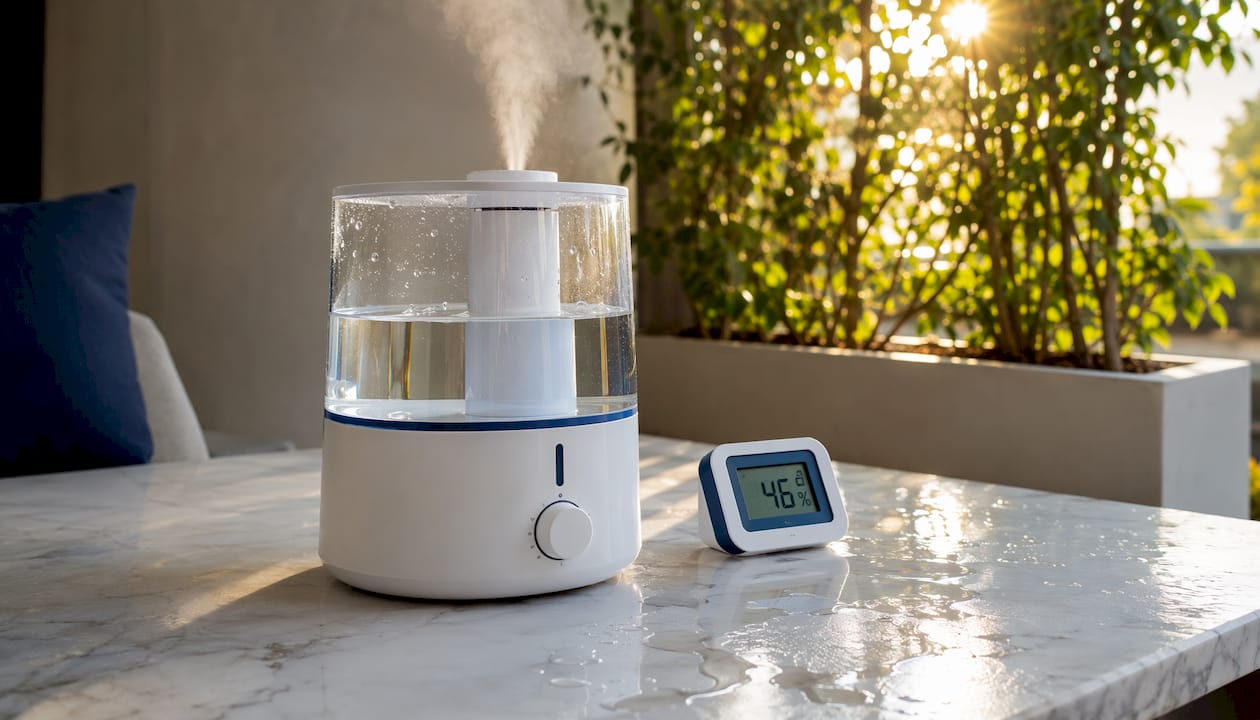
Evaporative humidifiers draw air through a wet wick or filter, releasing moisture naturally. They self-regulate to some extent — output drops as RH rises, which reduces the risk of over-humidifying. Wicks need regular replacement to prevent bacterial and mould growth.
One thing to be clear on: residential humidifiers are comfort and health devices. Water-mist fire suppression systems are a completely different technology, using high-pressure pumps and engineered nozzles. Do not conflate the two when assessing what a humidifier can do.
Pro Tip: Look for AHAM verification on any unit you buy. AHAM-verified products have independently tested performance claims, so the moisture output figure on the box reflects real-world operation.
How to use a humidifier safely during a smoke event
Run your humidifier to reach 40–55% indoor RH while keeping a HEPA air purifier running continuously and all windows and doors closed. That combination addresses both particle load and mucosal comfort.
- Check your hygrometer before switching on. If RH is already above 50%, hold off.
- Set placement carefully. Position the humidifier at least one metre from walls and furniture to allow even mist distribution. Avoid placing it directly beside the HEPA purifier’s intake — you want the purifier drawing room air, not mist.
- Run the HEPA purifier continuously in the same room, or in the bedroom overnight. The purifier handles particles; the humidifier handles comfort.
- Monitor condensation. If you see moisture on windows or walls, reduce output or move the unit.
- Use distilled or demineralised water in ultrasonic units to prevent mineral dispersion.
- Ventilate briefly when smoke clears. When outdoor air quality improves, open windows for 10–15 minutes to flush accumulated moisture before closing up again.
A PM2.5 monitor alongside your hygrometer gives you a complete picture of indoor conditions. When PM2.5 readings are elevated, keep the home sealed. For practical room air quality steps, Pureair-au’s guide covers the full setup.
Pro Tip: Bedrooms are the highest-priority room. You spend 7–8 hours there breathing, so running both a HEPA purifier and a humidifier in the bedroom overnight during smoke events gives the most consistent protection.
Daily and weekly maintenance to keep your humidifier safe
Proper cleaning, correct water choice, and regular electrical checks are the most important safety measures for sustained fire-season use. A neglected humidifier can become a source of airborne bacteria or, in the case of steam units, an electrical hazard.
Daily: Empty the water tank completely when the unit is not in use. Wipe the tank interior and any external surfaces with a clean cloth. Check the power cord and plug for any signs of damage or heat.
Weekly: Deep clean the tank and base with a diluted white vinegar solution or the manufacturer’s recommended descaler. Replace wicks and filters on the schedule the manufacturer specifies — a clogged wick grows bacteria and reduces output. If you use a steam unit, inspect the electrode connectors for any signs of corrosion or loosening.
Safety warning: Steam humidifiers with faulty electrode connectors have caused residential fires. If your unit is subject to an active recall or shows any sign of arcing, overheating, or unusual smell, shut it off immediately, unplug it, and contact the manufacturer. Do not continue using it.
The Canada.ca recall notice for Research Products steam humidifiers covers units sold under multiple brand names between June 2010 and January 2015. Check your model number if you have an older unit.
When should you prioritise humidification, filtration, sealing, or evacuation?
Health protection indoors is the right priority when PM2.5 is elevated and there is no immediate fire threat to your property. The moment there is a direct local fire risk, evacuation takes precedence over every indoor air strategy.
- PM2.5 below 25 µg/m³ (Good to Moderate): Normal ventilation. No special action needed.
- PM2.5 25–100 µg/m³ (Unhealthy for sensitive groups): Close windows, run HEPA purifier, add humidifier if RH is below 40%. Limit strenuous activity indoors.
- PM2.5 above 100 µg/m³ (Unhealthy to Hazardous): Seal gaps around doors and windows with towels or draught excluders. Run HEPA purifier on high. Maintain RH at 40–55%. Prepare go-bag and monitor emergency alerts.
- Smoke visible or smellable inside, or fire danger rating indicates immediate threat: Stop all indoor air management activity. Follow your evacuation plan and emergency services instructions.
For external home protection during fire seasons, fire-resistant roofing and fire safety measures for your roof are worth considering as part of a whole-home resilience approach.
Running costs are worth factoring in. Evaporative and ultrasonic humidifiers use modest electricity. HEPA filters need replacement every 6–12 months depending on smoke load, and replacement filters for quality units typically cost $52–$82 in Australia. Budget for both when planning your fire-season setup.
Key takeaways
Pairing a humidifier with a medical-grade HEPA purifier and a sealed home gives Australian families the most protective indoor environment during bushfire smoke events.
| Point | Details |
|---|---|
| Humidifiers support health, not fire suppression | They ease mucosal irritation during smoke events but cannot change outdoor bushfire behaviour. |
| Target indoor RH of 40–55% | Below 40% dries airways; above 55–60% risks mould growth and dust mite activity. |
| Steam units carry specific fire risks | A CPSC recall documented 103 overheating reports and 10 fire incidents; check your unit against active recalls. |
| Always pair with HEPA filtration | Humidifiers do not remove PM2.5 particles; a HEPA purifier capturing 99.97% of particles is the complementary tool. |
| Pureair-au for Australian families | AHAM-verified humidifiers and HEPA purifiers selected for Australian conditions, with a Smart Finder to match the right unit to your home. |
A practical perspective on humidifiers in smoke-prone seasons
The conversation around humidifiers during bushfire season tends to split into two unhelpful camps: people who dismiss them as irrelevant because they do not suppress fires, and people who overstate them as a health cure-all. Neither view serves families well.
The honest position is that humidification is a supporting tool, not a centrepiece. The centrepiece is filtration. A quality HEPA purifier running continuously during a smoke event does the heavy lifting on particle removal. The humidifier’s job is narrower but genuinely useful: keeping airways moist enough to function as intended, particularly overnight and for the family members most vulnerable to smoke irritation.
What gets underestimated is the maintenance burden. A humidifier that sits in a cupboard between fire seasons and gets pulled out in January without cleaning is a bacterial dispersal device, not a health tool. The families who get real benefit from humidification are the ones who treat the unit as a piece of medical equipment: clean it, use the right water, and check the electrics. That discipline is what separates a useful appliance from a liability.
The other thing worth saying plainly: no indoor air strategy should delay evacuation. The best-equipped home in Australia is still a building in the path of a fire. Know your local fire danger ratings, have a plan, and treat indoor air management as what it is — a comfort and health measure for the days when staying inside is the right call, not a reason to stay when it is not.
Pureair-au’s AHAM-verified options for Australian homes
For families ready to set up a proper smoke-season indoor air system, Pureair-au offers AHAM-verified humidifiers and medical-grade HEPA purifiers selected specifically for Australian conditions. The range includes ultrasonic and evaporative humidifiers that meet recognised electrical safety standards, paired with HEPA purifiers that capture 99.97% of airborne particles including bushfire smoke.
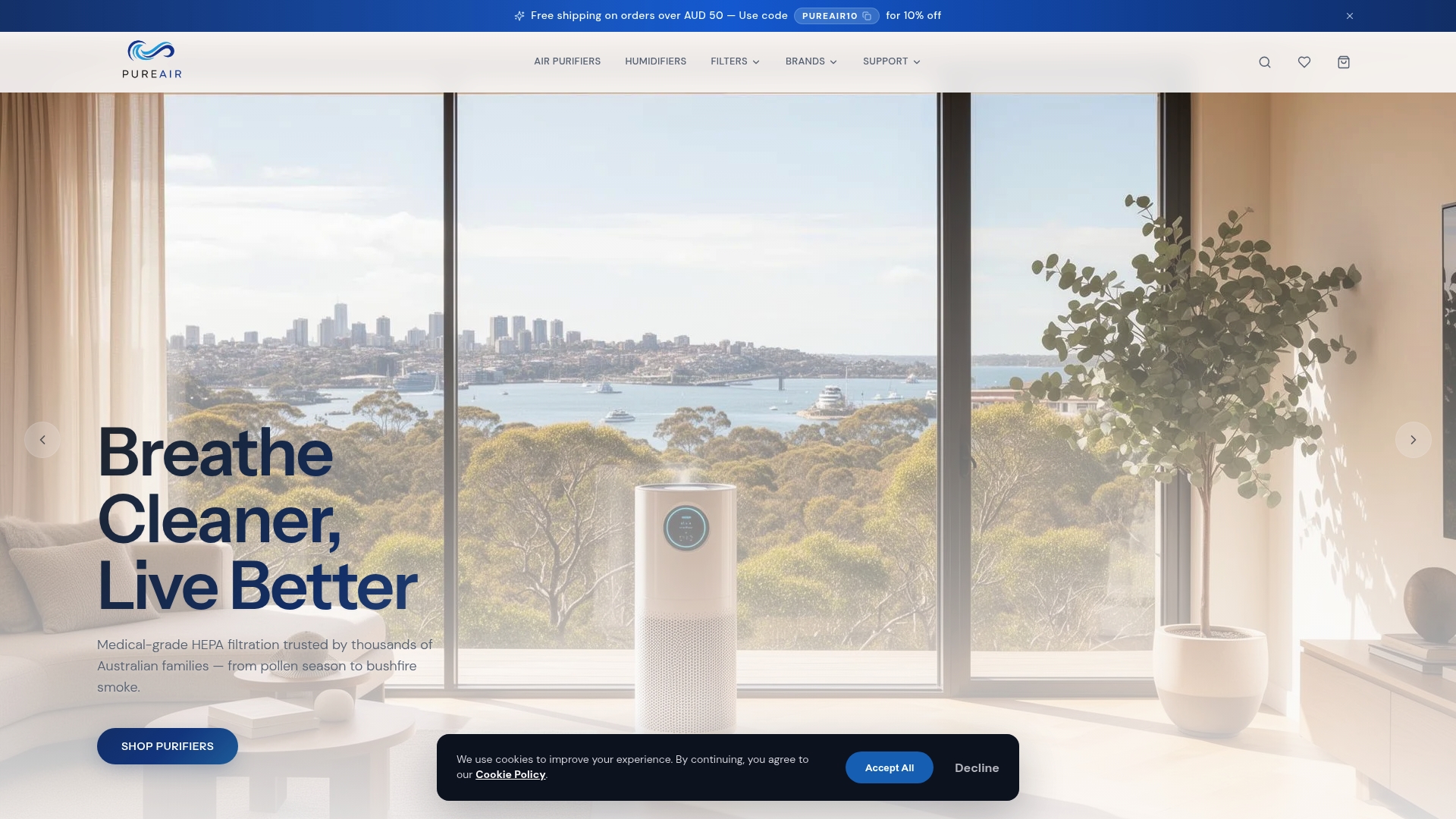
The Pureair-au Smart Finder tool matches your household size, specific concerns (smoke, allergies, mould), and room layout to the right combination of units, so you are not guessing at capacity or compatibility. For families who want an integrated purifier and humidifier in one unit, the Blueair 2-in-1 DH3i is available through the catalogue. Browse the full Pureair-au product range to find AHAM-verified units with local customer support and Australian delivery.
Useful sources and further reading
| Source | What it covers |
|---|---|
| Bureau of Meteorology — fire weather guidance | RH as a core fire-weather variable; Australian fire danger ratings |
| U.S. National Park Service — understanding fire danger | Fuel timelag classes and diurnal RH effects on fire danger |
| MDPI Sensors — indoor RH and wood moisture modelling | How indoor RH affects timber moisture and structure fire risk |
| MDPI Fire — extreme fire behaviour and fuel moisture | Critical fuel moisture thresholds and limits of indoor interventions |
| CPSC recall — steam humidifiers fire hazard | 103 overheating reports, 10 fire incidents, US$10 million in damages |
| Canada.ca recall — steam humidifiers | Canadian recall details for Research Products steam humidifiers |
| Intertek — UL 998 / CSA C22.2 No. 104 safety standards | Electrical safety requirements for humidifiers |
| Pureair-au — air quality solutions for bushfire season | Australian-focused guidance on HEPA filtration, humidification and sealing |