
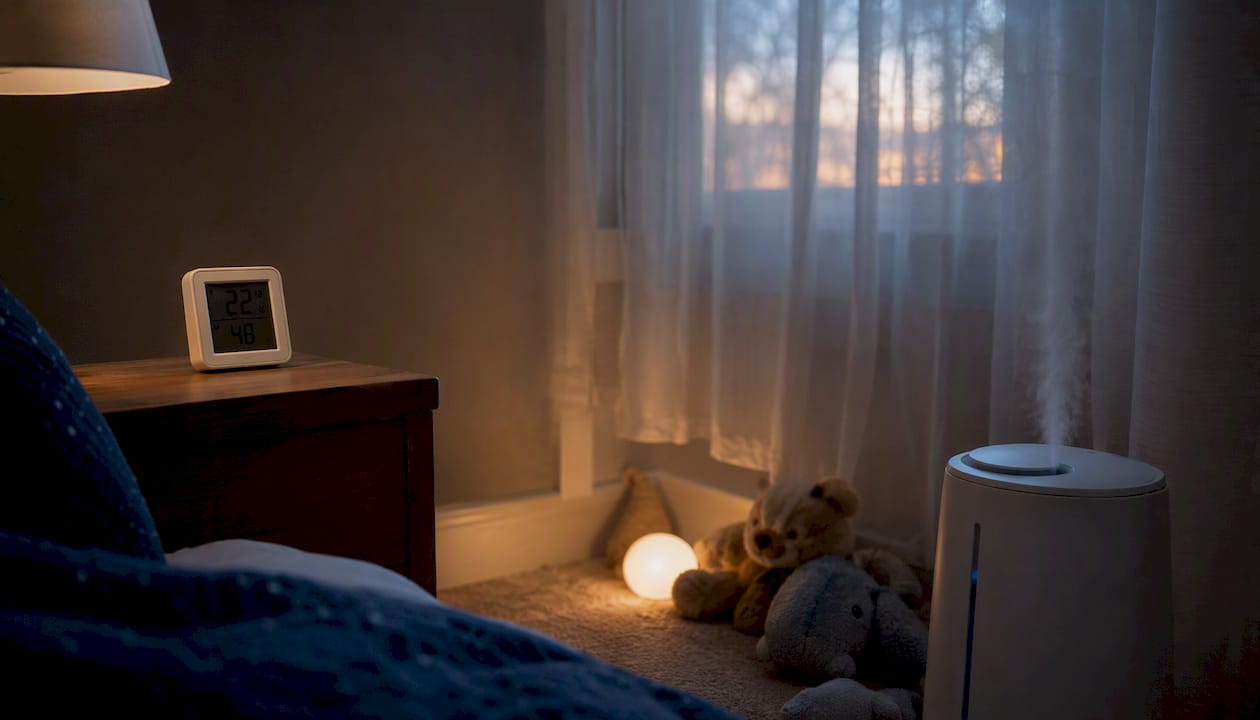
That single number is the most practical target for most Australian homes, and it sits within the 35–50% range recommended by the Pediatric Environmental Health Center at Boston Children’s Hospital.
If you’re not sure where your child’s room sits right now, here’s what to do tonight:
- Grab a digital hygrometer (or order one tomorrow) and place it at roughly the same height as your child’s head when sleeping, at least 30 cm from any wall.
- If the reading is below the recommended range, run a cool-mist humidifier before bed and check again. If it’s above the recommended range, open a window briefly, run a ceiling fan, or use a dehumidifier if available.
- If your child has a blocked nose, is coughing at night, or wakes frequently, humidity outside the 40–50% band is worth investigating before anything else.
Consult your GP if your child is showing breathing difficulty, persistent coughing, or you can see visible mould in the room.
Key takeaways
| Point | Details |
|---|---|
| Target RH range | Aim for 40–50% RH; below 35% dries airways, above 60% promotes mould and dust mites. |
| Measure accurately | Place a digital hygrometer at sleeping height, away from walls and mist output; log morning and evening readings. |
| Clean your humidifier | Rinse the tank daily, deep-clean weekly with diluted white vinegar, and replace filters monthly. |
| Adjust for season | Use a humidifier in dry southern winters; switch to a dehumidifier or air conditioning in humid coastal summers. |
| Pureair-au support | Pureair-au’s Smart Finder and AHAM-verified product range help Australian parents choose and maintain the right device for their climate. |
Table of Contents
- Why indoor humidity affects your child’s health and sleep
- What the safe humidity range for a child’s bedroom actually means
- How to measure and monitor humidity in your child’s bedroom
- When to use a humidifier or dehumidifier, and how to choose the right one
- Humidifier safety and maintenance: the cleaning schedule that actually matters
- How to adjust humidity by season and what to do when your child is sick
- Signs your child’s bedroom is too dry or too humid
- Your practical checklist: tonight, weekly, and monthly
- The part most parents get wrong about humidity in Australian homes
- Pureair-au helps you get the right device and keep it working
- Sources
Why indoor humidity affects your child’s health and sleep
Relative humidity is the percentage of water vapour in the air compared to the maximum it can hold at that temperature. For children, whose airways are narrower and whose immune systems are still developing, the quality of the air they breathe overnight matters more than most parents realise.
Dry air thins the mucus lining of the nose and throat. That lining is your child’s first defence against viruses and bacteria. When it dries out, nasal passages become irritated, nosebleeds become more frequent, and coughs linger longer than they should. Research commentary from Harvard T.H. Chan School of Public Health notes that humidity affects aerosol stability and respiratory virus transmission dynamics, which is one reason controlled indoor humidity is considered part of broader infection-reduction strategies.
On the other end, too much moisture creates a different set of problems. Mould spores germinate on surfaces where relative humidity reaches 70% or higher, according to Building Science Corporation’s analysis of indoor moisture. Both mould and dust mites are strongly linked to asthma flare-ups and allergic rhinitis in children.
Sleep is the third piece. The Sleep Foundation recommends keeping bedroom RH in roughly the 30–50% band to support comfortable, undisturbed sleep and avoid respiratory irritation. Children are particularly sensitive: a stuffy, humid room or a dry, scratchy one can fragment sleep cycles and leave kids overtired and irritable the next day. Better room air quality and stable humidity are two of the simplest levers parents have.
Statistic callout: Dust mites reproduce most rapidly above 50% RH, and mould can begin growing on surfaces once relative humidity reaches 70% — both well within the range that poorly ventilated Australian bedrooms can reach in summer.
What the safe humidity range for a child’s bedroom actually means
The evidence converges on a fairly tight window. Boston Children’s Hospital recommends a child-safe humidity range within moderate limits to balance airway hydration and allergen control. (https://www.childrenshospital.org/services/pediatric-environmental-health-center/hhomes/humidity). The National Asthma Council Australia advises keeping indoor humidity between about 30% and 50% to reduce asthma and allergy triggers. Building Science Corporation recommends keeping interior relative humidity below a certain upper limit to minimize mould risk, with higher surface humidity posing increased mould risk.
In those regions, a dehumidifier or air conditioning is the priority, not a humidifier.
Pro Tip: Check your hygrometer reading at both bedtime and first thing in the morning. The morning reading is often the more useful one for spotting a high-humidity problem.
How to measure and monitor humidity in your child’s bedroom
Knowing the number is everything. A hygrometer measures relative humidity and temperature, and a decent digital one costs between $15 and $40 at most hardware stores or online.
- Choose a digital hygrometer with a temperature display. Analogue dial versions drift over time. Look for one with ±3% accuracy, a clear display, and battery life of at least six months. Models with a data-logging function or a min/max memory are worth the small extra cost.
- Place it at sleeping height, away from walls and windows. Mount or rest it roughly 60–90 cm above the mattress, at least 30 cm from any wall. Near a window or an exterior wall gives you the wall’s microclimate, not the room’s.
- Keep it away from the humidifier’s mist output. A hygrometer sitting directly in the mist stream will read 10–20% higher than the actual room average.
- Log readings at two times: just before your child goes to sleep and first thing in the morning. Humidity in a closed bedroom rises overnight. Practical home guides note that overnight readings can climb meaningfully in sealed rooms, so a single daytime check can miss the peak.
- Run the device for at least three days before making changes. One reading is a snapshot; three days of morning and evening readings gives you a reliable picture of the room’s typical range.
- Consider a smart monitor for ongoing tracking. Wi-Fi-enabled humidity monitors (such as those compatible with home automation apps) let you check readings remotely and set alerts if RH drifts outside your target band. Useful if your child is a light sleeper and you’d rather not open the door to check.
When to use a humidifier or dehumidifier, and how to choose the right one
Humidifier types for a child’s bedroom:
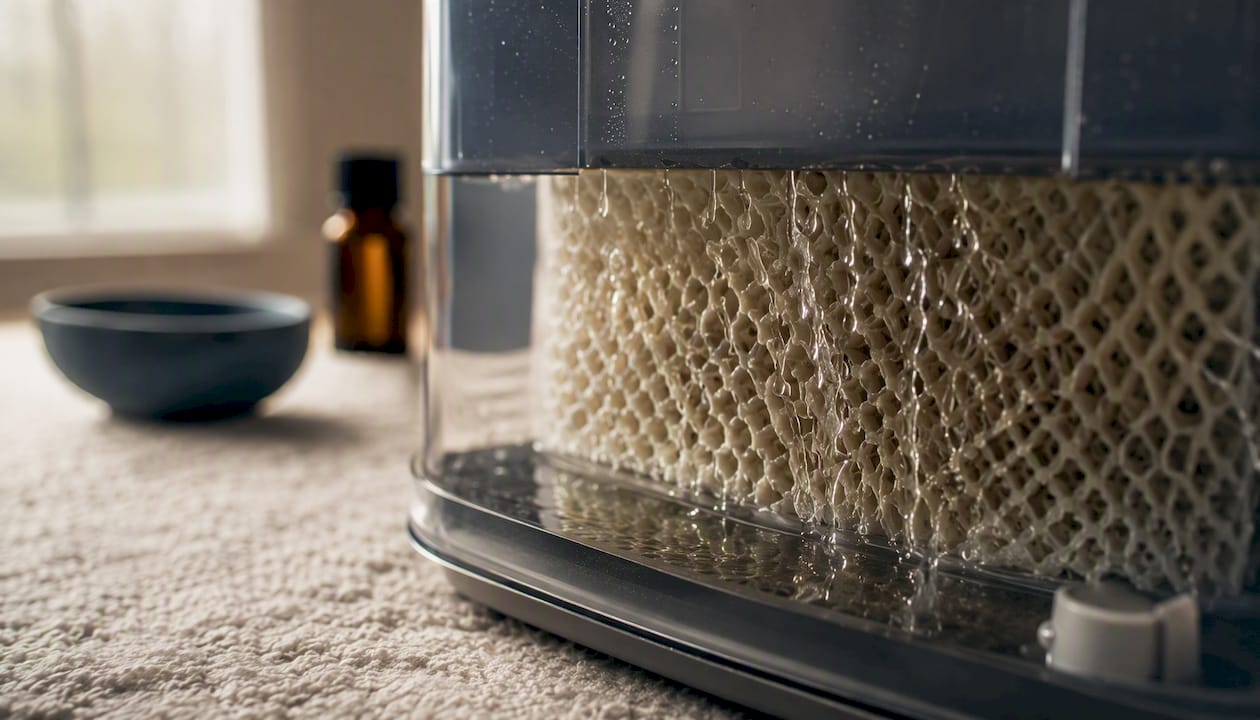
Cool-mist evaporative models draw air through a wet wick filter and release moisture as water vapour. They’re self-regulating to some degree (output drops as room humidity rises), quiet, and safe around children because there’s no hot element. The filter needs regular cleaning.
Ultrasonic models use high-frequency vibration to produce a fine cool mist. They’re very quiet, which suits light sleepers. The trade-off: they can disperse mineral dust from tap water into the air, which is why distilled water is strongly recommended.
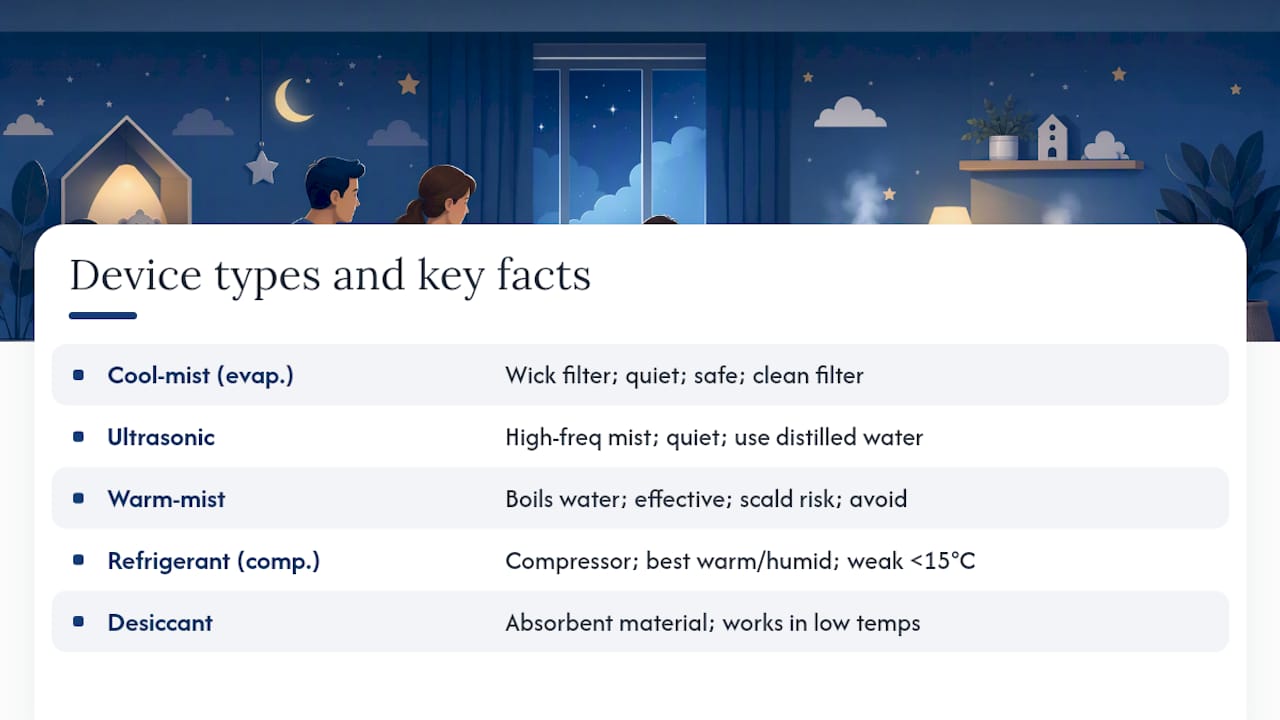
Warm-mist models boil water to produce steam. They’re effective but carry a scald risk around toddlers and young children. Avoid these in a child’s bedroom unless the unit is completely out of reach and has an automatic shut-off.
Dehumidifier types:
Refrigerant (compressor) dehumidifiers work well in warm, humid conditions and are the standard choice for coastal and tropical Australian homes in summer. They’re less effective below about 15°C.
Desiccant dehumidifiers use a moisture-absorbing material and work at lower temperatures, making them better suited to cooler southern climates in winter.
Sizing: Match the device to the room. Most child bedrooms are 10–15 m². A humidifier rated for up to 25 m² is adequate; don’t oversize, as it can push RH too high too quickly. For dehumidifiers, a unit rated at 10–12 litres per day is sufficient for a typical bedroom in a humid climate.
Pro Tip: Always choose a humidifier or dehumidifier with a built-in humidistat and an automatic shut-off. Without one, you’re guessing — and it’s easy to overshoot into mould territory overnight.
For more on using dehumidifiers safely with children, including sizing and placement, Pureair-au has a dedicated parents’ guide.
Humidifier safety and maintenance: the cleaning schedule that actually matters
A dirty humidifier is worse than no humidifier. Stagnant water in the tank breeds bacteria and mould within 24–48 hours, and the unit then disperses those into your child’s breathing air. The Pediatric Environmental Health Center at Boston Children’s Hospital is explicit: humidifiers must be cleaned regularly and use distilled water to avoid becoming allergen sources themselves.
- Daily: Empty the tank completely, rinse it with fresh water, and refill with distilled or demineralised water. Never top up a tank that still has water in it from the previous day.
- Every 3 days: Wipe down the tank interior and base with a diluted white vinegar solution (one part vinegar to one part water). Rinse thoroughly before refilling.
- Weekly: Disassemble all removable parts, soak in the vinegar solution for 20–30 minutes, scrub with a soft brush, rinse, and air-dry completely before reassembly.
- Monthly: Inspect the filter or wick (if your model has one) for discolouration, mineral build-up, or any visible mould. Replace it if there’s any doubt. Most manufacturers recommend filter replacement every 1–3 months depending on use.
- End of season: Before storing the unit, do a full deep clean, dry every component completely, and store disassembled. A humidifier stored with residual moisture will grow mould over winter and seed it straight into the room when you next switch it on.
No-no list for child bedrooms:
- Never add essential oils to a humidifier not specifically designed for them. Diffused oils can irritate children’s airways and are not recommended for infants.
- Never leave a warm-mist unit within reach of a toddler or young child.
- Never run a humidifier without cleaning it on schedule. A documented cleaning log on the fridge door takes 30 seconds to update and removes the guesswork.
Pro Tip: Use distilled or demineralised water in ultrasonic humidifiers. Tap water contains minerals that the unit aerosolises into fine white dust, which settles on surfaces and can be inhaled. Distilled water eliminates this entirely and extends the life of the unit.
For a full setup walkthrough, including placement and first-use steps, see Pureair-au’s guide on setting up a humidifier in your baby’s room.
How to adjust humidity by season and what to do when your child is sick
Australia’s climate range is wide enough that seasonal strategy matters. At those levels, dry nose, throat irritation, and nosebleeds become common. The National Asthma Council Australia specifically recommends the 30–50% band to reduce asthma and allergy triggers, and winter dryness is the main threat in temperate regions.
In Brisbane, Darwin, Cairns, and coastal New South Wales during summer, the problem is the opposite. Running air conditioning (which reduces absolute humidity while cooling) or a refrigerant dehumidifier is the priority. Leaving laundry to dry indoors, cooking without exhaust fans, and poor bathroom ventilation all add to the load. The EPA’s moisture control guidance points to ventilation, dehumidification, and source control as the three levers to pull. For practical strategies specific to high-humidity regions, Pureair-au’s guide to reducing indoor humidity in humid climates covers the detail.
Consult your GP if your child has breathing difficulty, a barking cough that doesn’t ease, or symptoms lasting more than a week.
Signs your child’s bedroom is too dry or too humid
Signs of too-low humidity:
- Dry, cracked lips or skin on waking
- Frequent nosebleeds, especially in the morning
- Persistent dry cough or scratchy throat with no other illness signs
- Static electricity when touching bedding or clothing
Quick fixes: run a cool-mist humidifier for 2–3 hours before bed, place a bowl of water near (not on) the heater, and keep the bedroom door slightly ajar to allow some moisture exchange with the rest of the house.
Signs of too-high humidity:
- Condensation on windows or window frames in the morning
- A musty or earthy smell in the room
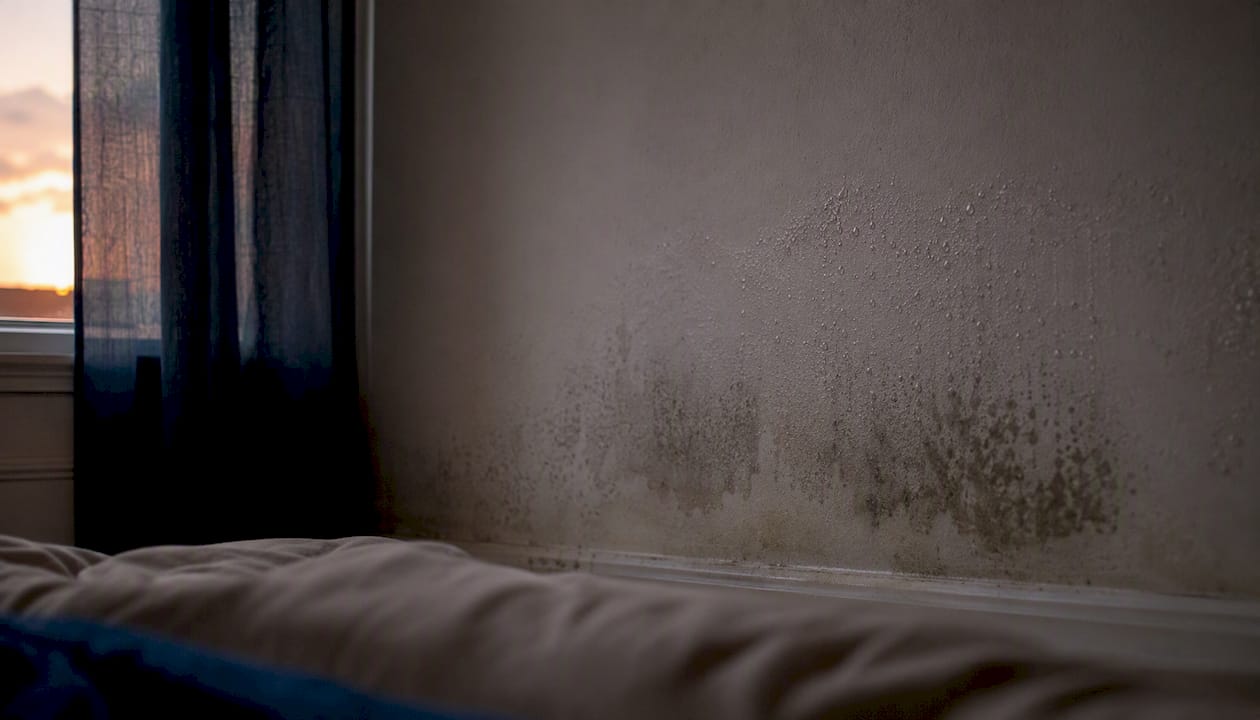
- Visible mould spots on walls, ceiling corners, or window seals
- Bedding that feels damp or takes longer than usual to dry
- Your child waking with a stuffy nose despite no illness
Quick fixes: open windows for 15–20 minutes in the morning, run a ceiling fan, switch on a dehumidifier, and stop drying laundry indoors. Check that bathroom and kitchen exhaust fans are working and being used.
When to call a professional: Persistent mould that returns after cleaning, condensation on interior walls (not just windows), or a child with recurring respiratory symptoms that correlate with time spent in the bedroom all warrant a professional assessment. Blocked or dirty ducts can worsen moisture distribution throughout the home; professional duct cleaning services can identify airflow problems that contribute to uneven humidity.
Your practical checklist: tonight, weekly, and monthly
Tonight
- Place a digital hygrometer at sleeping height in your child’s bedroom.
- Check the reading. If below 40%, run a cool-mist humidifier for 1–2 hours.
- If above 60%, open a window briefly or run a dehumidifier for 30–60 minutes.
- Close the bedroom door once the room is at target and recheck in the morning.
Weekly
- Clean all humidifier parts using the vinegar-and-rinse method.
- Log your morning and evening RH readings for the week.
- Check window frames and ceiling corners for any condensation or early mould spots.
- Inspect bedding for dampness or musty odour.
Monthly
- Replace or inspect the humidifier filter or wick.
- Review device settings for the current season: increase humidifier output heading into winter, shift to dehumidifier mode heading into summer.
- Run a full deep-clean of the humidifier, including soaking all parts.
- Cross-reference your logged RH readings against your child’s sleep quality and any respiratory symptoms to spot patterns.
For a broader child bedroom air quality checklist that covers ventilation, filtration, and allergen control alongside humidity, Pureair-au has a free resource worth bookmarking.
The part most parents get wrong about humidity in Australian homes
Most of the advice parents find online is written for northern hemisphere climates, where the main problem is winter dryness from central heating. Australian homes face a more varied challenge: dry winters in the south, humid summers on the coast, and the added complication of bushfire smoke seasons that push families to seal their homes tightly, which then traps moisture.
The instinct to humidify is usually right in winter, but it’s easy to overdo it.
The other thing that gets underestimated is maintenance. A humidifier that hasn’t been cleaned in two weeks is actively seeding the room with bacteria and mould spores. That’s not a theoretical risk; it’s documented paediatric guidance. The device is only as good as the routine behind it.
Children in humid tropical regions face the opposite pressure: parents there rarely need a humidifier at all, but they do need a dehumidifier and good cross-ventilation. Treating every Australian home the same way is the mistake. Measure first, then act.
Pureair-au helps you get the right device and keep it working
Getting humidity right in a child’s bedroom comes down to three things: the right device for your climate, accurate measurement, and consistent maintenance. Pureair-au stocks humidifiers, dehumidifiers, and smart humidity monitors suited to Australian conditions, from cool-mist and ultrasonic humidifiers for dry southern winters to refrigerant dehumidifiers for coastal and tropical homes.
The Smart Finder tool on the Pureair-au website lets you filter by room size, concern (mould, allergies, dry air, bushfire smoke), and budget to land on the right unit without wading through specs. All products are AHAM verified for performance, and the support team can advise on sizing and maintenance schedules for your specific region.
Browse the full range of humidifiers, dehumidifiers, and air quality monitors to find the right fit for your child’s bedroom.
Sources
The sources below were used to develop this guide. Each is worth bookmarking if you want to go deeper on a specific aspect.
- Pediatric Environmental Health Center | HHOMES: Humidity | Boston Children’s Hospital
- Best Humidity Level for Sleeping: Ideal Bedroom Humidity
- What are the main ways to control moisture in your home? | EPA
For climate-specific guidance, check your state health department’s indoor air quality resources, as recommendations for Darwin differ meaningfully from those for Hobart.
This article is general information, not a substitute for advice from a qualified doctor. Consult a qualified healthcare professional about your own circumstances before acting on anything here.