If you’re looking for a straight replacement for VBreathe, here are the picks that actually hold up for Australian conditions — VOCs, bushfire smoke, and year-round allergens included.
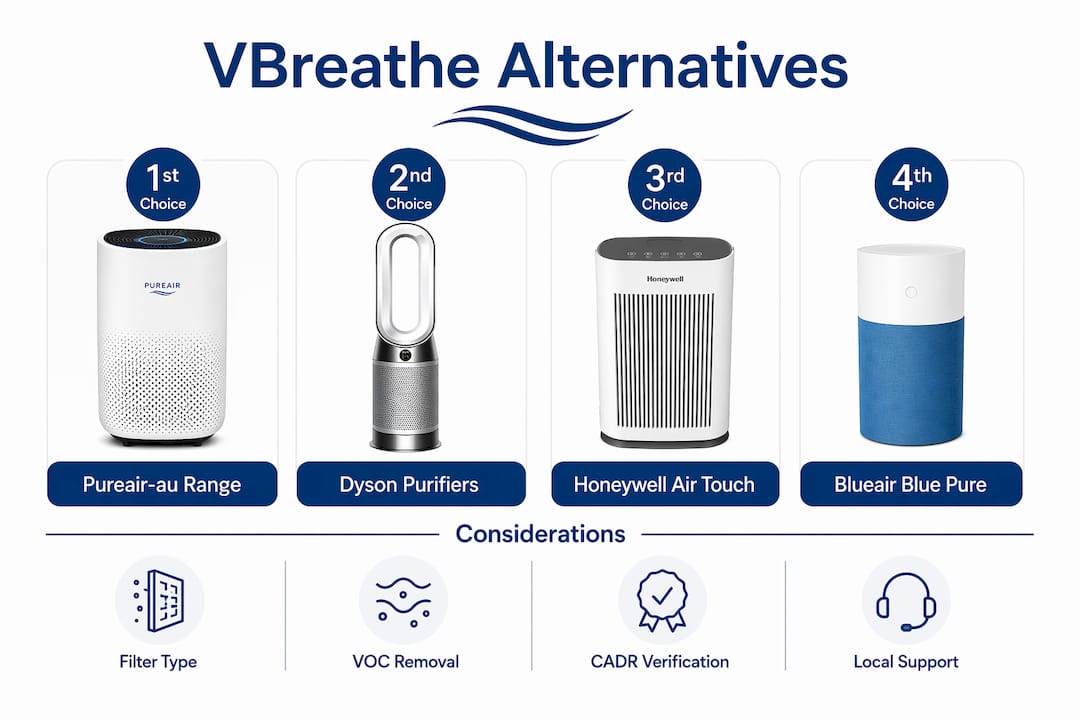
- Pureair-au (Pure Air) — the recommended first stop for most Australian households. AHAM-verified units, local warranty and support, a Smart Finder tool to match your specific concern (smoke, mould, allergies), and medical-grade HEPA filtration that captures 99.97% of airborne particles. Best for families wanting verified performance with genuine local backup.
- Dyson Purifier series — strong HEPA + activated carbon combination, real-time air quality monitoring, and smart home integration. Premium price, but the VOC sensing is genuinely useful. Best for tech-forward households and open-plan living.
- Blueair (Blue Pure / Classic series) — consistently high CADR ratings relative to price, HEPASilent technology keeps noise low, and replacement filters are widely stocked in Australia. Best for bedrooms and medium rooms where quiet, continuous operation matters.
- Philips NanoProtect series — True HEPA with NanoProtect filter media, solid CADR figures, and replacement filters available locally. Best for allergy-prone households and families with young children.
- Honeywell Air Touch series — reliable workhorse units at accessible price points, available through Pureair-au with local warranty. The Air Touch P1 starts at $246 AUD. Best for renters and budget-conscious buyers who still want verified HEPA.
- Xiaomi Mi / Smart Air Purifiers — competitive CADR for the price, app-connected, and widely available in Australia. Best for tech-savvy buyers in smaller rooms who want data without paying Dyson prices.
The EPA notes there is no single silver bullet — effectiveness depends on the contaminant, room airflow, and matching CADR to room volume. That framing matters when you’re replacing a system like VBreathe, which uses active gel technology rather than passive HEPA filtration.
Table of Contents
- How do these alternatives compare on specs that matter for Australia?
- What do you actually gain (and lose) switching from VBreathe?
- How to choose the right VBreathe alternative for your home
- Are there research-backed alternatives that don’t involve buying a new unit?
- Which alternative should you actually buy?
- Key takeaways
- Why the “best purifier” question is harder than it looks
- Pureair-au: Australia’s locally supported air quality option
- Sources and further reading
How do these alternatives compare on specs that matter for Australia?
Consumer Reports’ buying guide covers more than 60 brands and consistently points to HEPA and activated carbon as the primary technologies worth paying for. The table below uses those benchmarks alongside Australian availability and running costs.
| Best for | VOC removal method | Filter type | CADR / room size | Noise | Price range (AUD) | Filter replacement | AU availability / warranty |
|---|---|---|---|---|---|---|---|
| VOCs, smoke, allergies, whole-home | Activated carbon + HEPA | True HEPA + carbon | Varies by model; AHAM-verified | Varies by model | $150–$900+ | 6–12 months; filters from ~$50–$150 | Pureair-au; local warranty, Smart Finder support |
| VOCs, smart monitoring, open-plan | Activated carbon (multi-layer) | HEPA H13 + carbon | — | — | — | 12 months; ~$100–$150 per set | Major AU retailers; 2-year warranty |
| Bedrooms, quiet continuous use | HEPASilent (electrostatic + mechanical) | HEPASilent + carbon | — | — | — | 6–12 months; ~$60–$120 | Major AU retailers; 1–2 year warranty |
| Allergies, families, children’s rooms | Activated carbon + NanoProtect HEPA | True HEPA (NanoProtect) | — | — | $300–$600 | 12 months; $52–$82 per filter | Major AU retailers; 2-year warranty |
| Budget, renters, verified HEPA | Activated carbon | True HEPA + carbon | — | — | $246 | 12 months; filter cost varies | Pureair-au; local warranty |
| Small rooms, tech users, value | Activated carbon | True HEPA + carbon | — | — | $150–$300 | 6–12 months; filter cost varies | Major AU retailers; 1-year warranty |
A note on VOC removal: activated carbon is the standard passive method across all these brands. The weight and type of carbon in the filter determines how much VOC load it can handle before saturation. Dyson uses a multi-layer carbon filter with a relatively high surface area; Blueair’s carbon is integrated into their filter media. Neither approach is magic — a saturated carbon filter stops working, and replacement timing matters as much as the technology itself.
Active technologies that emit substances (some ionisers, vapour-based systems like VBreathe’s gel approach) carry ongoing consumable costs that can exceed passive HEPA and carbon over time. They can also produce by-products. Passive HEPA plus carbon is the cleaner, more predictable long-term choice for most homes.
What do you actually gain (and lose) switching from VBreathe?
VBreathe’s active gel technology works differently from a HEPA purifier. It uses a vapour-based approach to treat air rather than mechanically filtering particles through a dense medium. That distinction has real consequences.
What you gain with HEPA alternatives:
Verified CADR figures. Every brand in the shortlist above offers AHAM-verified performance data, which means you can calculate whether a unit will actually turn over the air in your room the required number of times per hour. VBreathe’s Tasman model has drawn criticism for slow cycle times — one detailed review noted the device takes a very long time to clean a 4 m × 4 m room, with continuous noise throughout. A well-sized HEPA unit handles a room that size in under an hour.
Continuous operation design. Purpose-built HEPA purifiers from Dyson, Blueair, Philips, and Honeywell are engineered for 24/7 use. Their motors and filter housings are rated for it. Box fans and active-vapour systems are not always designed with the same durability in mind.
Local support and filter availability. This is where Pureair-au separates itself from grey-market imports. Replacement filters for Philips, Honeywell, and Blueair units are stocked locally, and Pureair-au’s air quality resources cover Australian-specific scenarios including bushfire smoke events.
What you might lose:
Portability and battery operation. VBreathe’s Tasman is cordless and compact. Most HEPA alternatives are mains-powered. If you need a unit for a car or a tent during a bushfire evacuation, a portable HEPA unit with a battery pack is a separate purchase.
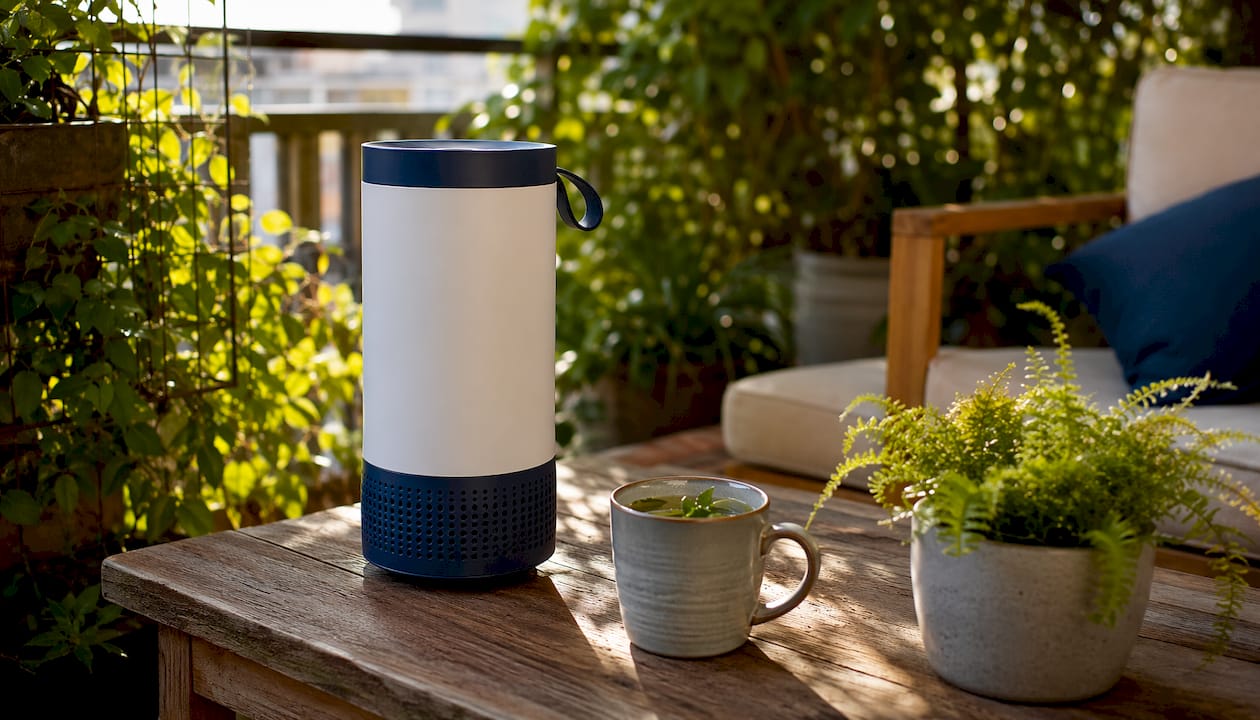
The “set and forget” gel approach. Some users like the simplicity of a gel cartridge with no filter to track. With HEPA units, filter replacement is a real maintenance task — typically every 6–12 months depending on use and local air quality.
Use-case matching:
- Bushfire smoke response: prioritise high CADR and True HEPA. Blueair Blue Pure 211+ and Pureair-au’s AHAM-verified range are strong here. See bushfire season guidance for room-by-room strategy.
- Chemical VOCs from renovations: prioritise carbon weight and surface area. Dyson’s multi-layer carbon filter or a Pureair-au unit with a substantial carbon stage handles renovation off-gassing better than thin-carbon alternatives.
- Allergy-prone households: True HEPA (H13 or better) is non-negotiable. Philips NanoProtect and Pureair-au’s medical-grade range both qualify.
How to choose the right VBreathe alternative for your home
Matching a purifier to your room is straightforward once you know the three numbers that matter: room area in m², your target air changes per hour (ACH), and the unit’s CADR.
Simple sizing method: multiply your room area (m²) by ceiling height (typically 2.4 m) to get volume in m³. Multiply that by your target ACH (4–6 for allergy or smoke situations, 2–3 for general use). That gives you the minimum m³/h your purifier needs to deliver. A unit with a CADR of 300 m³/h covers a 25 m² room at roughly 5 ACH with standard 2.4 m ceilings.
Checklist before you buy:
- CADR and room coverage — confirm the CADR figure is AHAM-verified, not a manufacturer estimate. Check it against your room size using the formula above.
- HEPA rating — True HEPA (H13 or H14) removes particles down to 0.1 microns. Standard HEPA removes down to 0.3 microns. For smoke and fine particulates, H13 is the floor.
- Carbon quantity and type — ask for the carbon cartridge weight or surface area. A thin carbon layer saturates quickly. For VOC-heavy environments (new furniture, paint, renovations), you want a substantial carbon stage, not a token layer.
- Noise at typical fan speeds — manufacturers publish peak noise (full speed), but you’ll run the unit on medium or low most of the time. Check the dB rating at medium speed; anything under 40 dB is genuinely quiet for a bedroom.
- Energy consumption — a unit running 24/7 at 30–50 W adds roughly $50–$100 AUD per year to your electricity bill at typical Australian rates. Higher-wattage units cost more to run.
- Filter life and replacement cost — calculate the annual cost: filter price divided by months of life. A $120 filter lasting 12 months costs $10/month. A $60 filter lasting 6 months costs the same. Factor this into your total cost of ownership.
- Warranty and local support — ask specifically: is the warranty serviced in Australia, or do you ship overseas? Pureair-au provides local warranty and support for the brands it stocks.
- Smart home compatibility — Dyson, Xiaomi, and some Philips models integrate with Apple HomeKit, Google Home, or their own apps. Blueair and Honeywell have app connectivity on select models.
Questions to ask sellers:
- Can you provide the AHAM/CADR test certificate for this model?
- What is the carbon cartridge weight or type in the filter?
- Are replacement filter SKUs stocked locally, and what is the current lead time?
- Is the warranty serviced domestically?
For a deeper look at filtering indoor air pollution particles, Pureair-au’s guide walks through sizing and filter selection in detail.
Are there research-backed alternatives that don’t involve buying a new unit?
Yes, and the evidence is stronger than most people expect.
The Corsi-Rosenthal box: DIY that actually works
The EPA confirms that well-built DIY air cleaners, particularly the Corsi-Rosenthal box design, can be effective temporary alternatives to commercial purifiers. The build involves four MERV 13 HVAC filters taped into a cube around a standard box fan. Component costs run approximately AUD $60–$85. Commercial units with similar performance cost between AUD $150 and $800+.
Research published by the American Chemical Society found a well-built Corsi-Rosenthal box can match or outperform some HEPA filters for particles in the 1–3 micrometre range, with competitive performance over extended periods. NPR coverage of CDC and NIOSH guidance reinforces this for short-term smoke remediation.
The catch: no standardised CADR verification, higher noise than purpose-built units, and the motor stress issue is real. Box fans are not designed for continuous 24/7 operation under the added resistance of four MERV 13 filters. Running one around the clock risks motor burnout faster than a purpose-built HEPA unit. Use it as an emergency measure, not a permanent solution.
Pro Tip: If you build a Corsi-Rosenthal box, run the fan on medium rather than high. It reduces motor stress, cuts noise significantly, and the performance drop is modest. Never leave it unattended for extended periods, and check the fan housing for heat buildup.
HVAC upgrade: the highest-leverage whole-home move
The EPA recommends upgrading central HVAC filters to at least MERV 13 and running the fan continuously for whole-home filtration, where the system can handle the increased airflow resistance. Filter costs run approximately AUD $20–$30 per filter. That is dramatically cheaper per square metre than running multiple portable units across a house.
The limitation: not all HVAC systems can handle MERV 13 resistance without straining the motor or reducing airflow. Consult an HVAC technician before upgrading if your system is older or if you notice reduced airflow after fitting a higher-rated filter. For whole-home coverage in a new build or a system rated for MERV 13, this is the most cost-effective long-term option.
Tiered approach for Australians:
- Immediate emergency (bushfire smoke, renovation fumes): Corsi-Rosenthal DIY box, AUD $60–$85.
- Room-focused short-term: portable HEPA purifier from the shortlist above, AUD $150–$900+.
- Long-term whole-home: HVAC upgrade to MERV 13, AUD $20–$30 per filter change, with professional assessment first.
For a full comparison of whole-home versus room filtration systems, Pureair-au’s homeowner guide covers the trade-offs clearly.
Which alternative should you actually buy?
The right pick depends on your situation more than any single spec.
Family in a bushfire-prone area: Pureair-au’s AHAM-verified range is the strongest fit. You need verified CADR, True HEPA for fine smoke particles, and local support when you need a replacement filter fast. Blueair Blue Pure 211+ is a solid second choice for large living areas. For a room-by-room strategy during smoke events, the bushfire season guide is worth bookmarking.
Apartment dweller concerned about VOCs: Dyson Purifier series or a Pureair-au unit with a substantial carbon stage. VOC removal depends on carbon quality, not just HEPA. Dyson’s real-time VOC sensing tells you when the filter is working and when it is not, which is genuinely useful in a space where you can’t open windows easily.
Renter on a budget: Honeywell Air Touch P1 at $246 AUD through Pureair-au. True HEPA, local warranty, and a price point that makes sense for a rental. Avoid cheap no-name units without AHAM verification — you have no way to know what you’re actually getting.
Household wanting low-noise continuous filtration: Blueair Blue Pure series. The HEPASilent technology runs at 17 dB on its lowest setting, which is quieter than most refrigerators. For a bedroom or a nursery, that matters. Parents looking for bedroom-specific guidance can use Pureair-au’s child bedroom air quality checklist.
Practical next steps: buy through an Australian retailer or directly through Pureair-au’s catalogue to confirm local warranty coverage. On delivery, check the filter is seated correctly, register the warranty immediately, and note the filter replacement date in your calendar. Most filters ship with a recommended replacement interval printed on the packaging.
Key takeaways
Matching CADR to your room size and choosing verified HEPA plus meaningful activated carbon are the two decisions that determine whether an air purifier actually works for VOCs and smoke in an Australian home.
| Point | Details |
|---|---|
| Match CADR to room volume | Multiply room m² by ceiling height and target ACH (4–6 for smoke/allergies) to find your minimum CADR requirement. |
| Verified HEPA + carbon for VOCs | True HEPA (H13/H14) handles particles; activated carbon handles VOCs. Both stages must be present and not token-sized. |
| HVAC MERV 13 for whole-home coverage | Upgrading to MERV 13 filters costs approximately AUD $20–$30 per filter and covers the whole house more cheaply than multiple room units. |
| DIY as a temporary option | A Corsi-Rosenthal box costs approximately AUD $60–$85 and is EPA-acknowledged as effective for short-term smoke emergencies, not permanent use. |
| Pureair-au for local support | Pureair-au stocks AHAM-verified units with Australian warranty, local filter availability, and a Smart Finder tool for matching units to specific concerns. |
Why the “best purifier” question is harder than it looks
The conventional wisdom in air purifier buying guides is to chase the highest CADR number at the lowest price. That logic works for smoke and dust. It breaks down the moment VOCs enter the picture.
VOC removal is almost entirely a function of the carbon stage, not the HEPA filter. A unit with a spectacular CADR and a thin carbon layer will clean your air of smoke particles efficiently and do almost nothing about formaldehyde from new furniture or paint fumes from a renovation. The HEPA filter and the carbon filter are solving different problems, and most buying guides treat them as interchangeable.
The other thing guides consistently underweight is filter economics over time. A $900 Dyson with $130 annual filter costs is not necessarily more expensive to run over three years than a $300 unit with $100 annual filter costs. Do the three-year maths before you decide the cheaper unit is the better deal.
VBreathe’s approach, using active gel vapour rather than passive filtration, is genuinely different from everything else on this list. The honest assessment from detailed user reviews is that the performance claims do not hold up for anything beyond a very small room, and the battery drain and firmware issues compound the value problem. Switching to a passive HEPA system is not a downgrade. For most Australian homes, it is a significant upgrade in verifiable, consistent performance.
Pureair-au: Australia’s locally supported air quality option
Most of the brands on this list are available through grey-market importers with no local warranty and filter stock that can take weeks to arrive. Pureair-au is the difference: every unit sold through pureair-au.com comes with Australian warranty coverage, locally stocked replacement filters, and access to the Smart Finder tool that matches you to the right unit based on your specific concern, whether that is bushfire smoke, mould, pet dander, or chemical VOCs from a renovation.
All products are AHAM-verified, which means the CADR figures on the product pages are independently tested, not marketing estimates. If you are replacing a VBreathe system and want a unit that is sized correctly for your room and backed by local support, the Pure Air catalogue is the practical starting point. Use the Smart Finder to narrow your options, or browse by concern. Replacement filters for Philips, Honeywell, and Blueair units are stocked and ready to ship.
Disclosure: this article is published on the Pureair-au website. Product recommendations reflect Pureair-au’s range and editorial assessment.
Sources and further reading
- DIY Air Cleaners — US EPA: primary source for Corsi-Rosenthal performance data, HVAC MERV 13 guidance, and DIY cost estimates used throughout this article.
- Air Purifier Buying Guide — Consumer Reports: basis for technology comparisons (HEPA, carbon), market availability notes, and CADR/AHAM verification guidance.
- Do-it-yourself box filter clears the air of indoor pollutants — American Chemical Society: peer-reviewed performance data on Corsi-Rosenthal boxes versus commercial HEPA units for particles 1–3 micrometres.
- Is smoke in your home? Here’s how to make an air purifier using a box fan — NPR: consumer-facing summary of CDC and NIOSH guidance on DIY smoke remediation.
- Pure Air — product and support pages: Australian availability, AHAM verification, Smart Finder tool, and local warranty details for units referenced in this article.