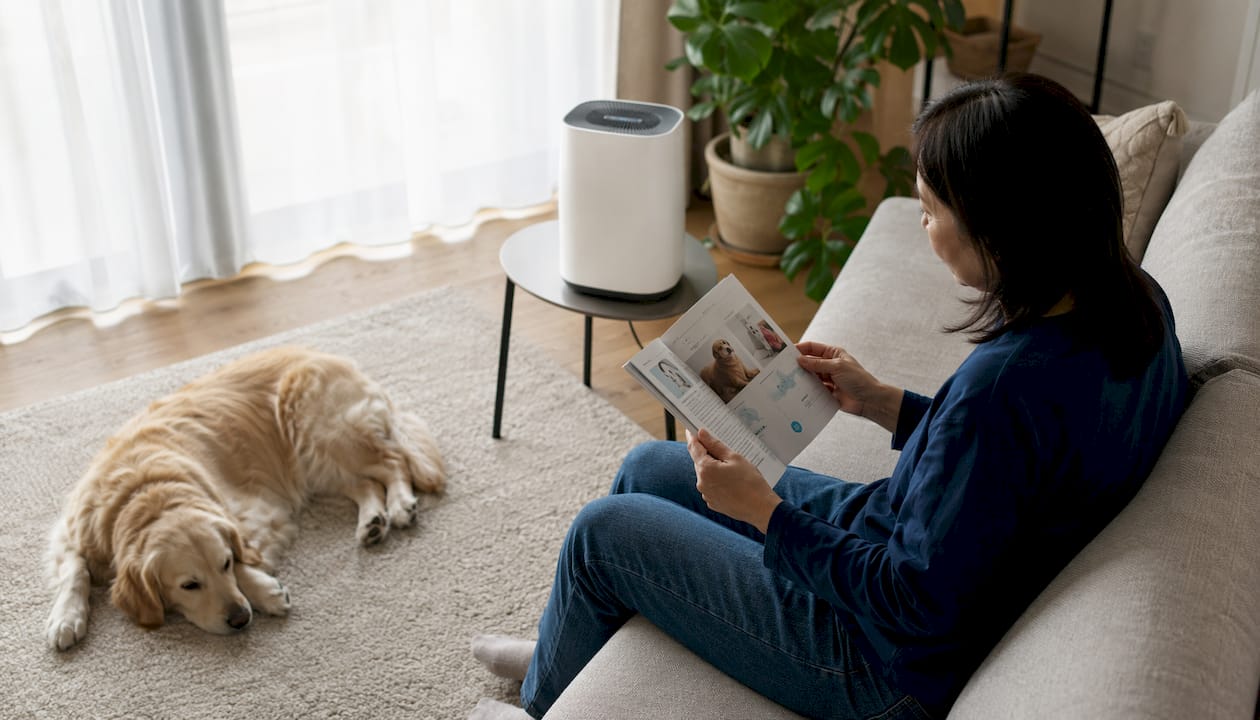
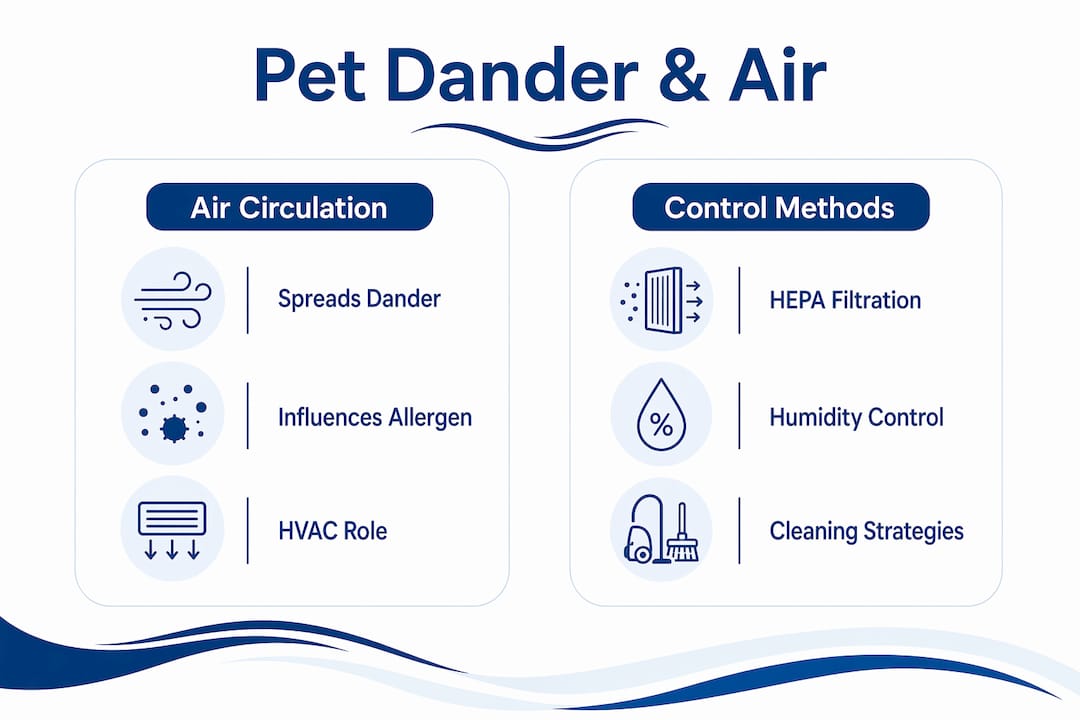
Air circulation is the single biggest driver of how pet dander spreads through your home. Pet dander consists of microscopic skin flakes that stay airborne with the slightest movement of air, travelling well beyond the rooms your pets actually occupy. The result: allergen exposure in bedrooms, hallways, and living areas, even when your cat or dog has never set paw there.
Here is what that means in practice:
- Pet dander particles are tiny and jagged, making them easy to suspend and hard to settle
- Any airflow, from ceiling fans to open windows, redistributes these allergens across your home
- HEPA air purifiers capture airborne dander effectively but cannot remove allergens already settled on surfaces
- HyperHEPA filters go further, trapping even finer particles that standard HEPA may miss
- Managing airflow, filtration, humidity, and cleaning together gives you the best shot at real relief
Why pet dander is harder to control than other indoor allergens
Pet dander is not just pet hair. It is the microscopic skin flakes shed by cats, dogs, and other furry animals, and those flakes carry proteins that trigger allergic reactions. Because of their small size and irregular shape, dander particles cling to upholstered furniture, clothing, and bedding, then re-enter the air whenever those surfaces are disturbed.
The allergens themselves, particularly Fel d 1 from cats and Can f 1 from dogs, are potent even at low concentrations. They can provoke sneezing, itchy eyes, and asthma flare-ups in sensitised people. Unlike pollen, which has a season, pet allergens are present year-round in any home with a furry animal.
What makes dander especially persistent is its ability to travel. Studies confirm that cat and dog allergens are routinely found in homes with no pets at all, carried in on clothing and hair. Restricting your pet to certain rooms reduces the overall allergen load but does not eliminate exposure, because airborne transfer through doorways and ducts continues regardless.
How air purifiers actually reduce airborne pet allergens
A HEPA filter captures at least 99.97% of airborne particles sized 0.3 microns, which covers the range where pet dander allergens sit. That figure comes from the US Environmental Protection Agency and is the benchmark used by the American College of Allergy, Asthma and Immunology (ACAAI) when recommending filtration for allergy sufferers.
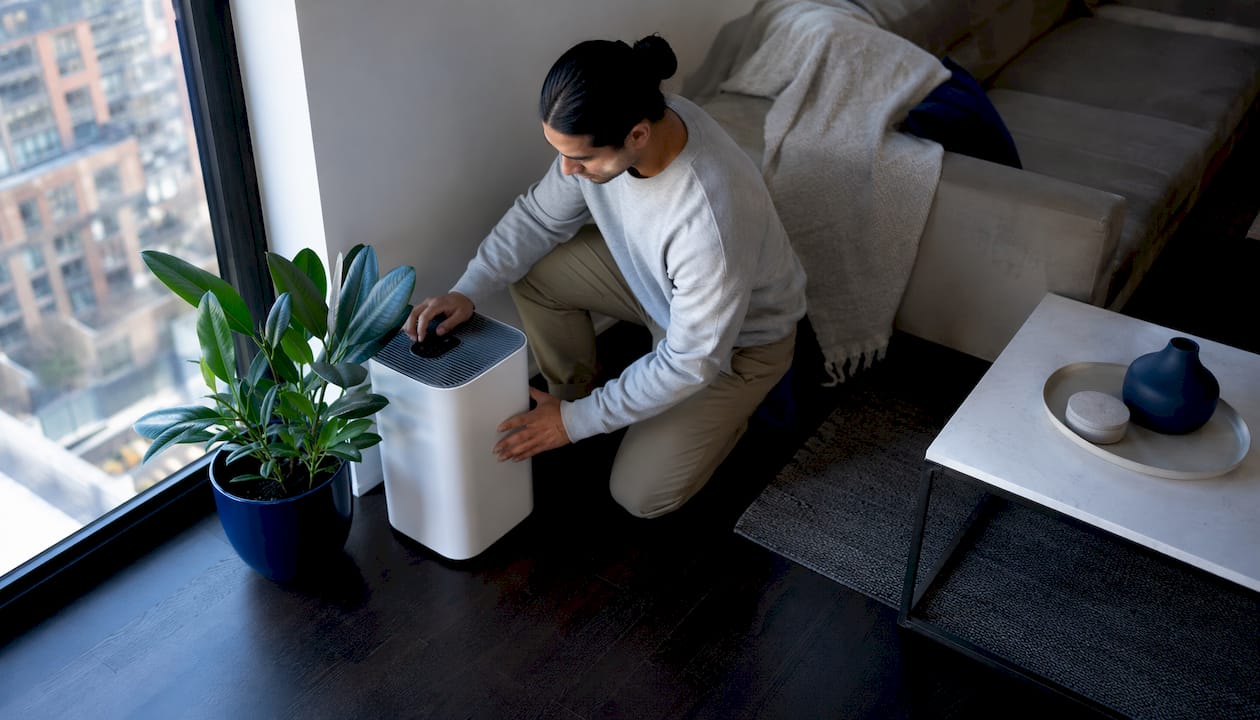
The clinical evidence is specific. A study across nine dog-owning homes found that running a HEPA air cleaner reduced airborne Can f 1 by roughly 75% when the dog was in the room, and by approximately 90% when the dog was elsewhere. A separate bedroom study of 22 homes reported median reductions of 76.6% for cat allergen (Fel d 1) and 89.3% for dog allergen (Can f 1) with air filtration running.
Two things limit those gains. First, filtration only works on particles that pass through the unit. Allergens settled on your couch or carpet stay there until you clean them. Second, intermittent purifier use allows airborne allergen levels to rebuild due to continuous particle resuspension from movement. Continuous operation, particularly in the bedroom where you spend the most time, closes that gap.
HyperHEPA filters extend the capture range below 0.3 microns, which matters because some cat allergen particles are ultrafine and can bypass standard HEPA media. For households with severe cat allergies, the upgrade is worth considering.
Pro Tip: Position your air purifier at breathing zone height, roughly 0.5–1 metre off the floor, rather than tucked in a corner at ground level. A simulated bedroom study found that targeted breathing zone airflow reduced allergen concentrations by over 99% in that zone, even when room averages barely shifted.
Choosing the right air purifier for pet dander in 2026
Not every air purifier is built for the job. These are the factors that actually matter:
- Filter type: HEPA or HyperHEPA is non-negotiable. Ionisers and UV-only units do not capture dander particles reliably.
- Coverage area: Match the unit’s rated coverage to your room size. An undersized purifier cycling air too slowly will not keep up with ongoing dander resuspension.
- AHAM verification: Products verified by the Association of Home Appliance Manufacturers (AHAM) carry independently tested Clean Air Delivery Rate (CADR) scores, so you know the performance claim is real.
- Filter replacement schedule: Most HEPA filters need replacing every 6–12 months. Factor that cost in before you buy.
- Noise level: A purifier you switch off at night because it is too loud is a purifier that stops working when you need it most. Check the decibel rating at the highest useful setting.
- Air quality sensors: Units with built-in particle sensors can ramp up automatically when dander levels spike, such as after your dog shakes itself dry.
For Australian homes, pet-safe air solutions that combine HEPA filtration with humidity control are particularly useful given the variable climate across different states.
How humidity shapes pet allergen behaviour indoors
Humidity has a direct effect on how long pet allergens stay airborne. Drier air keeps particles suspended longer, extending the window of exposure. More humid air causes particles to absorb moisture and become heavier, which makes them settle faster onto surfaces.
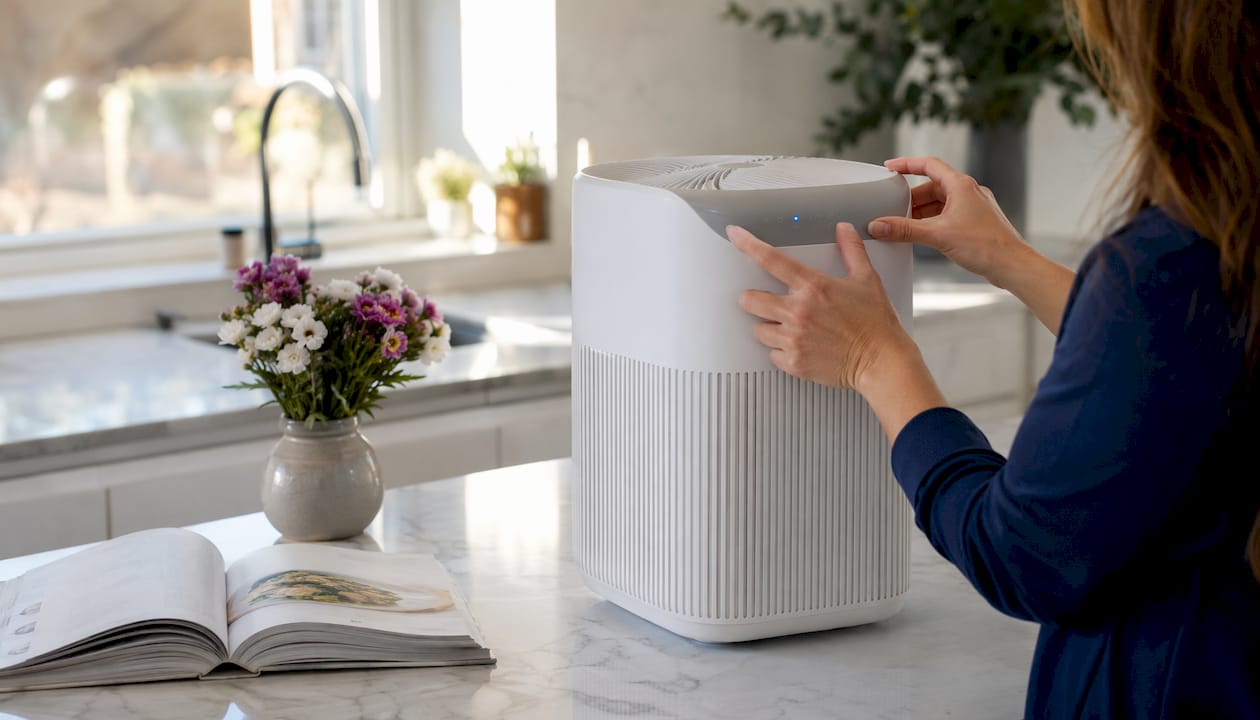
That sounds like an argument for high humidity, but the trade-off is real. Elevated indoor moisture encourages dust mite growth, and dust mite allergens compound the problem for anyone already reacting to pet dander. Research confirms that humidity alters allergen persistence indoors in ways that affect both airborne concentration and surface accumulation.
The practical target is a relative humidity of 40–60%. Below that range, dander stays airborne too long. Above it, dust mites thrive. A dehumidifier for allergen control helps in humid coastal climates like Sydney or Brisbane, while a humidifier may be needed in drier inland areas during winter.
Pro Tip: A combined purifier and humidifier unit, such as the Blueair 2-in-1 DH3i, handles both filtration and moisture control in a single device, which simplifies management in rooms where you need both functions running simultaneously.
Cleaning and ventilation strategies that work alongside filtration
Air purifiers handle what is airborne. Cleaning handles what has already settled. You need both, because pet dander requires dedicated surface cleaning that standard vacuuming often misses.
- Vacuum with a HEPA-filtered vacuum cleaner at least twice a week. Standard vacuums resuspend fine particles back into the air.
- Wash pet bedding weekly in hot water to remove settled allergen before it re-enters circulation.
- Keep pets out of bedrooms where possible. It reduces the allergen load in the room where you spend the most time, even though airborne transfer via ducts will still occur.
- Clean HVAC ducts and replace HVAC filters regularly. Ducts accumulate pet dander over time and redistribute it every time the system runs. A MERV rating of 11–13 on your HVAC filter catches pet allergens without restricting airflow.
- Use natural ventilation strategically. Opening windows on low-pollen days increases air exchange and dilutes indoor allergen concentrations, but on high-pollen days it adds a second allergen source.
How HVAC systems interact with pet allergen management
Your central heating and cooling system is also an allergen distribution network. Return air ducts pull particles from one room and push them into others, which means a dog sleeping in the lounge can raise allergen levels in a bedroom three rooms away. Airflow pathways through HVAC systems transport pet allergens across home zones in ways that make room-by-room restrictions less effective than they appear.
Upgrading the HVAC filter to a MERV 11–13 disposable filter turns your whole system into a whole-home filtration layer. It will not replace a dedicated room air purifier, but it catches a meaningful share of circulating dander before it reaches living areas. Avoid permanent washable filters for this purpose; the fine particles that cause allergies are nearly impossible to remove from them completely.
Short-circuiting is the other problem. If your air purifier sits too close to a supply vent, conditioned air can flow directly into the unit’s intake without first mixing with room air, so allergen-laden air from the rest of the room bypasses filtration entirely. Place purifiers away from direct vent airflow to prevent this.
Air quality solutions for Australian homes with pets in 2026
Australian homes face a combination of challenges that most overseas guidance does not account for: bushfire smoke seasons, high pollen loads, and climates that swing from humid coastal conditions to dry inland heat within the same state. Pet allergens sit on top of all of that.
Pureair-au’s range of AHAM-verified air purifiers is designed specifically for these conditions, combining advanced HEPA filtration with options for humidity management. The Smart Finder tool on the Pureair-au website matches you to the right unit based on your specific concerns, whether that is pet dander, bushfire smoke, or mould. All products carry AHAM verification, so the performance figures are independently tested rather than self-reported.
For bedrooms, a dedicated room purifier running continuously gives you the most reliable allergen reduction where it counts most. For open-plan living areas, a higher-capacity unit with a real-time air quality sensor adjusts output as conditions change throughout the day.
Ready to breathe easier at home? Pureair-au stocks a full range of HEPA and HyperHEPA air purifiers, humidifiers, and dehumidifiers suited to Australian conditions. Browse the complete product catalogue to find the right unit for your home and your pets.
Key takeaways
Air circulation is the primary mechanism by which pet dander spreads through a home, and HEPA filtration running continuously is the most evidence-backed way to reduce airborne allergen exposure.
| Point | Details |
|---|---|
| Air circulation spreads dander | Even slight airflow keeps pet dander airborne and moves it into rooms your pet never enters. |
| HEPA filtration cuts allergens sharply | Bedroom studies show HEPA filtration reduces airborne cat allergen by around 76.6% and dog allergen by around 89.3%. |
| Continuous operation matters | Intermittent use lets airborne allergen levels rebuild; running the purifier constantly prevents that rebound. |
| Humidity target: 40–60% | Below this range dander stays airborne longer; above it, dust mites thrive alongside pet allergens. |
| HVAC filters extend whole-home coverage | A MERV 11–13 disposable HVAC filter catches circulating pet dander before it reaches living areas. |