
Ventilation dilutes and removes indoor pollutants, controls moisture and CO2, and reduces infectious aerosols when paired with source control and filtration. For most Australian homes, three actions matter most: control pollutant sources first (no indoor smoking, exhaust fans on when cooking), maintain adequate ventilation through mechanical systems or timed natural airing, and switch to filtration when outdoor air is compromised by bushfire smoke or heavy traffic. Australian Standards AS 1668.2 and AS/NZS 3666, the National Construction Code administered by the Australian Building Codes Board (ABCB), and guidance from the Victorian Department of Health all set the baseline for what “adequate” means in practice. Pureair-au’s range of HEPA-rated purifiers and humidity control devices fills the gap when ventilation alone cannot do the job.
Australia’s regional risks change the equation. Bushfire smoke seasons, coastal humidity, and the humid tropics all create conditions where opening a window can make indoor air worse, not better. Understanding when to ventilate and when to filter is the most practical skill any Australian homeowner can develop.
- Control pollutant sources before relying on ventilation.
- Target at least a typical baseline air change rate in residential spaces.
- Use HEPA filtration during bushfire smoke events, high-traffic days, or when mechanical supply is unavailable.
Table of Contents
- How ventilation improves indoor air quality: the core mechanisms
- What types of ventilation suit Australian homes and climates?
- Key metrics and Australian standards: how much ventilation is enough?
- How ventilation affects different pollutants in your home
- Practical ventilation strategies for Australian homes and workplaces
- How to measure whether your ventilation is actually working
- When ventilation isn’t enough: filtration and humidity control
- What the evidence says: recommended benchmarks for Australian contexts
- Key takeaways
- Why ventilation matters more than most Australian families realise
- Pureair-au: HEPA filtration and humidity control for Australian homes
- Useful sources
How ventilation improves indoor air quality: the core mechanisms
Ventilation works through three distinct physical effects, and knowing which one you are relying on helps you choose the right strategy.
Dilution is the most familiar. Bringing cleaner outdoor air into a space reduces the concentration of pollutants already present, whether CO2 from occupants, VOCs off-gassing from furniture, or fine particles from cooking. The EPA notes that inadequate ventilation is the primary reason indoor pollutant levels climb, because there is simply not enough fresh air to dilute what indoor sources continuously emit.
Displacement and directional flow move contaminated air away from occupants’ breathing zones before it can be inhaled. A well-designed supply system pushes clean air in at low velocity near occupants and exhausts stale air at ceiling level, so contaminants travel away from people rather than through them. This matters most in rooms with high occupant density or where a specific source (a printer, a gas cooktop) sits close to where people breathe.
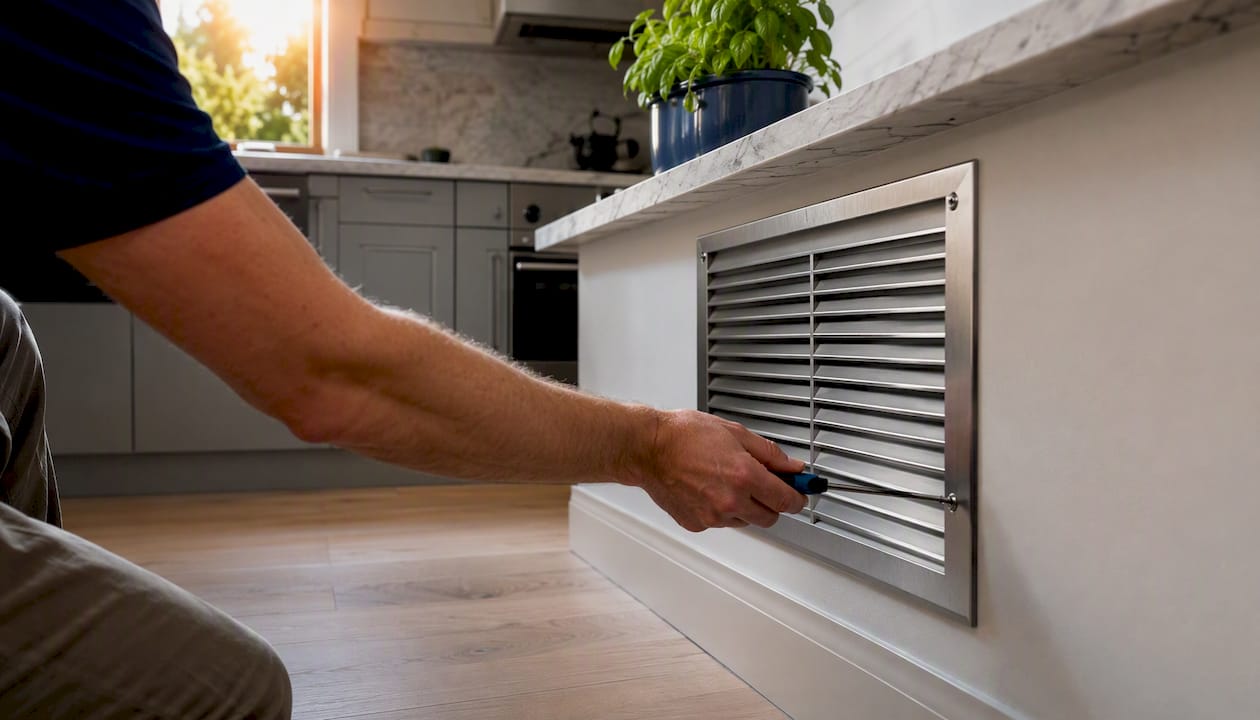
Removal and exhaust take pollutants physically out of the building. Kitchen range hoods and bathroom exhaust fans are the most common residential examples. Their limitation is that they only remove air from the immediate vicinity of the fan; pollutants generated elsewhere in the home may not reach the exhaust point at all.
Ventilation only helps where air actually reaches occupants. A poorly distributed system, or one with leaky ducts, can leave bedrooms and living areas with far less fresh air than the system’s rated capacity suggests. Building airtightness compounds this: a very tight modern home with no mechanical supply can trap pollutants even when exhaust fans are running.
Pro Tip: In humid Australian zones such as coastal Queensland or Darwin, balance ventilation with a humidity check. Bringing in warm, moist outdoor air during summer afternoons can push indoor relative humidity above 60%, the threshold where mould growth accelerates. Time natural ventilation for cooler, drier morning hours instead.
Understanding what indoor pollutants you are dealing with is the logical first step before deciding how much ventilation you need.
What types of ventilation suit Australian homes and climates?
Natural ventilation
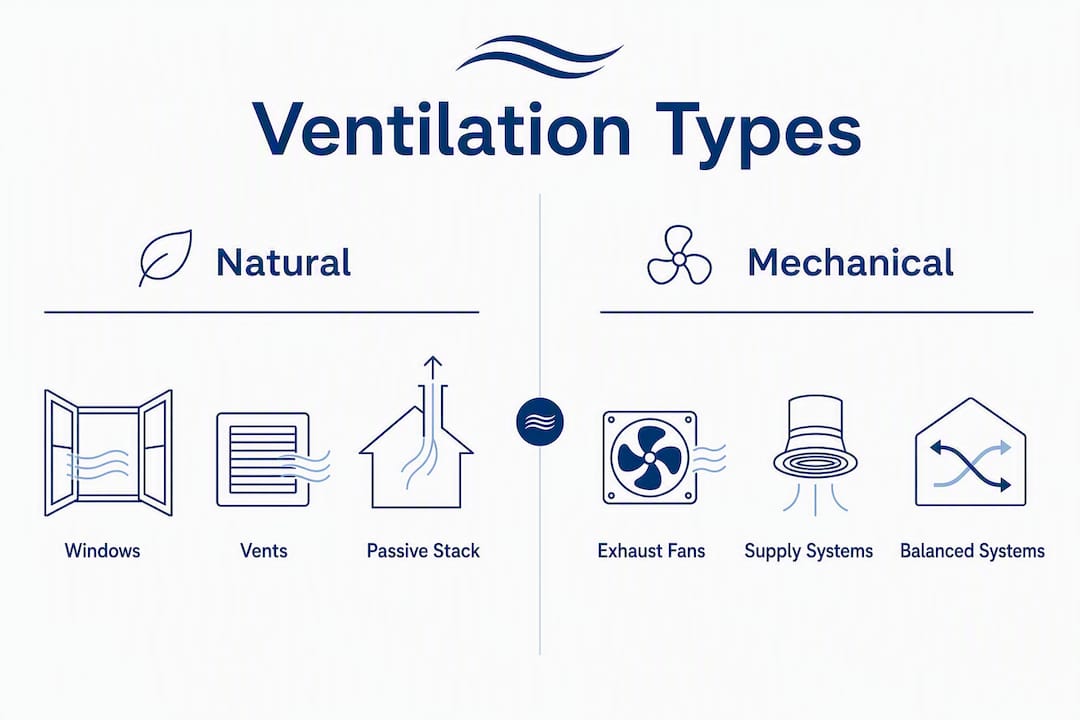
Windows, vents, and passive stack systems rely on wind pressure and temperature differences to move air. They cost nothing to run and work well in temperate climates during mild weather. The problem in Australia is that they are uncontrolled: during bushfire smoke events, high-pollen days, or humid summer afternoons, opening windows introduces the very pollutants you are trying to avoid.
Exhaust-only systems
Bathroom and kitchen exhaust fans are the most common mechanical ventilation in Australian homes. They remove moisture and odours locally, but field testing shows that exhaust-only systems can draw replacement air from attics, subfloors, or wall cavities rather than from a clean outdoor intake. In some cases this actually increases indoor particulate and TVOC concentrations compared with a system that draws and filters fresh air from a known source.
Supply and balanced systems
Supply systems push filtered outdoor air into the home through a dedicated intake, giving you control over where the air comes from and what it passes through before entering living spaces. Balanced systems, including Heat Recovery Ventilators (HRVs) and Energy Recovery Ventilators (ERVs), supply and exhaust equal volumes simultaneously, recovering heat or moisture in the process. Building America field tests found that central fan integrated supply (CFIS) and balanced systems produced substantially lower concentrations of 0.3–2.0 μm particles and TVOCs compared with exhaust-only approaches.
ERVs are particularly suited to humid tropical and subtropical Australian climates because they transfer moisture from incoming air to outgoing air, limiting the humidity load on the indoor space.
Hybrid systems
Hybrid systems combine natural and mechanical elements, using automated dampers or sensors to switch between modes. They are common in commercial buildings and increasingly available for residential use. During bushfire smoke events, the system automatically closes natural intakes and switches to filtered mechanical supply.
Practical summary for Australian settings:
- Temperate climates (Melbourne, Adelaide, Canberra): natural ventilation works well for much of the year; add exhaust fans and consider a supply system for tight, well-insulated homes.
- Humid tropics and subtropics (Darwin, Cairns, coastal Queensland): ERVs or supply with dehumidification are preferable to uncontrolled natural ventilation in summer.
- Bushfire-prone regions: mechanical supply with HEPA or MERV-13 filtration is the only reliable option during smoke events.
- Coastal environments: salt air accelerates corrosion in HVAC components; specify marine-grade equipment and inspect more frequently.
For homes with significant attic space, attic venting installation affects how pressure differentials move air through the building envelope, which in turn influences where exhaust-only systems draw their replacement air from.
Key metrics and Australian standards: how much ventilation is enough?
The metrics that matter
Air changes per hour (ACH) measures how many times the total air volume of a space is replaced in one hour. A residential baseline of 0.35 ACH is commonly cited for acceptable indoor air quality in homes. Higher-risk settings need considerably more.
Litres per second per person (L/s per person) is the preferred metric for occupied commercial and institutional spaces. Research published in PMC links office ventilation rates of up to roughly 25 L/s per person with reduced sick building syndrome symptoms.
CO2 concentration is the most practical proxy for ventilation adequacy in occupied spaces. Outdoor CO2 sits around 420 ppm. Readings below 800 ppm in an occupied room generally indicate adequate ventilation for typical occupancy; sustained readings above 1,000 ppm signal that fresh air supply is insufficient for the number of people present.
Filter ratings matter when ventilation includes filtration. MERV-13 is the minimum recommended for infection control settings; HEPA (equivalent to MERV-17 and above) captures 99.97% of particles at 0.3 μm and is the standard for medical-grade air purifiers.
Australian regulatory references
AS 1668.2 sets minimum mechanical ventilation and air-conditioning requirements for Australian buildings. It specifies outdoor air supply rates for different occupancy types and is the primary compliance reference for commercial and multi-residential construction.
AS/NZS 3666 covers microbial control in air-handling and HVAC systems, setting requirements for design, installation, commissioning, and maintenance to prevent Legionella and other biological contamination.
The National Construction Code (NCC), administered by the ABCB, incorporates ventilation requirements for residential buildings, including minimum openable window areas and mechanical ventilation provisions for habitable rooms.
Victorian Department of Health guidance on ventilation, updated in response to COVID-19 aerosol transmission evidence, provides practical thresholds and recommendations for schools, workplaces, and healthcare settings that are applicable across Australian jurisdictions.
| Space type | Typical ACH target | L/s per person | Notes |
|---|---|---|---|
| Residential (general) | 0.35 ACH | Not typically applied | Minimum baseline; higher for sensitive occupants |
| Office / commercial | 3–6 ACH | Up to ~25 L/s | AS 1668.2 sets occupancy-based rates |
| Bedroom (sleeping) | 0.5+ ACH | N/A | Higher rates linked to reduced allergy risk |
| High-risk / clinical | 6 ACH | Per clinical guidelines | CDC guidance cites 5 ACH or more for infection control |
How ventilation affects different pollutants in your home
Particulates and bushfire smoke (PM2.5)
Dilution with outdoor air reduces indoor particle concentrations when outdoor air is clean. During bushfire smoke events, outdoor PM2.5 can reach levels that make natural ventilation actively harmful. The American Lung Association notes that outdoor air can be two to five times cleaner than indoor air under normal conditions, but that relationship reverses during smoke events. Keep windows closed, run a HEPA purifier, and seal gaps where possible.
VOCs and odours
Source control is the primary strategy for VOCs: choose low-VOC paints and adhesives, store solvents outside, and avoid burning candles or incense indoors. Ventilation helps after the source is controlled, but if outdoor air carries its own VOC load (near a highway or industrial area), mechanical supply with activated carbon filtration is more effective than opening windows.
CO2 and occupant density
CO2 rises predictably with the number of people in a space and falls when ventilation increases. A bedroom with two sleeping adults and a closed door can reach 1,500 ppm or more by morning. The fix is straightforward: crack a window, run a supply fan, or set the HVAC to circulate. CO2 monitors make this visible and actionable.
Moisture and mould risk
Humidity interacts with ventilation in ways that catch many Australian homeowners off guard. Ventilating aggressively during a humid Queensland summer pulls warm, moisture-laden air indoors, raising relative humidity and mould risk rather than reducing it. In these conditions, a dehumidifier or ERV is more appropriate than increased natural ventilation.
Bioaerosols and infectious aerosols
Ventilation dilutes airborne virus particles and reduces the probability of inhalation. The EPA’s guidance on respiratory viruses confirms that increasing ventilation is one of the most effective non-pharmaceutical measures for reducing airborne transmission. For higher-risk settings, the CDC recommends targeting 5 ACH or more and upgrading to MERV-13 filters as a combined strategy.
| Pollutant | Primary strategy | Ventilation role | When filtration is needed |
|---|---|---|---|
| PM2.5 / bushfire smoke | Close windows; run HEPA | Limited when outdoor air is poor | Always during smoke events |
| VOCs | Source control | Dilution when outdoor air is clean | Activated carbon if outdoor air is also polluted |
| CO2 | Increase fresh air supply | Direct and effective | Not applicable |
| Moisture / mould | Dehumidification | Can worsen in humid climates | Dehumidifier preferred |
| Bioaerosols | Ventilation + filtration | Dilution reduces concentration | MERV-13 or HEPA for high-risk settings |
Practical ventilation strategies for Australian homes and workplaces
Source control checklist (do this first)
- No indoor smoking under any circumstances.
- Run the range hood on high whenever cooking, especially with gas.
- Use low-VOC or zero-VOC paints, adhesives, and cleaning products.
- Store petrol, solvents, and pesticides in a detached shed, not inside the home.
- Fix leaks promptly; standing moisture is a mould source, not just a ventilation problem.
Step-by-step home ventilation assessment
- Walk through each room and note which spaces have mechanical exhaust (bathroom, laundry, kitchen) and which rely entirely on natural ventilation.
- Check that exhaust fans actually vent to the outside, not into the roof cavity. A surprising number of older Australian homes have fans that exhaust into the ceiling space.
- Place a CO2 monitor in the bedroom overnight and in the main living area during peak occupancy. Record readings at the start and end of the period.
- If CO2 exceeds 1,000 ppm consistently, the space needs more fresh air supply, not just exhaust.
- Inspect HVAC filters. A clogged filter restricts airflow and reduces the system’s ability to both circulate and clean air.
- Check that supply vents are open and unobstructed by furniture or curtains.
- Consider a professional HVAC commissioning check if the system is more than five years old or if CO2 readings remain high after the above steps.
Seasonal adjustments for Australian climates
Bushfire season (typically October through March in southern Australia): Keep windows and doors closed when the Air Quality Index is elevated. Run a HEPA purifier continuously in main living areas and bedrooms. Check the NSW EPA, Victorian EPA, or relevant state authority’s air quality monitoring service before opening windows in the morning.
Humid summer (coastal Queensland, Northern Territory, northern WA): Ventilate during the cooler, drier hours of early morning. Avoid ventilating during the afternoon when humidity peaks. A dehumidifier running alongside any mechanical ventilation keeps relative humidity below 60%.
Cool temperate (Melbourne, Hobart, ACT): Timed morning airing for 15–20 minutes is effective and low-risk for most of the year. Seal draughts in winter to reduce heat loss, but maintain mechanical exhaust in wet areas to control moisture.
Do not rely on exhaust fans alone in a tight, well-insulated home. Without a supply path, the fan creates negative pressure and draws air from wherever it can find it, including subfloor spaces and wall cavities.
For a room-by-room approach to improving air quality at home, the practical steps differ depending on the space and its occupancy pattern.
How to measure whether your ventilation is actually working
CO2 concentration is the most accessible and reliable proxy for ventilation performance in occupied spaces. Outdoor air sits around 420 ppm. A well-ventilated room with normal occupancy should stay below 800 ppm. Sustained readings above 1,000 ppm in an occupied space indicate that the ventilation rate is insufficient for the number of people present, and readings above 1,500 ppm are associated with measurable cognitive impairment in some studies.
What to look for in a CO2 monitor:
- Sensor type: NDIR (non-dispersive infrared) sensors are accurate and stable; avoid electrochemical sensors for CO2.
- Display: real-time readout with a colour-coded alert is more useful than a logged-only device.
- Placement: position the monitor at breathing zone height (roughly 1.0–1.5 m from the floor), away from windows, doors, and direct sunlight.
- Data logging: useful for identifying patterns, such as CO2 climbing every evening when the family gathers in the living room.
Simple non-monitor checks:
- Condensation on windows in the morning suggests overnight moisture accumulation from inadequate ventilation.
- Persistent musty odours in a room with no visible mould often indicate poor air exchange.
- The smoke pencil test: hold a stick of incense near a supply vent or window gap and watch whether the smoke is drawn in or pushed out, confirming airflow direction.
Monitoring air quality in homes with pets follows the same CO2 proxy logic but adds particulate and allergen monitoring as additional layers.
When to call a professional: persistent CO2 above 1,000 ppm after operational fixes, visible mould despite adequate ventilation, unexplained odours, or an HVAC system that has not been commissioned or serviced in more than two years.
When ventilation isn’t enough: filtration and humidity control
Ventilation has real limits. When outdoor air is poor, when the building cannot achieve target ACH through structural or operational constraints, or when occupants are vulnerable (infants, elderly people, those with asthma or compromised immunity), filtration and humidity control become necessary complements rather than optional extras.
Criteria for adding filtration:
- Outdoor PM2.5 or smoke levels are elevated (bushfire events, proximity to heavy traffic or industry).
- The home cannot achieve 0.35 ACH through available ventilation without introducing outdoor pollutants.
- Occupants include people with allergies, asthma, or respiratory conditions.
- The space has high occupant density and infection risk is a concern.
Technologies and their roles:
HEPA filtration captures 99.97% of particles at 0.3 μm, making it effective against PM2.5, pollen, pet dander, dust mite allergens, and most bioaerosols. It does not remove gases or VOCs. Activated carbon filters adsorb many VOCs and odours but have limited capacity and require regular replacement. UVGI (ultraviolet germicidal irradiation) inactivates biological contaminants in air streams but requires professional installation and is not a substitute for particle filtration. Dehumidifiers and humidifiers address moisture directly, which ventilation alone cannot reliably control in extreme climates.
Maintenance notes:
Running the HVAC fan on the ‘ON’ setting rather than ‘AUTO’ increases continuous filtration and air mixing, but it also accelerates filter loading and raises energy consumption. The ENERGY STAR guidance recommends weighing this trade-off against the air quality benefit, particularly in homes with vulnerable occupants where continuous filtration justifies the cost. Replace HEPA filters on the manufacturer’s schedule, or earlier if the unit’s indicator triggers, since a saturated filter restricts airflow and can become a secondary particle source.
Pro Tip: Filtration does not remove all gases. A HEPA purifier running during a bushfire smoke event will capture particles effectively, but CO and NO2 from smoke require activated carbon or, better still, keeping the building sealed and the source outside. Never assume a purifier eliminates all smoke-related risk.
Comparing filtration system types helps you match the technology to the specific pollutant load in your home.
What the evidence says: recommended benchmarks for Australian contexts
The research base on ventilation and health outcomes is consistent on several points. Higher ventilation rates reduce sick building syndrome symptoms, lower respiratory infection transmission, and are associated with better cognitive performance in office settings. The PMC multidisciplinary review links office rates of up to 25 L/s per person with reduced SBS prevalence. A separate Wiley review found that home ventilation rates above 0.5 ACH were associated with reduced allergic outcomes in some climates, suggesting that the 0.35 ACH residential minimum is a floor, not a target, for households with allergy sufferers.
For infection control, the CDC recommends targeting 5 ACH or more in higher-risk settings and pairing that with MERV-13 or better filtration. The Victorian Department of Health’s ventilation guidance for schools and workplaces aligns with this approach, recommending CO2 monitoring as a practical verification tool.
The EPA is unambiguous that ventilation is a secondary layer of protection: source control comes first, and ventilation addresses what remains. This hierarchy matters in practice because no ventilation rate can compensate for an active indoor combustion source or a persistent VOC emitter.
| Context | Recommended benchmark | Priority action |
|---|---|---|
| Residential baseline | 0.35 ACH | Mechanical exhaust + timed natural airing |
| Allergy-sensitive household | 0.5 ACH or above | Supply ventilation or HEPA purifier |
| Office / commercial | elevated ventilation rates | AS 1668.2 compliance + CO2 monitoring |
| High-risk / congregate | 5+ ACH, MERV-13 or HEPA | Professional commissioning + filtration |
| Bushfire smoke event | Close windows; run HEPA | Portable HEPA purifier + sealed building |
Trade-offs are real. Increasing outdoor air supply raises heating and cooling loads. In humid climates, it can raise moisture levels. A high-performance balanced system with ERV and filtration resolves most of these conflicts but carries a higher upfront cost. For most Australian homes, the practical answer is a layered approach: source control, adequate mechanical exhaust, CO2 monitoring, and a portable HEPA purifier for high-pollution events.
Key takeaways
Ventilation is the single most important structural control for indoor air quality, but it works best as part of a layered strategy that starts with source control and adds filtration when outdoor air cannot be trusted.
| Point | Details |
|---|---|
| Source control comes first | Remove or limit indoor pollutant sources before relying on ventilation to dilute them. |
| Residential baseline is 0.35 ACH | Target at least 0.35 ACH in homes; allergy-sensitive households benefit from 0.5 ACH or above. |
| CO2 is your ventilation gauge | Sustained readings above 1,000 ppm in an occupied space signal inadequate fresh air supply. |
| Bushfire smoke changes the rules | Keep windows closed during smoke events and run HEPA filtration; outdoor air is not always cleaner. |
| Pureair-au for filtration gaps | When ventilation targets are unachievable or outdoor air is poor, Pureair-au’s HEPA purifiers and humidity control devices provide the next layer of protection. |
Why ventilation matters more than most Australian families realise
The conventional advice, “just open a window,” misses the most important variable: what is outside. For most of the year in temperate Australian cities, natural ventilation is perfectly adequate and costs nothing. But Australia’s air quality profile is not temperate-city-normal for the whole year. Bushfire smoke seasons are lengthening. Urban traffic corridors in Sydney, Melbourne, and Brisbane generate PM2.5 spikes that rival smoke events in their indoor penetration. Coastal humidity in summer creates conditions where ventilating freely can raise mould risk faster than it reduces CO2.
The gap in most households is not awareness of ventilation as a concept. It is the absence of any feedback mechanism. Without a CO2 monitor or a basic understanding of what outdoor conditions mean for indoor air, most people ventilate on comfort (temperature, stuffiness) rather than on air quality. Those two signals often point in opposite directions. A cool autumn morning feels like perfect window-opening weather, and usually it is. But if there is a hazard reduction burn upwind, the PM2.5 outside is already at a level that will degrade indoor air within minutes of opening a window.
The practical implication is simple: a CO2 monitor and a reliable source of local air quality data (the state EPA’s monitoring network, for instance) are the two tools that make every other ventilation decision more accurate. Add a HEPA purifier for the events when outdoor air is the problem, and you have covered the vast majority of scenarios an Australian home will face.
Pureair-au: HEPA filtration and humidity control for Australian homes
Ventilation handles the baseline. Pureair-au handles the events ventilation cannot.
During bushfire smoke season, when outdoor PM2.5 makes opening windows counterproductive, a HEPA purifier running in the main living area and bedroom is the most direct way to protect your family’s air. Pureair-au’s range of air purifiers, humidifiers, and dehumidifiers is selected specifically for Australian conditions: units rated for the room sizes common in Australian homes, with HEPA filtration that captures 99.97% of airborne particles including smoke, pollen, pet dander, and viral aerosols.
For humid climates where ventilation alone raises moisture risk, the Blueair 2-in-1 Purify + Humidify DH3i combines particle filtration with humidity management in a single unit. If mould prevention in a humid zone is your priority, the Xiaomi Smart Dehumidifier Lite is a practical, affordable option for bedrooms and living areas. All products are AHAM verified, and Pureair-au’s Smart Finder tool matches you to the right unit based on your specific concern, whether that is bushfire smoke, allergies, mould, or a combination. Replacement filters are stocked and available so your purifier stays effective year-round. Browse the full range and use the Smart Finder at pureair-au.com.
Useful sources
- AS 1668.2 — Standards Australia: The primary Australian standard for mechanical ventilation and air-conditioning in buildings; sets minimum outdoor air supply rates by occupancy type.
- AS/NZS 3666 — Standards Australia: Covers microbial control in air-handling and HVAC systems, including design, installation, commissioning, and maintenance requirements.
- National Construction Code — Australian Building Codes Board (ABCB): Incorporates residential ventilation requirements including minimum openable areas and mechanical ventilation provisions.
- Ventilation — Victorian Department of Health: Practical ventilation thresholds and CO2 monitoring guidance for schools, workplaces, and healthcare settings.
- Moisture control and ventilation — WHO Guidelines for Indoor Air Quality (NCBI Bookshelf): International evidence base for ventilation, moisture control, and building design standards.
- Ventilation rates and health: multidisciplinary review — PMC: Peer-reviewed review linking ventilation rates to sick building syndrome and health outcomes.
- Ventilation rates and health — Wiley Online Library: Review associating home ventilation above 0.5 ACH with reduced allergic outcomes.